Harvard Physicist's 3-Month AI Test: Claims 20 Minutes to Reproduce Weeks of Research

A viral Reddit post about AI-assisted physics research raises exciting possibilities — and important questions about verifiability.
A Reddit post describing a Harvard physicist's use of AI to reproduce weeks of work in 20 minutes, complete 15 unsolved physics calculations, and contribute to 36 papers sparked widespread discussion. While acknowledging LLMs' efficiency potential for structured computation, the article flags key concerns: the cited "Claude Fable 5" is not an official Anthropic product name, the figures lack peer review, and "never-solved calculations" likely refers to high-cost shelved problems rather than true open problems. The article ultimately frames AI's role in research as a "computational accelerator," emphasizing that verifiability is the core standard for evaluating AI contributions.
An AI Research Experiment That Sparked Widespread Discussion
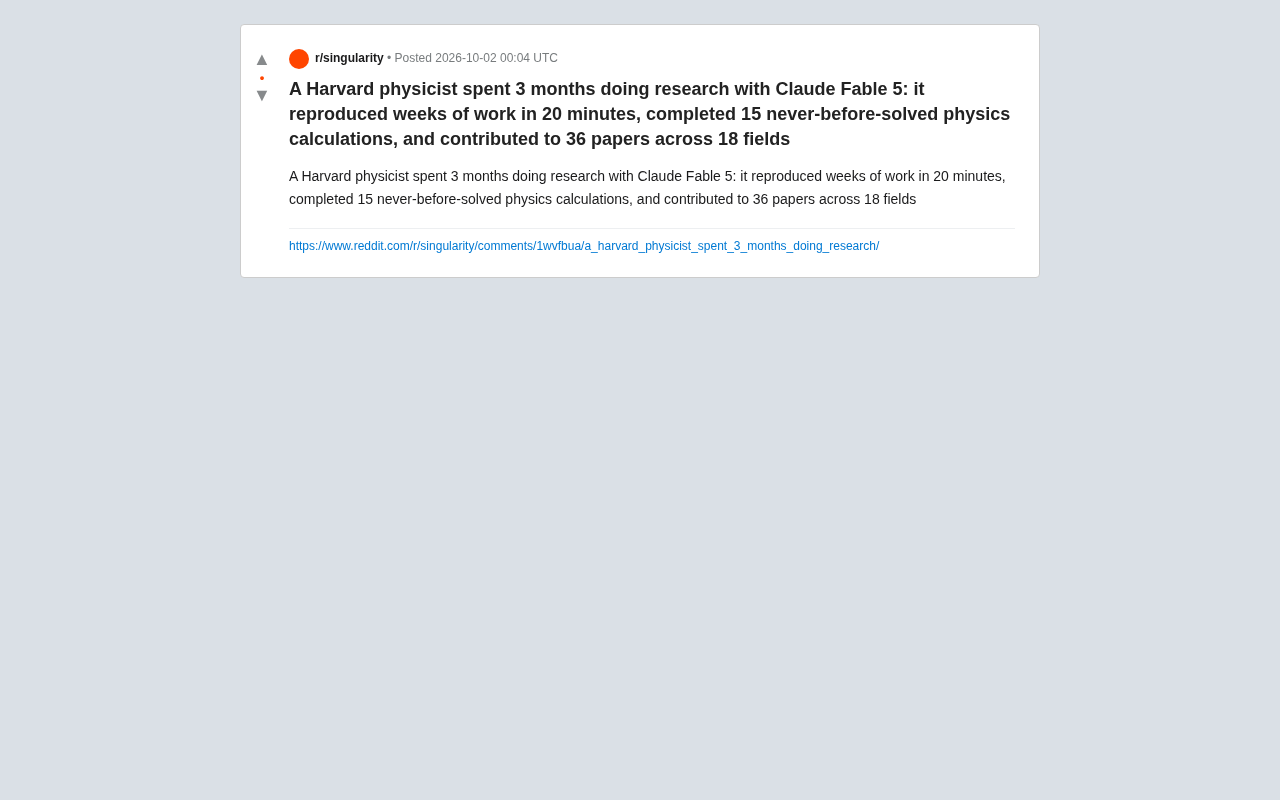
Recently, a Reddit post about a Harvard physicist using AI tools for scientific research sparked widespread discussion. According to the post, a Harvard physicist spent three months conducting research with an AI model called "Claude Fable 5," with remarkable results: the AI reportedly reproduced work that would normally take weeks in just 20 minutes, completed 15 physics calculations that had never previously been solved, and contributed to 36 papers spanning 18 fields.
These numbers attracted attention because they touch on a question the scientific community has long been watching closely — whether large language models can genuinely participate in cutting-edge scientific discovery, rather than merely serving as writing assistants or literature organization tools.
Several Dimensions Worth Examining Behind the Numbers
A Breakthrough in Efficiency
The most striking claim in the post is the efficiency comparison: "weeks of work reproduced in 20 minutes." If true, this would suggest AI has demonstrated remarkable acceleration capabilities on specific physics calculation tasks. In theoretical physics research, vast amounts of time are typically consumed by complex symbolic derivations, integral calculations, and numerical verification — precisely the kind of structured tasks where AI excels.
Based on publicly available research, frontier large models have indeed made significant progress in mathematical derivation and symbolic computation, handling fairly complex analytical operations. The claim of "reproducing weeks of work" is therefore not technically implausible — provided the work in question consists of formalizable, verifiable computational tasks.
How to Interpret "Never-Before-Solved Calculations"
The post claims that AI completed "15 physics calculations that had never been solved before." This statement deserves careful interpretation. In physics, "never solved" could refer to two different situations: problems that were previously untouched due to computational intractability, or genuinely open-ended unsolved problems. The former is the more likely area of AI contribution — it lowers the barrier to entry, enabling researchers to tackle calculations that were previously shelved due to prohibitive cost.
It would be premature to equate such results with major scientific breakthroughs, but they do point to a trend: AI is expanding the range of problems accessible to individual researchers.
A Note on the Name "Claude Fable 5"
It's worth highlighting that "Claude Fable 5," as mentioned in the original post, is not a known official product name from Anthropic. The Claude product line typically uses poetry-related suffixes such as Haiku, Sonnet, and Opus. "Fable 5" may be a typo by the post's author, an informal nickname, or a personal label for a particular version.
Without corroboration from official sources, readers should treat the specific numbers and model names in the post as a single-source personal account rather than peer-reviewed findings. Claims about research results on social media platforms often carry risks of exaggeration or information distortion.
Anthropic's naming system for the Claude product line follows an internal logic: Haiku, Sonnet, and Opus correspond to lightweight, mid-tier, and flagship capability levels respectively — not version iteration numbers. Since 2024, Anthropic has also released the Claude 3 series (including Claude 3 Haiku, Claude 3.5 Sonnet, etc.) and Claude 3.7 Sonnet, which features extended thinking capabilities. All of these versions have official documentation and API endpoints for verification. The word "Fable" has never appeared in any official announcement, and the number "5" does not align with Anthropic's existing version naming conventions. This leaves open several possibilities: the post's author may have misremembered an internal test version or a third-party wrapper product as an official name, or the information may have been distorted through social media transmission. For cases drawing academic conclusions based on specific model capabilities, accurately identifying the model is critical, since different versions vary significantly in reasoning depth and mathematical ability.
The Real Value and Limitations of Cases Like This
The Positive Takeaway
Setting aside questions about the accuracy of specific numbers, this post reflects an ongoing reality: an increasing number of frontline researchers are integrating large language models into their daily research workflows. The description of "contributing to 36 papers across 18 fields," even if somewhat exaggerated, points to the potential of AI tools for cross-disciplinary versatility — the same model can provide computational support across condensed matter physics, astrophysics, quantum field theory, and other areas.
This versatility is something traditional specialized scientific software lacks, and it represents the most imaginative quality of large models in research contexts.
The Caution That Must Be Maintained
That said, the scientific community has always maintained a cautious stance toward AI involvement in research. The core issue is verifiability: computational results produced by AI must undergo human review, numerical validation, or experimental testing before they can be incorporated into formal research. AI's "contributions" are fundamentally about acceleration and assistance — the final scientific judgment still rests with human researchers.
Furthermore, there is a fundamental difference between reproducing known results and discovering new knowledge. The former can serve as a capability benchmark; the latter is the true frontier of science. Current evidence more strongly supports the former.
One inherent limitation of large language models in mathematical and physics computation is the "hallucination" problem — models may generate derivation steps or numerical results that appear rigorous but are actually incorrect, expressed in ways that are indistinguishable from correct answers. This is particularly dangerous in symbolic computation: a single symbolic error can invalidate an entire derivation chain, and models lack the metacognitive ability to recognize when they've made a mistake. Because of this, researchers cannot judge correctness solely based on the "logical coherence" of the output — they must rely on independent verification using computer algebra systems (such as Mathematica or SymPy), numerical validation, or comparison against known results. Positioning AI as a "draft generator" rather than a "final answer provider" represents the broader consensus in academia for LLM applications in research.
Takeaways for Researchers
For scholars considering integrating AI into their research work, this case offers several practical insights:
- Position AI as a computational accelerator and idea validation tool, not an autonomous discovery engine
- Maintain rigorous human review of every step of AI-generated derivations
- Leverage its cross-domain capabilities to quickly obtain usable analytical frameworks in unfamiliar subfields
- Approach "miracle case studies" on social media with critical thinking — focus on reproducible methods rather than sensational numbers
As AI model reasoning capabilities continue to improve, highly formalized disciplines such as physics and mathematics may well be among the first fields where AI-assisted research bears fruit. But the true measure will always be whether results can withstand rigorous scientific validation.
Related articles

Should U.S. College Fraternities Be Banned? A Researcher's Incisive Observations
Why not just ban U.S. college fraternities? A researcher finds the key resistance comes from decision-makers' own fraternity identities and schools' "willful ignorance."

Microsoft Discovery: Accelerating Scientific Discovery with AI Agents
Microsoft's Discovery platform runs specialized AI agents to help researchers screen and prioritize the most promising compounds and experimental paths, reducing experiments and accelerating scientific discovery.

Cambridge Heavy Industries Secretly Develops Desktop-Scale Nuclear Fusion Device
Cambridge Heavy Industries is secretly developing a desktop-scale laser-driven nuclear fusion device, targeting the equipment supply market for fusion power plants. This article analyzes its miniaturization technology path, commercialization logic, and unique positioning in the fusion startup wave.