Has Opus 5.5 Been Nerfed? The Truth and Controversy Behind the Community Uproar
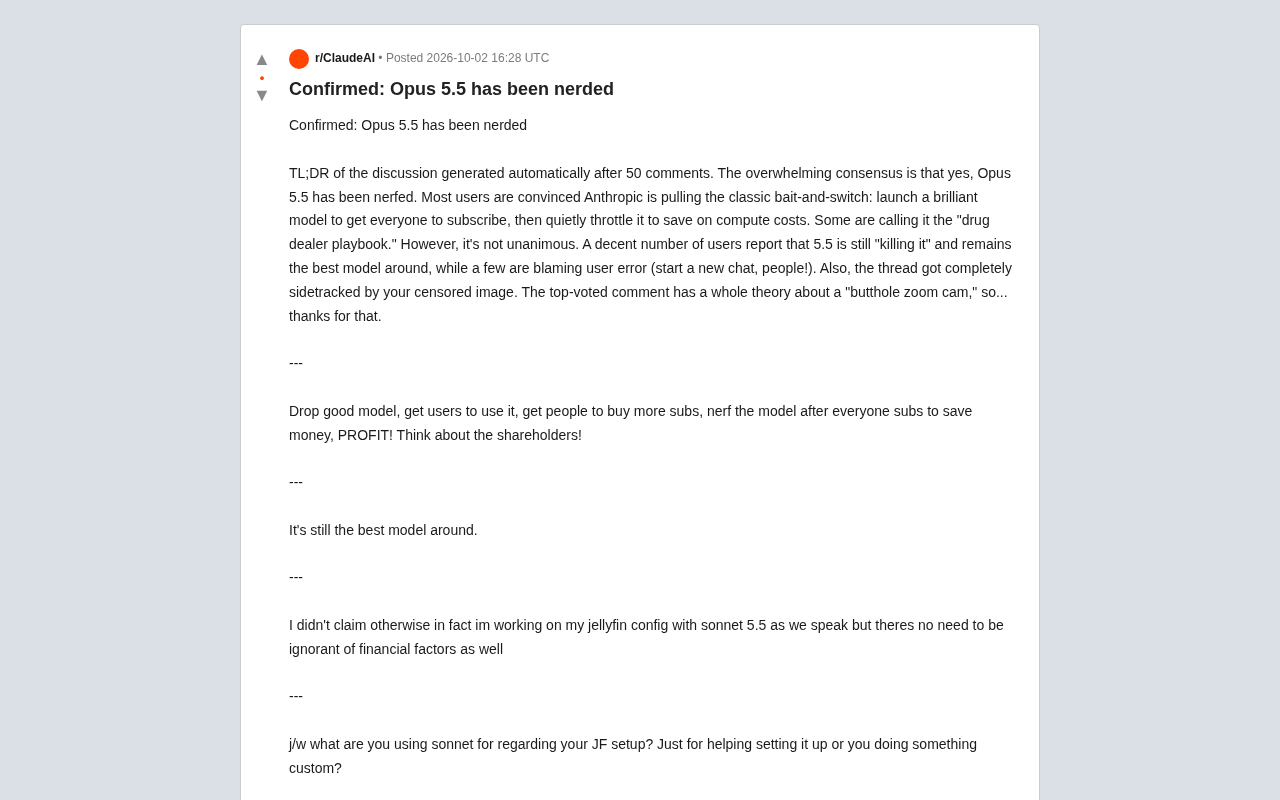
Reddit erupts over whether Anthropic quietly nerfed Opus 5.5, exposing AI's transparency crisis.
A Reddit debate over Anthropic's Opus 5.5 has ignited accusations that the model was quietly degraded after attracting subscribers — dubbed a "drug dealer playbook." Two motives are proposed: cutting compute costs and artificially boosting the perceived upgrade of future releases. The fallout is real: some professionals now cross-validate with GPT and Kimi, eroding single-ecosystem dependency. Yet many users still find Opus 5.5 excellent, and some "degradation" may stem from context length or usage habits. The deeper issue is AI services' lack of transparent changelogs, turning every subjective performance drop into unresolvable controversy.
A heated debate has recently swept through Reddit over Anthropic's flagship model, Opus 5.5, centered on a single accusation: has this once-impressive model been quietly "nerfed" after launch? After more than 50 comments, the discussion reflects a collective anxiety among users about AI companies' "bait-and-switch" tactics.
The "Hook Them, Then Gut It" Suspicion
The loudest voice in the thread is users' suspicion of a so-called bait-and-switch playbook. One user summed up the logic vividly: "Release a great model, get people hooked, attract subscriptions, then once everyone's subscribed, slash the model to save money — profit! Think of the shareholders!"
This accusation, mockingly dubbed the "drug dealer playbook," is far from isolated. One user bluntly stated that Anthropic is "now pulling the same crap as OpenAI — disgusting and sad." The underlying emotion is clear: users feel they're paying for a service that fluctuates without any official explanation.
A repeatedly cited analogy captures the core grievance: "Imagine your internet provider randomly cutting your speed in half with no notice and no acknowledgment..." For professional users who depend on AI models to get work done, this kind of opaque "experience degradation" is genuinely unacceptable.
The term "bait-and-switch" in a business context refers to a strategy where a company attracts users with a compelling product or offer, then quietly degrades service quality or raises prices once users are locked in and switching costs are high. In the AI subscription space, this concern is especially acute — users can't access model weights directly, nor can they observe changes to backend inference parameters. They can only gauge performance through subjective experience. Anthropic's API service agreement does not commit to maintaining specific version performance baselines, leaving an institutional gap that fuels user suspicion.
Not Just Cost-Cutting: An Alternative Motive
Interestingly, not everyone attributes the alleged nerfing solely to reducing compute costs. Some commenters offered a more strategic reading: "This may not be just about saving money, or not entirely. Post-launch nerfing also lets them make their next release look more impressive by comparison."
This observation highlights a commonly overlooked business logic — by lowering the performance baseline of existing models, companies create a stronger sense of "upgrade" for the next generation. If true, this would mean model performance fluctuations could be a deliberately engineered product cadence, not merely a technical or financial trade-off.
However, users who hold this view also acknowledge that such "tricks" only work in the short to medium term. As one person put it: "I hope this kind of game eventually backfires on them."
Voting with Their Feet: Multi-Model Cross-Validation Becomes the New Normal
Perhaps the most tangible impact of this controversy is the way it's reshaping professional users' workflows. One user shared their approach: "Because of these fluctuations, I've added GPT and Kimi to my workflow to cross-check Opus's outputs. Gradually, I'm pushing more and more work to other models."
They further articulated a crisis of trust in Anthropic: "Anthropic's nonsense makes me not want to be completely locked into their ecosystem."
This is a warning signal for all AI companies. When users lose confidence in the stability of a single model and proactively build redundant "multi-model cross-validation" systems, the ecosystem lock-in that companies work hard to create gets undermined in the process. Short-term cost savings or marketing calculations may come at the cost of long-term user loyalty.
"Ecosystem lock-in" refers to a state where users find it difficult to leave a platform due to high switching costs — including learning curves, workflow reconstruction, and data format compatibility. For AI tools, lock-in mechanisms typically include proprietary API call formats, deeply integrated prompt engineering in user codebases, and adapted habits around specific model output styles. However, the commoditizing competition in today's large language model market has substantially reduced friction in cross-model migration — GPT, Claude, Gemini, and other mainstream models are converging in baseline capabilities, and the marginal cost of switching is falling. This makes lock-in strategies far less defensible than they are in traditional software ecosystems.
Beyond the Controversy: This Is Far from Settled
It's important to emphasize that "Opus 5.5 has been nerfed" is far from an established fact — it remains an unconfirmed community discussion with no official validation. Even amid the wave of skepticism, a significant number of users hold the opposite view.
Many insist that Opus 5.5 is "still the best model available" and "still absolutely crushes it." Some skeptics even admitted they were "currently using Sonnet 5.5" to configure Jellyfin and tackle complex tasks like rewriting custom plugins in JS — suggesting that in many real-world scenarios, the model's capabilities haven't noticeably degraded.
A more measured contingent attributes the issue to "user error," advising those who notice performance drops to "try starting a new conversation." Context accumulation and overly long sessions can genuinely affect model performance, and these subjective experiences are difficult to distinguish from actual performance regression.
The Gap Between Perception and Reality
At its core, this debate exposes a stubborn structural problem in AI services: the lack of quantifiable, verifiable transparency around model performance. A user's sense that things have "gotten worse" could stem from real backend adjustments — or from random variation in prompt quality, context length, task difficulty, or even a psychological shift in expectations.
Without official benchmarks and changelogs, "nerfing" is nearly impossible to confirm or disprove, so every perceived drop in quality gets amplified into a conspiracy-laden discussion. For companies, the solution may not lie in whether they actually adjusted the model, but in whether they're willing to communicate any such changes openly and transparently.
After all, what users want isn't a model that never changes — it's a provider that won't "quietly throttle their connection" behind their backs.
The "illusory degradation" of AI model performance is a problem researchers have noted but not fully solved. Factors affecting user perception — beyond actual backend changes — include attention dilution from filled context windows, hidden changes to system prompts, adjustments to the sampling temperature parameter, and so-called "model drift" — where the same prompt produces different outputs over time due to variations in the inference environment. Neither academia nor industry currently has standardized continuous monitoring benchmarks for production models. Users are left to rely on community-sourced subjective evaluations, which fundamentally ensures that disputes like "was it nerfed?" are unlikely to ever receive an authoritative, fact-based resolution.
Related articles

iPhone Duo Hands-On: Is the $2,000 Small-Screen Foldable Worth It?
YouTube's Allison shares her iPhone Duo hands-on: dual-screen multitasking doubles efficiency, great video viewing, nice matte finish—but thick body, small outer screen, and a $2,000 luxury price.

Sentry's Ad Cracks Up Developers: Can On-call Actually Be Fun?
Sentry's ad short film taps into developers' on-call anxiety, using humorous dialogue to showcase its observability platform—errors, logs, traces, metrics, replays, and releases in one place.

LLM App Getting Worse With Every Change? Build an Effective Evaluation System in Three Steps
How do you know if your LLM app is getting better or worse? A Reddit-based guide to test sets, automated regression evaluation, LLM-as-judge scoring, and structured agent tracing.