Healthcare Software Giant Epic Halts Product Development to Fix Security Vulnerabilities Threatening Patient Data

Epic halts new feature development for weeks to fix security flaws threatening millions of patients' health data.
U.S. EHR giant Epic has announced a pause on routine product development, redirecting engineering resources to fix security vulnerabilities in its widely used patient data platform, MyChart. Medical data — containing identity, medical history, insurance, and payment information — commands far higher black-market value than ordinary credentials, and any breach can trigger identity theft and insurance fraud. Epic's move is seen as a cautious risk management stance: intervening before vulnerabilities are exploited at scale and placing security above product iteration speed. Specific vulnerability details and whether any data breach has occurred have yet to be disclosed, and the incident serves as a reminder to the entire health tech industry that security is a foundational requirement for digital transformation, not a feature to be deferred.
Healthcare technology software giant Epic has made a rare decision: pausing new product development and redirecting its engineering resources over the coming weeks toward fixing security vulnerabilities. The company's MyChart system is one of the most widely used patient health data access platforms in the United States, and this shift directly affects the security of vast amounts of sensitive patient information.
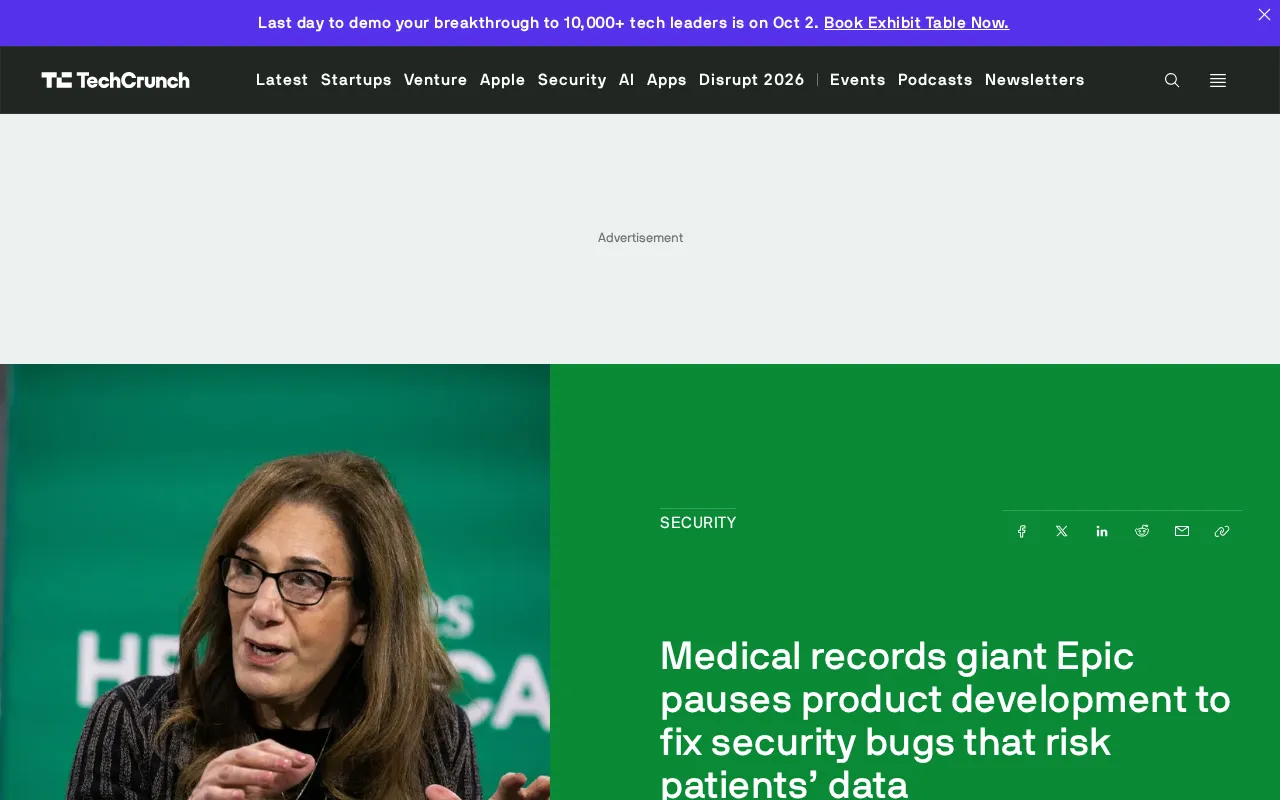
Why Epic Hit Pause on Product Development
Epic is a cornerstone vendor in the U.S. electronic health record (EHR) space, with its systems adopted by numerous large hospitals and healthcare institutions. MyChart, the patient-facing portal, allows users to view lab results, schedule appointments, communicate with physicians, and manage their personal health records online. Because it handles large volumes of personally identifiable health information (PHI) protected under strict legal frameworks, any potential security flaw can carry serious consequences.
According to reports, Epic has decided to suspend the rollout of regular product features for several weeks and redirect team efforts toward addressing identified security vulnerabilities. For a large software vendor known for continuous iteration and rapid feature delivery, voluntarily putting the brakes on development is not a common move — it typically signals that internal risk assessments have elevated the issue to a level requiring immediate priority.
Background: An EHR (Electronic Health Record) system is the core software infrastructure healthcare institutions use to digitally store, manage, and share patient clinical information — covering diagnostic records, medication history, lab reports, imaging data, and more. Epic currently holds approximately one-third of the U.S. hospital EHR market share, with particularly high penetration among large academic medical centers with more than 500 beds. Because EHR systems are deeply embedded in hospital clinical workflows and switching costs are extremely high, when Epic encounters a security issue, healthcare institutions can't easily mitigate the impact by changing vendors — they are highly dependent on Epic's own speed and transparency in addressing problems.
The High Sensitivity of Patient Data Security
Medical data is an extremely high-value target for cyberattackers. Unlike ordinary account credentials, a complete medical record contains identity information, medical history, insurance data, and even payment details — commanding far higher prices on the black market than other types of personal data. A exploitable vulnerability in a healthcare platform can lead not only to patient privacy breaches, but also to cascading risks such as identity theft and insurance fraud.
For this reason, Epic's decision to intervene proactively before vulnerabilities are exploited at scale reflects a relatively cautious approach to risk management. Placing security above new features is a direct act of responsibility toward the millions of patients whose data lives in the system, and aligns with the healthcare industry's stringent data protection compliance requirements.
Background: In the United States, health data is strictly protected under the Health Insurance Portability and Accountability Act (HIPAA). HIPAA requires healthcare institutions and their business associates to implement rigorous administrative, physical, and technical safeguards for "protected health information" (PHI). Violations can result in fines ranging from tens of thousands to millions of dollars, with criminal liability possible in severe cases. In 2024, U.S. healthcare giant Change Healthcare suffered a ransomware attack that affected the health records of more than 100 million Americans — considered one of the largest healthcare data breaches in U.S. history — further heightening the industry's vigilance toward EHR platform security vulnerabilities.
Implications for the Healthcare Industry
This incident serves as yet another reminder to the entire health tech industry: security is not an optional add-on in the product iteration cycle — it is a foundational prerequisite. As more and more clinical processes go digital and patient data moves to the cloud, the security of underlying systems directly determines the trustworthiness of the entire healthcare service chain.
For hospitals and healthcare institutions, relying on third-party platforms to store and process patient data means continuously monitoring vendors' security practices and incident response capabilities. For software vendors, Epic's decision to pause development sends a meaningful signal about prioritization — when security and speed come into conflict, security should win.
It's worth noting that publicly available information remains limited. Key details — including which specific vulnerabilities are involved, whether they have been actively exploited, and whether any data breach has occurred — have not been fully disclosed. Epic's subsequent remediation progress and transparency will be an important indicator for outside observers assessing the company's security governance capabilities.
Summary
Epic's decision to pause product development and concentrate on fixing security vulnerabilities is a significant event with implications for the data security of millions of patients. It highlights the mounting security pressures facing the health tech sector amid accelerating digitalization, and offers a noteworthy case study for the industry's ongoing balancing act between product velocity and data security.
Related articles

Will GitHub Die? Open Source Maintainer Burnout and the Collaboration Crisis in the AI Era
Lex Fridman podcast discussion on open source maintainer burnout and GitHub's predicament: massive pull requests overwhelm core maintainers, and AI worsens code bloat. Using math journal peer review and Poincaré conjecture verification as analogies, the article analyzes why verification in knowledge production must be deliberately slow, and how open source communities can avoid the failure mode of maintainers exiting.

Stop Building Cookie-Cutter AI Websites: 3 Tools That Transform Your Coding Agent
Three tools that boost AI coding agents: FFmpeg skill for local video editing in Claude Code and Cursor, Hallmark's 50 design themes to fix cookie-cutter AI sites, and Jailbreaks' 25+ model prompts.

How America's Gerontocracy Squeezes the Younger Generation
Americans over 55 hold nearly three-quarters of national wealth, alongside an 80-year-old president and elderly congressional leaders. The Atlantic's Idrees Kahloon explains how gerontocracy drives up housing costs, squeezes opportunities for the young, and explores zoning reform and child poverty reduction as practical fixes.