Helio: Deploy in 5 Minutes and See Today's Rooftop Solar Output at a Glance

Helio is an open-source solar monitoring tool that shows today's generation on open, with history and revenue views.
Helio is an open-source monitoring app for rooftop solar users, built around a "number-first" design: it displays today's generation on launch, reading the energy counter of inverters in the ShineMonitor / SmartClient ecosystem directly rather than estimating. It also offers real-time power, 5-minute curves for any date, 30-day/annual/lifetime history, and revenue calculated with custom rates. MIT-licensed, database-free, tracking-free, with credentials kept away from the browser, it self-deploys on Vercel in about 5 minutes. The article argues it fills the gap between manufacturer apps and owners' need to "just see today's generation," but it only supports a specific inverter ecosystem and suits technically savvy users willing to self-deploy.
Rooftop solar users often face an awkward situation: they've installed solar panels, yet have to dig through a pile of apps to find that one number—"how much power did I generate today." Helio aims to solve this pain point: it displays today's generation the moment you open it, with data coming directly from the inverter's own energy counter.
A Number-First Design Philosophy
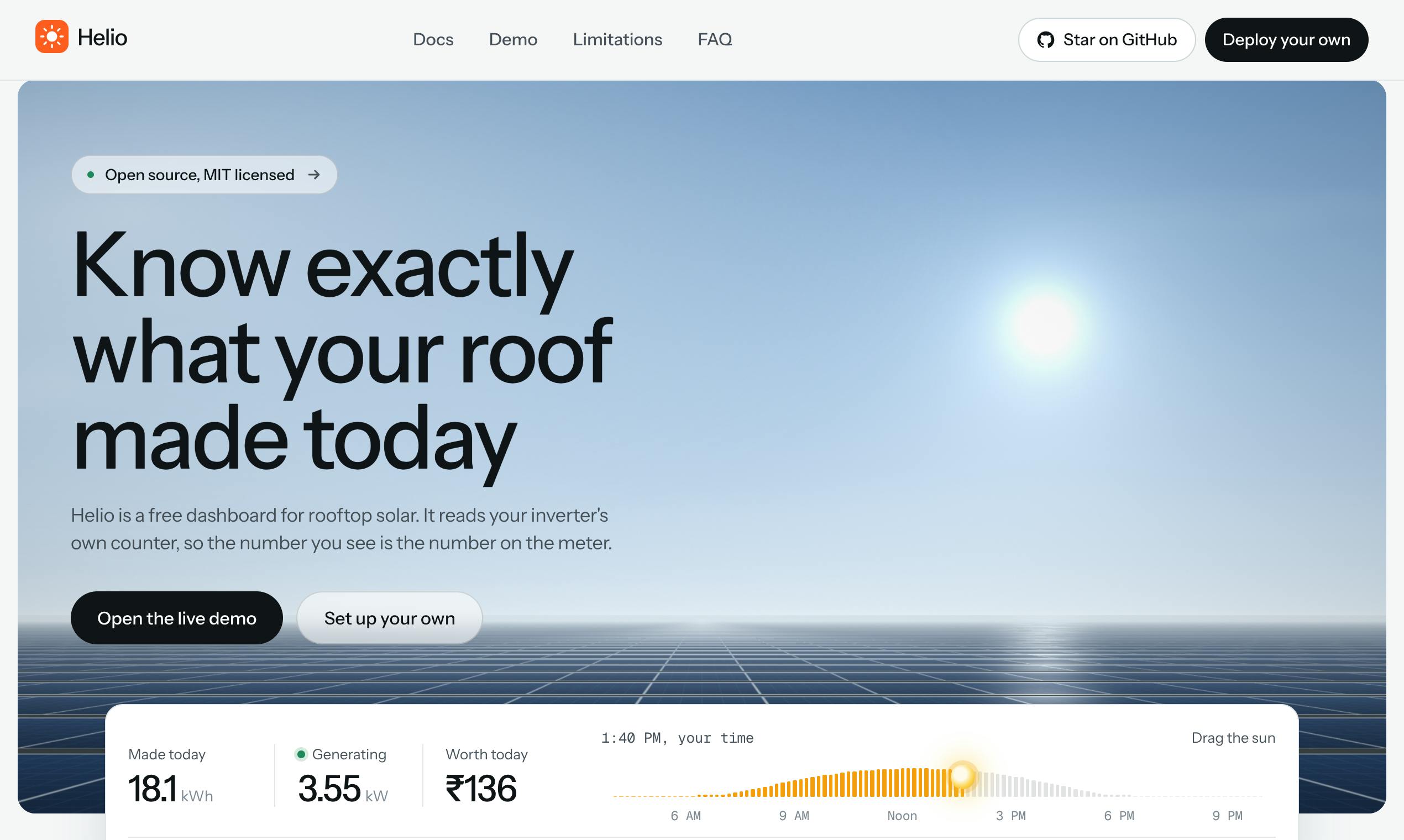
Helio's core interaction is extremely restrained: launch the app, and the first screen shows "how many kWh I generated today." This number isn't an estimate—it's the raw count read from the inverter via ShineMonitor / SmartClient. For users who just want to know "how much power the sun produced today," this goal-oriented design eliminates layer upon layer of clicking.
Around this core number, Helio also offers real-time power, 5-minute granularity curves for any historical date, 30-day, annual, and lifetime generation history, as well as revenue calculated using user-defined currency and electricity rates. In other words, it uses "today" as the entry point, but behind it lies a complete historical data browsing capability.
Open Source, No Database, 5-Minute Deployment
Helio uses the MIT license and is completely free. Deployment means deploying your own copy on Vercel, which the official documentation says takes about 5 minutes. There are two notable technical architecture choices: no database dependency, and login credentials never reach the browser. The former reduces the operational burden of self-hosting, while the latter addresses a common privacy concern in solar monitoring apps—inverter accounts are typically bound to device control permissions.
No tracking is another selling point. For a home energy monitoring tool, these design choices matter more to users' trust decisions than the sheer number of features.
Vercel is a cloud hosting platform for front-end and full-stack applications, known for its "push code and it deploys" experience, supporting Serverless Functions, edge networks, and automatic HTTPS. Users typically just connect their code repository to Vercel, configure a few environment variables, and the platform automatically handles the build and release— this is precisely the foundation for Helio's claim of "5-minute deployment."
Serverless and database-free architecture: Helio does not persistently store generation data on the server. Instead, it fetches the count from the inverter manufacturer's API in real time on each request, then performs conversion and presentation in memory. This eliminates database installation, backup, and migration work, and reduces the data exposure surface; the trade-off is that page loading depends on the availability and response speed of the inverter manufacturer's API, and historical curves must be fetched on demand rather than cached locally.
The "Last Mile" Problem of Solar Monitoring
Solar inverter manufacturers typically provide official apps, but their interfaces are often designed around installers and O&M scenarios—the "today's generation" that ordinary owners need ends up buried behind multiple layers of menus. The value of tools like Helio lies in filling the gap between manufacturer apps and users' real needs.
It doesn't do device control or fault diagnosis—it focuses solely on "viewing data." This single-point approach aligns with a wave of lightweight open-source tools in home automation in recent years: solving one specific, high-frequency problem with a minimal code surface and clear boundaries.
ShineMonitor / SmartClient is a monitoring cloud platform and its accompanying client provided by solar inverter manufacturers (commonly seen among domestic string inverter brands). Inverters upload operational data to this cloud platform via Wi-Fi or 4G collectors, and owners and installers then view generation, power, alarms, and other information through the app or web interface.
Helio does not communicate directly with the inverter; instead, it calls this cloud platform's API to read the energy counter. This means two things: first, it can only cover devices connected to this system; second, its availability and data granularity (such as 5-minute curves) are constrained by the extent of the manufacturer's API openness and rate limits. For self-hosting users, safeguarding inverter account credentials thus becomes a critical privacy consideration.
Who It's For, and Who It's Not For
Helio is suitable for technically savvy users who already use inverters in the ShineMonitor / SmartClient ecosystem and are willing to self-deploy. The 5-minute deployment and free open-source nature lower the barrier to entry, but the prerequisite is that users are familiar with the Vercel deployment process. For users who expect out-of-the-box functionality or use inverters from other brands, it currently doesn't cover them.
The product received 81 votes and ranked 20th on Product Hunt, with 5 comments—a small-scale but precisely positioned launch. As an individual developer's work, its polish is reflected in its dedication to "one number."
One-line Summary
Helio is an open-source solar monitoring tool that displays today's generation the moment you open it, with history and revenue views.
Paragraph Summary
Helio is an open-source monitoring app for rooftop solar users, built around a "number-first" design: it displays today's generation on launch, reading the energy counter of inverters in the ShineMonitor / SmartClient ecosystem directly rather than estimating. Around this entry point, it also offers real-time power, 5-minute granularity curves for any date, 30-day/annual/lifetime generation history, and revenue calculated with custom currency and electricity rates. Technically, it uses the MIT license, has no database, no tracking, keeps login credentials away from the browser, and can be self-deployed on Vercel in about 5 minutes. The article argues it fills the gap between manufacturer apps and ordinary owners' need to "just see today's generation," but it only supports a specific inverter ecosystem and is suited to technically savvy users willing to self-deploy.
Related articles

PC Memory Wasted? Hacker News Debates Centralized Data Centers
Hacker News users argue that personal computer memory is wasted and should be centralized in data centers, sparking debate on centralized vs. distributed computing resource allocation. This article analyzes the logic behind the claim, the costs of centralization, and new tensions in memory resource allocation in the AI era.

Why Fair Use Benefits Everyone: OpenAI Publishes Multi-Party Case Brief Analysis
OpenAI publishes excerpts from multiple court briefs featuring creators, scholars, accessibility advocates, and legal experts, explaining how fair use supports AI training and innovation, and analyzing its practical impact on developers and content professionals.

AI Companies' Joint Statement: 'Some Thing is Happening' Hints at Industry Shakeup
A Hacker News post 'Some Thing is Happening: A note from the AI companies' sparks speculation. This article analyzes the potential meaning of the joint AI company statement, industry context, and impact on developers.