Herdr: A Dedicated Runtime for Coding Agents — Why It Gained 2,196 Stars in a Week

Rust-written coding agent runtime Herdr gains traction, filling the engineering gap in agent execution environments.
The new GitHub project herdrdev/herdr positions itself as "the runtime your coding agents live on." Written in Rust, it has 50,137 stars and 4,052 forks, with 2,196 new stars in a single week. The article notes that AI coding is shifting from code completion to autonomous task completion, raising engineering issues like process isolation, result feedback, state maintenance, and permission boundaries. Herdr targets this underlying execution environment rather than building another chat interface. Rust's concurrency control, memory safety, and low overhead fit runtime needs, but the high contribution barrier brings maintenance challenges. The author considers the direction pragmatic and necessary, but star popularity does not equal production maturity.
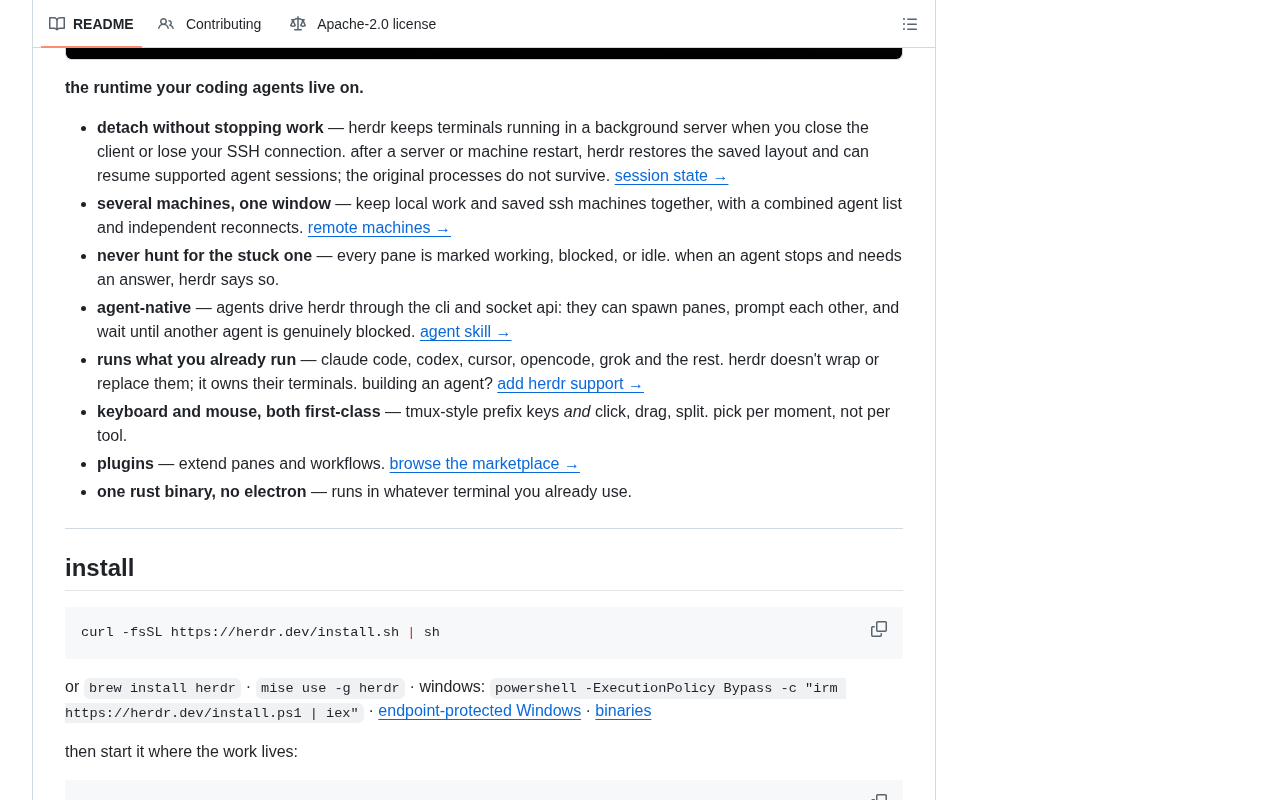
A new project worth watching has appeared on GitHub — herdrdev/herdr. Its self-positioning is straightforward: the runtime your coding agents live on. Written in Rust, the project has already garnered 50,137 stars and 4,052 forks, with 2,196 new stars in a single week — a clear sign of its momentum.
Why Coding Agents Need a "Runtime"
Over the past year, the focus of AI coding tools has been shifting from "completing a line of code" to "autonomously completing a task." When an agent needs to read and write files, execute commands, run tests, and iterate repeatedly, what it faces is no longer an editor but an entire execution environment.
Problems follow: How are processes isolated? How are command execution results passed back to the model? How is state maintained across multiple rounds of operations? Where are the permission boundaries? These engineering details directly determine whether an agent can work reliably. Herdr is targeting exactly this layer — not building another chat interface, but providing a dependable underlying execution environment for agents.
The Difference Between Agent Runtimes and Container Runtimes
Container runtimes (such as runc and containerd) solve the problem of "how to start and isolate a process in a standardized way," with interfaces aimed at orchestration systems. A coding agent runtime, by contrast, faces a model-driven multi-round decision loop: within a single task, it must repeatedly accept actions output by the model (reading files, running commands, modifying code), execute them, pass structured results back to the model, and maintain session-level state. Therefore, beyond process isolation, an agent runtime must also handle action semantic parsing, output truncation and format normalization, timeouts and interrupts, and "context continuity across multiple invocations within the same task." It is more like a session and tool scheduling layer for LLMs layered on top of a container runtime.
The Logic Behind the Rust Tech Stack
Implemented in Rust, the project's choice naturally fits runtime-type projects. A runtime needs to reside long-term, frequently schedule child processes, handle concurrent tasks, and simultaneously guarantee memory safety and low overhead. Rust's control at the systems programming level gives it an advantage over scripting languages when building this kind of infrastructure.
Judging from community feedback, the scale of 50,137 stars and 4,052 forks indicates it has moved past the "personal toy" stage and is beginning to be treated as a reusable foundational component. The growth rate of 2,196 stars in a week also shows that it aligns closely with the real pain points of current agent development.
The Concrete Advantages and Costs of Rust in Runtime-Type Projects
Rust's ownership and borrow checker eliminate data races at compile time, so multi-threaded child process scheduling and shared session state maintenance need not rely on runtime lock checks — especially important for a long-residing, highly concurrent runtime. Its zero-cost abstractions and lack of GC avoid the tail-latency jitter caused by garbage collection, making it suitable for scenarios sensitive to command feedback latency. The costs show up in two areas: first, the learning curve of the async ecosystem (Tokio, etc.) and the complexity of trait design; second, cross-platform system call wrappers require substantial unsafe code and platform-specific testing. Together, these factors explain why runtime-type infrastructure has clearly migrated toward Rust in recent years, and also why its contribution barrier is relatively high.
Its Place in the Agent Toolchain
Placing Herdr in the broader ecosystem makes its role clearer: above it are various coding agents and applications, below it are the operating system and containers, and Herdr sits in the middle, translating "what the agent wants to do" into safe system calls and process behavior. This layered approach resembles the evolution of container runtimes — standardize the execution environment first, and only then can upper-layer applications scale.
For developers, this means no longer having to build process management and execution feedback logic from scratch each time, freeing them to focus on agent decision-making and orchestration. For tool authors, a unified runtime also helps different agents share behavioral conventions.
Layering and Standardized Interfaces in the Agent Toolchain
A typical coding agent toolchain can be divided into four layers: the model layer (LLM inference), the orchestration layer (the agent loop that decides what to do next), the runtime layer (which actually executes file and command operations), and the infrastructure layer (operating system, containers, sandboxes). Currently, the orchestration and model layers iterate fastest and have the least unified standards, while the runtime layer has long lacked a common abstraction, forcing every project to implement shell execution, file I/O, and result feedback on its own. If the runtime layer can form a stable interface, the orchestration layer can invoke execution capabilities much like calling POSIX, thereby reducing the cost of cross-project reuse. This is similar to how OCI standardized container images and runtimes: once the interface is stable, upper-layer innovation no longer needs to reinvent the wheel.
Observations Beyond the Hype
The surge of over two thousand stars in a single week is worth noting, but stars do not equal production readiness. The value of a runtime ultimately depends on stability, observability, and the maturity of its permission model — all of which require time to prove. While Rust brings performance and safety benefits, it also raises the contribution barrier. Whether the project can build sustained community maintenance is a point worth watching going forward.
In terms of direction, however, abstracting a dedicated runtime layer for coding agents is a pragmatic and necessary judgment. As agents move from demos into everyday development workflows, this kind of "invisible infrastructure" will determine the lower bound of the experience more than flashy interactive interfaces. Herdr's rise is, to some extent, a signal of this trend.
One-line Summary
Herdr, a Rust-written coding agent runtime, is gaining traction by filling the engineering gap in agent execution environments.
Paragraph Summary
The new GitHub project herdrdev/herdr positions itself as "the runtime your coding agents live on." Written in Rust, it has 50,137 stars and 4,052 forks, with 2,196 new stars in a single week. The article notes that AI coding is shifting from code completion to autonomous task completion: agents need to read and write files, execute commands, run tests, and iterate repeatedly, which raises engineering issues such as process isolation, result feedback, state maintenance, and permission boundaries. Herdr targets exactly this underlying execution environment rather than building another chat interface. Rust's concurrency control, memory safety, and low overhead fit runtime needs, but the high contribution barrier also brings maintenance challenges. The author considers the direction pragmatic and necessary, but star popularity does not equal production maturity — stability, observability, and the permission model still await the test of time.
Related articles

Gemini 4 Neon Leak: A Potential Strong Contender Against Opus 5.5
A Hacker News thread suggests Gemini 4 Neon looks like an Opus 5.5 competitor. This article unpacks the product positioning behind this community signal, shifts in the top-model competitive landscape, and what it means for developers' model selection strategy.

Claude Fable 5.2's Self-Authored Short Film 'Fable' Sparks Discussion
A short film 'Fable,' credited to Claude Fable 5.2 for script, visuals, and directing, appears on Hacker News. This article analyzes the significance of full-pipeline AI creation, community reactions, and what it means for content creators.

Anthropic IPO Pricing: A Signal of AI Giants Going Public
Anthropic's IPO pricing draws attention. This article analyzes its potential impact on AI industry valuation, commercialization paths, and the competitive landscape, and highlights public-market expectations and challenges for AI companies.