Hermes Agent: Complete Breakdown of 87 Built-in Skills — 7-Layer Architecture & Priority Guide

Hermes Agent's 87 built-in Skills broken down into a 7-layer capability architecture
Hermes Agent is an autonomous Agent framework built on LLMs that achieves plugin-based capability extension through a modular Skills system. Its V0.13.0 version includes 87 built-in Skills reorganizable into 7 functional layers: Agent Operating System Layer (multi-Agent orchestration, Webhook event-driven), Software Engineering Layer (TDD, debugging, code review — 17 Skills total, the largest layer), Knowledge & Productivity Layer, Research Layer, Creative Layer, Local Device Layer, and High-Risk Layer. New users can cover 80% of daily scenarios by mastering just 17 high-frequency Skills.
Skills Hub Overview: 87 Is Just the Tip of the Iceberg
Hermes Agent is an autonomous Agent framework built on top of large language models. To understand the design logic of this framework, you first need to distinguish between two layers: the large language model (LLM) itself is a text prediction system, while the Agent framework is an "action layer" built on top of the LLM. The Agent's core capability lies in the "perceive-reason-act" loop: it receives information from the external environment, performs reasoning and planning through the LLM, and then invokes tools to execute specific operations.
Hermes' core design philosophy is to deeply integrate AI capabilities with external tools and services through a modular Skills system. Skills are essentially predefined capability units — each Skill encapsulates the invocation logic, prompt templates, and execution strategies for specific tools, enabling the Agent to interact with external systems in a standardized way. This architecture draws on the plugin-based design philosophy from software engineering — the core principle of plugin architecture is decoupling the system's core logic from specific feature implementations, allowing third-party extensions through standardized interfaces without modifying the core code. Hermes' Skills Hub embodies this philosophy: official Built-in Skills provide stable core capabilities, while Optional and community Skills offer long-tail extensions, allowing users to trigger complex tool invocation chains through natural language commands without needing to understand the underlying API details.
Hermes Generation 4's Skills Hub contains a total of 689 Skills, distributed across 4 sources:
- Official Built-in: 87 (the focus of this article)
- Optional: 81
- Anthropic: 16
- Low-Pub Community: 505
This article focuses exclusively on the most critical Built-in portion. While the official documentation's 13 categories are comprehensive, they're highly fragmented and lack priority ranking by usage scenarios. Below, we reorganize them into 7 functional layers based on practical usage scenarios and break them down layer by layer.
Layer 1: Agent Operating System Layer — The Capability Foundation
This layer enables Hermes to manage itself and orchestrate other Coding Agents — it's the core foundation that distinguishes it from ordinary Coding Agents, comprising approximately 7 Skills.
- HermesAgent: All Hermes configuration, CLI, and debugging depends on it
- Cloud Code / Codex / OpenCode: Corresponding to Anthropic, OpenAI, and open-source Coding Agent CLIs respectively, allowing Hermes to delegate tasks to them
- Combine Orchestrator + CombineWorker: Multi-Agent orchestration capabilities
- Webhook Subscriptions: External event-triggered Agent execution
Multi-Agent Orchestration is an important paradigm in modern AI system architecture, with deep engineering motivations behind it. While current mainstream LLMs have expanded their Context Windows to hundreds of thousands or even millions of tokens, they still face bottlenecks when processing large codebases or complex engineering tasks — the context window not only limits the amount of information processable in a single pass, but also causes the model's "attention dilution" as content increases, degrading reasoning quality. The Orchestrator-Worker pattern is the solution to this challenge: the Orchestrator handles task decomposition, scheduling, and result aggregation, while Workers execute specific subtasks in independent, clean contexts. Hermes' CombineOrchestrator + CombineWorker combination is the implementation of this pattern, allowing large engineering tasks to be split into multiple concurrent subtasks, significantly improving processing efficiency for complex projects.
Webhook Subscriptions represents another architectural upgrade — elevating the Agent from a "passive response" mode to an "active perception" mode. A Webhook is a "reverse API" mechanism: traditional APIs involve active requests (Pull), while Webhooks involve passive reception (Push). When a GitHub repository receives a new PR, a Webhook can automatically trigger Hermes to perform code review; when a CI/CD pipeline fails, it automatically initiates a debugging workflow. This event-driven architecture allows the Agent to truly integrate into development workflows, rather than being merely a tool that requires manual invocation.
This layer determines that Hermes is not just a code generation tool, but an operating system capable of orchestrating multiple Agents working collaboratively. If you only treat it as an ordinary AI programming assistant, you're wasting this layer's most critical differentiating capability.
Layer 2: Software Engineering Layer — The Largest Core Layer
Comprising SoftwareDev (11 Skills) and GitHub (6 Skills), totaling 17 Skills, this is the largest of all 7 layers.
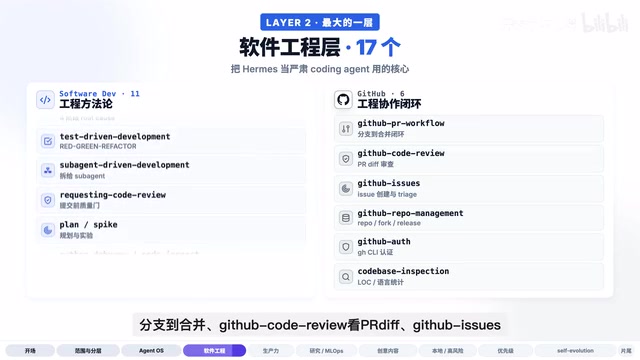
SoftwareDev side covers complete engineering methodology:
- Writing Plan: Breaking down tasks into executable steps
- Systematic Debugging: Four-stage Root Cause analysis
- Test Driven Development: Standard Red-Green-Refactor workflow
- SubAgent Driven Development: Delegating subtasks to SubAgents for parallel processing
- Requesting Code Review: Quality gate before submission
Test-Driven Development (TDD)'s Red-Green-Refactor cycle is a methodology validated over decades in software engineering: first write a failing test (Red), then write the minimum implementation to make the test pass (Green), and finally refactor to optimize code quality (Refactor). Introducing TDD into AI Coding Agents has special value that transcends traditional scenarios. The biggest risk of AI-generated code isn't syntax errors, but "hallucination-style correctness" — code that appears to meet expectations on the surface but has hidden defects in boundary conditions or business logic. Test cases provide the Agent with quantifiable verification standards, transforming the vague question of "is the code correct" into the definitive "do the tests pass." This verifiability enables the Agent to perform autonomous iteration: run tests, observe failure reasons, modify code, and verify again, forming a closed-loop self-correction mechanism that avoids the common AI code generation problem of "looks correct but is actually wrong," significantly improving the reliability of AI-generated code.
Key Takeaways
- Hermes Agent V0.13.0 has 87 built-in Skills that can be reorganized into 7 functional layers by usage scenario: Agent Operating System Layer, Software Engineering Layer, Knowledge & Productivity Layer, Research & Science Layer, Creative Content Layer, Local Device Layer, and High-Risk Layer
- The Software Engineering Layer (17 Skills) is the largest layer, covering complete engineering methodology and GitHub collaboration workflows — it's the core for using Hermes as a serious Coding Agent
- New users only need to master approximately 17 high-frequency core Skills to cover over 80% of daily scenarios, without needing to learn all 87 at once
- High-risk Skills (such as Godmode, Obliterators, iMessage, etc.) involve external side effects or security-sensitive operations — when AI Agents execute operations with real-world impact (deleting files, sending messages, modifying system configurations), the cost of errors is far higher than text generation. "Human-in-the-Loop" mechanisms are the mainstream approach to addressing this risk; always enable confirmation prompts when using these
- The 87 Skills are a frozen snapshot of the current version; the Self Evolution mechanism enables Skills to continuously evolve through version iterations — staying updated automatically brings improvements
Related articles
Deep Dive into AI Agent Skill Design: …
Deep Dive into AI Agent Skill Design: Engineering Practices from Anthropic and Perplexity
A deep dive into Skill design philosophy from Anthropic's Claude Code team and Perplexity's Agent team, covering the Tax Test, Gotchas Flywheel, progressive disclosure, and Eval-First practices for building high-quality AI Agent skill systems.
Deep Dive into OpenAI's Official GPT-5…
Deep Dive into OpenAI's Official GPT-5.6 Prompting Guide: The Shift from Manual to Automatic
A deep dive into OpenAI's official GPT-5.6 Sol prompting guide: conciseness-first, outcome-oriented design, autonomy boundaries, tool routing, and reasoning intensity tuning.
 Deep Dives
Deep Dive into How OpenClaw (Open-Source Crayfish) AI Agent Works
Deep analysis of OpenClaw AI Agent internals: System Prompt, tool calling, SubAgents, Skill system, memory, and Context Engineering explained.