Hermes Agent Deep Dive: Five-Layer Memory Architecture and Self-Evolution Mechanism Fully Explained

Huawei's open-source Hermes Agent rises fast with a five-layer memory architecture and self-evolution mechanism.
Hermes Agent is an open-source AI Agent framework from the Huawei team that reached 120,000 GitHub stars in under two months. Its standout features are a five-layer memory architecture (sensory, short-term, working, long-term, and meta-memory) that solves the persistent memory gap problem in AI agents, and a built-in self-evolution loop that enables continuous learning from execution results. Compared to frameworks like Open Manus, it offers clear advantages in architectural depth and production-grade engineering.
What Is Hermes Agent?
Hermes Agent is an open-source autonomous AI Agent framework developed by the Huawei team. Officially released in late February 2025, it amassed 120,000 GitHub stars in under two months — a remarkable growth trajectory. In terms of positioning, it belongs to the same category as the previously popular Open Manus (nicknamed "Crawfish" in the community) — both are AI agent development frameworks — but Hermes Agent takes a distinctly different approach in architectural design and production-grade engineering.
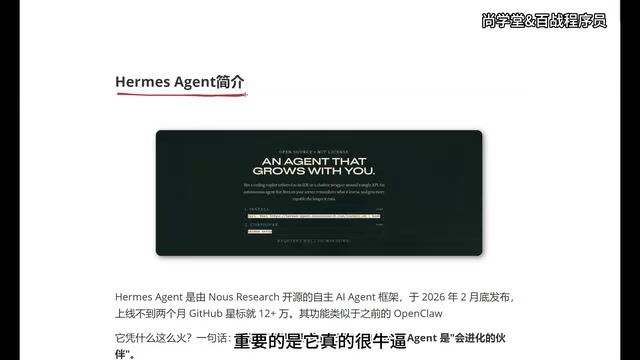
If you're new to the concept of AI Agents, here's a simple way to think about it: tools like Doubao or DeepSeek are essentially "conversational AI" — they help you brainstorm, plan, and write content. AI Agents go a step further. They don't just think; they autonomously execute tasks, call external tools, manage contextual memory, and even coordinate with other agents to complete complex, multi-step workflows.
The concept of AI Agents traces back to "autonomous agent" theory in AI research, with roots in multi-agent systems (MAS) research from the 1990s. Since 2023, the leap in capability of large language models like GPT-4 has triggered an explosion in AI Agent development. The core paradigm is a "Perceive–Plan–Act" loop: the agent perceives its environment, reasons and plans using a large model, executes actions via tool calls, and then adjusts its strategy based on the results. This is fundamentally different from traditional chatbots — chatbots respond passively, while agents drive proactively.
How Does Hermes Agent Differ from Open Manus?
Open Manus ("Crawfish") was once the most-watched open-source project in the AI Agent space, with many developers learning and building around it. After Hermes Agent launched, its more mature architecture and Huawei's engineering depth quickly drew significant attention away.
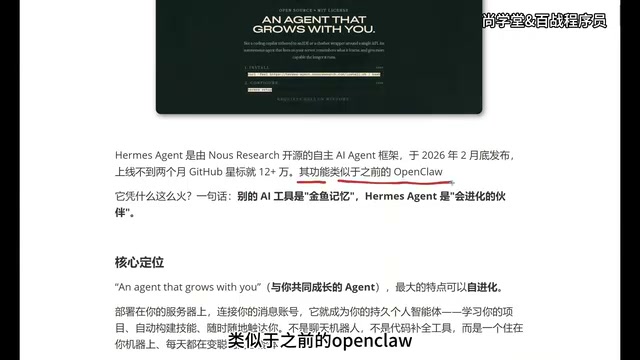
The core differences between the two come down to a few key areas:
Depth of Memory Architecture
Hermes Agent employs a five-layer memory architecture — its most defining technical feature. Traditional AI agents commonly suffer from "memory gaps": conversational context is easily lost, long-running task states can't be maintained, and information breaks down across sessions. The five-layer architecture — spanning sensory memory, short-term memory, working memory, long-term memory, and meta-memory — builds a complete system for information storage and retrieval, enabling agents to maintain coherent cognitive states while handling complex tasks.
Self-Evolution Feedback Loop
Hermes Agent has a built-in self-evolution loop. In short, the agent doesn't just execute tasks — it learns and iterates from the results. After each task, the system automatically evaluates performance, distills successful experiences into reusable skill modules, and converts failures into avoidance strategies. This mechanism makes the agent smarter over time, rather than staying frozen at its initial capability level.
From a technical standpoint, the self-evolution loop draws on several cutting-edge areas: Experience Replay from reinforcement learning, the "learning to learn" paradigm from Meta-Learning, and experience compression techniques from Knowledge Distillation. Concretely, after executing a task, the agent generates a structured execution trajectory. An automated evaluator scores the trajectory — high-scoring ones are abstracted into reusable skill templates stored in long-term memory, while low-scoring ones trigger a failure analysis module that generates constraints to prevent similar errors in the future. This mechanism is analogous to CI/CD in software engineering, but applied to iterating an agent's capabilities.
Five-Layer Memory Architecture: Core Technical Breakdown
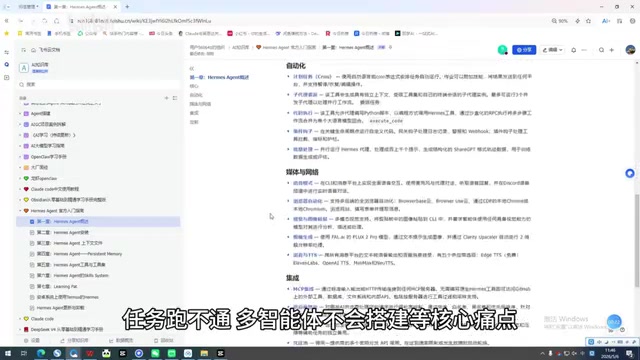
Hermes Agent's five-layer memory architecture can be understood by analogy to the human cognitive system:
- Sensory Memory Layer: Handles immediate input, similar to the human sensory buffer — responsible for initial filtering and encoding of raw data
- Short-Term Memory Layer: Maintains the current conversational context; limited in capacity but extremely fast to access
- Working Memory Layer: Carries the reasoning process for the current task — essentially the agent's core "thinking" workspace
- Long-Term Memory Layer: Persistently stores important information and learned outcomes, accessible across sessions
- Meta-Memory Layer: Manages the strategy for memory itself — deciding what information is worth retaining and what should be forgotten
This architecture is deeply inspired by the Atkinson-Shiffrin memory model and Baddeley's working memory model from cognitive psychology. In cognitive science, human memory is divided into sensory memory (lasting hundreds of milliseconds), short-term memory (capacity of roughly 7±2 chunks), and long-term memory (theoretically unlimited capacity). Meta-memory is a higher-order cognitive ability — the monitoring and regulation of one's own memory processes.
Mapping this theory onto an AI system presents key engineering challenges: efficient information compression, selective forgetting, and cross-timescale information retrieval. For instance, the sensory memory layer must filter information at millisecond speed; the long-term memory layer must support fuzzy semantic retrieval; and the meta-memory layer must dynamically adjust capacity allocation and eviction policies across all layers.
This architecture fundamentally addresses the "goldfish memory" problem that has long plagued AI agents, making complex multi-step task execution genuinely viable.
How Does Multi-Agent Collaboration Work?
In real-world business scenarios, a single agent rarely handles complex tasks alone. Hermes Agent provides a mature multi-agent collaboration mechanism that supports task distribution, information sharing, and result aggregation across multiple agents.
Each agent can have its own independent skill set and memory space, while collaborating efficiently through a unified coordination layer. Think of it like a project team: each member has their own expertise, but through a project manager's coordination, the team can accomplish work far beyond any individual's capacity.
Multi-Agent Collaboration is a classic challenge in distributed AI. Core difficulties include: task decomposition and assignment (how to break complex tasks into parallelizable subtasks), communication protocol design (how agents exchange information efficiently without bottlenecks), conflict resolution (how to arbitrate when multiple agents' decisions conflict), and global consistency guarantees (ensuring coherent final output).
Common collaboration patterns in the industry include hierarchical (clear manager–executor relationships), flat (peer negotiation among agents), and hybrid. Hermes Agent's unified coordination layer is essentially an engineered implementation of a hierarchical architecture — a central scheduler manages the task queue and resource allocation, balancing system controllability with execution efficiency.
Practical Engineering and Implementation Guide
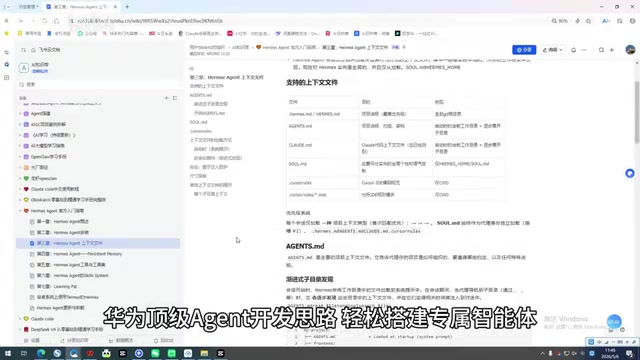
According to the official manual published by the Huawei team, the Hermes Agent deployment process covers several key stages:
Environment Setup and Foundation
The manual starts with development environment configuration, covering dependency installation, model integration, and framework initialization in detail. One notable point: Hermes Agent supports multiple large model backends, allowing developers to choose the right base model based on their requirements and budget.
Skill Training and Capability Extension
The framework provides a standardized skill definition interface. Developers can extend the agent's capabilities by writing skill modules — from simple API calls to complex multi-step workflows. The granularity of skill modules is flexible, and the learning curve is manageable.
Debugging in Practice and Common Troubleshooting
The manual includes a wealth of real-world examples and debugging tips to help developers quickly identify common issues. Problems like memory overflow, task infinite loops, and multi-agent communication latency — all frequently encountered in real development — are addressed with corresponding diagnostic approaches and solutions.
The AI Agent Framework Landscape
Between 2024 and 2025, the AI Agent framework space has seen a proliferation of projects. Beyond Hermes Agent and Open Manus, notable examples include: LangChain/LangGraph (chain-based calls and graph-structured orchestration), AutoGPT (the project that first ignited the Agent craze), CrewAI (focused on multi-agent role-based collaboration), and MetaGPT (simulating a software company's organizational structure).
Each framework has its own focus: LangChain leans toward general orchestration, CrewAI emphasizes role definition, while Hermes Agent differentiates itself through the depth of its memory system and Huawei's large-scale engineering experience. When choosing a framework, developers should evaluate based on the complexity of their specific use case, their team's tech stack, and performance requirements — rather than simply chasing star counts.
Conclusion: Worth Investing In, But Don't Follow the Hype Blindly
Hermes Agent marks a shift in AI Agent development frameworks from "functional" to "genuinely good." Its five-layer memory architecture and self-evolution loop offer more complete solutions at the technical level, making it a worthwhile open-source project for developers serious about the AI Agent space.
That said, a rational perspective is essential. No framework is a silver bullet, and Hermes Agent still requires developers to have solid foundational knowledge and engineering experience. The recommended approach is to start with the official documentation and manual, then deepen your understanding based on real project needs — rather than jumping on the bandwagon just because the star count is impressive.
Key Takeaways
- Hermes Agent is an open-source AI Agent framework built by the Huawei team, reaching 120,000 GitHub stars in under two months
- Its core technical highlight is the five-layer memory architecture (sensory, short-term, working, long-term, meta-memory), addressing the memory gap problem in AI agents
- A built-in self-evolution feedback loop enables the agent to automatically learn and improve from execution results
- Functionally similar to Open Manus, but with significant advantages in architectural depth and production-grade engineering
- The manual covers the complete workflow from foundational concepts to environment setup, skill training, and real-world deployment
Related articles
Deep Dive into AI Agent Skill Design: …
Deep Dive into AI Agent Skill Design: Engineering Practices from Anthropic and Perplexity
A deep dive into Skill design philosophy from Anthropic's Claude Code team and Perplexity's Agent team, covering the Tax Test, Gotchas Flywheel, progressive disclosure, and Eval-First practices for building high-quality AI Agent skill systems.
Deep Dive into OpenAI's Official GPT-5…
Deep Dive into OpenAI's Official GPT-5.6 Prompting Guide: The Shift from Manual to Automatic
A deep dive into OpenAI's official GPT-5.6 Sol prompting guide: conciseness-first, outcome-oriented design, autonomy boundaries, tool routing, and reasoning intensity tuning.
 Deep Dives
Deep Dive into How OpenClaw (Open-Source Crayfish) AI Agent Works
Deep analysis of OpenClaw AI Agent internals: System Prompt, tool calling, SubAgents, Skill system, memory, and Context Engineering explained.