Hermes Agent Development in Practice: From Installation & Configuration to Lark Integration and Code Review

Architecture overview and multi-scenario practical guide for the Hermes enterprise AI Agent framework.
This article systematically introduces Hermes, an AI Agent development framework designed for enterprise scenarios. Starting from its architecture (core runtime layer, tool integration layer, application interface layer, and scenario adaptation layer), it covers installation, configuration, and MCP protocol integration in detail, and demonstrates practical scenarios including a Lark-integrated news aggregation bot, Python library embedding, fully automated blog development, and scheduled code review — highlighting Hermes's core strengths of being orchestratable, integrable, and extensible.
Introduction
In an era where AI Agent tools are emerging rapidly, Harness Engineering (hereinafter referred to as Hermes) is gaining increasing attention from developers as an enterprise-grade Agent development framework. It not only supports desktop usage but also integrates deeply with workplace tools like Lark (Feishu), and can even be embedded into existing projects as a Python library. This article provides a systematic walkthrough of Hermes's core architecture, installation and configuration, and multiple practical application scenarios based on a comprehensive step-by-step tutorial, helping you get up to speed quickly with this Agent development tool.
Hermes Fundamentals and Architecture Overview
What Is Hermes?
An AI Agent is an intelligent system capable of autonomously perceiving its environment, formulating plans, and executing tasks. The fundamental difference from traditional chatbots lies in its ability to perform "tool calling" and "multi-step reasoning." Since 2023, with the explosive growth of LLM (Large Language Model) capabilities, Agent frameworks have entered a period of rapid evolution, with frameworks like LangChain, AutoGen, and CrewAI emerging one after another. Enterprise-grade Agent frameworks further emphasize security, observability, and integration capabilities with existing IT systems.
Hermes was born against this backdrop — it is an AI Agent development framework designed for enterprise-level scenarios. Its core goal is to enable developers to quickly build, deploy, and manage intelligent Agents. Unlike simple chatbots, Hermes emphasizes orchestratable, integrable, and extensible Agent capabilities, suitable for a wide range of scenarios from personal projects to enterprise applications.
Architecture Overview
Hermes's architecture follows a modular design principle, consisting of the following core layers:
- Core Runtime Layer: Responsible for Agent lifecycle management and task scheduling
- Tool Integration Layer: Supports MCP protocol access to extend external tool capabilities
- Application Interface Layer: Provides multiple interaction methods including desktop, command-line, and API
- Scenario Adaptation Layer: Adaptation modules for specific scenarios such as Lark, code review, and news aggregation
This layered design allows Hermes to function both as a standalone tool and as an SDK embedded in larger systems.

Installation and Basic Configuration
Desktop Installation
Hermes provides a desktop application with a relatively straightforward installation process. The tutorial covers detailed installation steps, including environment dependency checks, installer downloads, and initial configuration. For beginners, the desktop version is the most user-friendly entry point, offering a visual interface to quickly experience the Agent's core features.
Common Commands and Configuration Files
In command-line mode, Hermes provides a set of practical commands for managing Agent creation, execution, and debugging. Among these, writing the .md configuration file is a critical step in using Hermes — it defines the Agent's behavioral rules, available tools, and response strategies. Properly configuring this file directly determines the quality of the Agent's performance.
MCP Protocol Integration
MCP (Model Context Protocol) is a standardized protocol proposed and open-sourced by Anthropic in late 2024, designed to address interoperability issues between AI models and external tools and data sources. Before MCP, each Agent framework had its own tool integration approach, leading to severe ecosystem fragmentation. MCP defines a unified "tool description–invocation–response" interface specification, enabling any MCP-compatible tool to be directly called by any Agent framework that supports MCP — similar to how the USB interface unified the hardware ecosystem. Currently, hundreds of MCP Servers cover mainstream scenarios including file systems, databases, browser control, and code execution.
Hermes natively supports MCP integration, allowing you to seamlessly incorporate various MCP-compatible tools and services into your Agent, significantly extending the Agent's capability boundaries. This is one of Hermes's key competitive advantages over other Agent frameworks.
Practical Scenario 1: Lark Integration and News Aggregation Bot
Connecting to Lark Workflows
The Lark (Feishu) Open Platform provides comprehensive bot development capabilities, including messaging APIs, card messages, and group bot Webhook interfaces. The core challenge of integrating an AI Agent with Lark lies in: how to bridge Lark's event-driven model (events triggered when users @mention the bot) with the Agent's asynchronous task execution mechanism, and how to handle context management in multi-turn conversations. Hermes abstracts these complex integration tasks to the configuration level by wrapping Lark's Open APIs, allowing developers to complete integration without delving into Lark API details.
In enterprise scenarios, integrating AI Agents into everyday workplace tools is a must-have. Team members can use AI assistants within their familiar work environment without switching tools, significantly lowering the adoption barrier.

Building an AI News Aggregation Bot
This is a highly practical scenario: using Hermes to build a bot that periodically pushes the latest AI industry news. The implementation approach is as follows:
- Data Collection: Configure the Agent to periodically scrape the latest news and trending topics in the AI field
- Content Filtering: Use AI capabilities to filter content for quality and generate summaries
- Scheduled Push: Deliver processed content to Lark groups or other channels at configured intervals
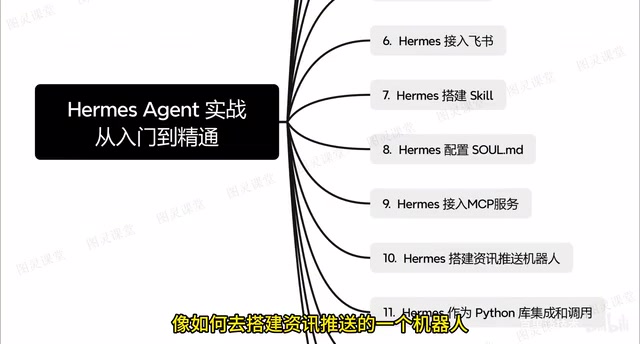
The value of this scenario lies in demonstrating that Hermes can do more than passive Q&A responses — it can proactively execute scheduled tasks, embodying true "Agent" characteristics: autonomous planning and execution.
Practical Scenario 2: Development Integration and Code Review
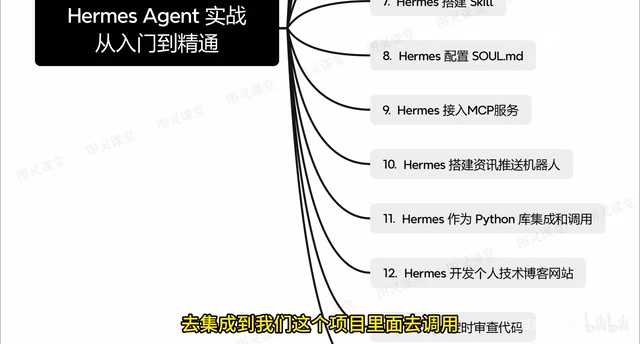
Integrating as a Python Library
One of Hermes's key highlights is its ability to be directly integrated into existing projects as a Python library. You don't need to deploy Hermes as a standalone service — you can call its Agent capabilities directly at the code level. This integration approach is particularly suited for the following scenarios:
- Embedding intelligent conversational capabilities in backend services
- Adding AI decision nodes to data processing pipelines
- Incorporating intelligent analysis into automated testing
Fully Automated Personal Tech Blog Development
The tutorial also showcases an interesting scenario: using Hermes to fully automate the development of a personal tech blog website. The Agent can automatically complete a series of development tasks based on instructions, including frontend page scaffolding, content generation, and style adjustments. This case effectively demonstrates the application potential of AI Agents in software development.
Scheduled Code Review
Automated Code Review is a critical part of the DevOps pipeline. Traditional solutions rely on static analysis tools (such as SonarQube and ESLint), which can only detect rule-based issues and cannot understand the business semantics of code. LLM-based code review, on the other hand, can understand code intent with context, identifying logic errors, architectural issues, and potential security vulnerabilities. By integrating the Agent with Git repositories (via GitHub/GitLab Webhooks or scheduled polling), you can achieve PR-level automated review, with suggestions fed back directly to the code hosting platform as comments, forming a complete CI/CD loop.
By configuring Hermes, you can have the Agent periodically scan project code repositories, automatically discover potential issues, and provide fix recommendations. This not only improves code quality but also reduces the burden of manual code review. Specific capabilities include:
- Code style and convention checks
- Potential bug identification
- Performance optimization suggestions
- Security vulnerability alerts
For small and medium-sized teams, this scenario is especially valuable — it can significantly raise the code quality baseline without adding headcount.
Tips and Best Practices
Based on the tutorial content, here are several core tips for using Hermes:
- Configuration Files First: Spending time refining your .md configuration file is more efficient than repeatedly tweaking prompts
- Leverage the MCP Ecosystem: Don't reinvent the wheel — prioritize integrating existing MCP tools and services
- Design Agents per Scenario: Use different Agent configurations for different business scenarios to avoid a "one-size-fits-all Agent"
Related articles
 Tutorials
ChatGPT Plus Subscription Guide: Are GPT-5.5, image-2, and Codex Worth the Upgrade?
A detailed look at ChatGPT Plus features — GPT-5.5, image-2, and Codex — with a Plus vs Pro comparison and a complete step-by-step subscription guide for users outside the US.
 Tutorials
Harness AI Engineering in Practice: Using Claude Code to Master Enterprise-Level E-Commerce Development
Deep dive into Harness AI Engineering: master enterprise e-commerce development with Claude Code using the Rules, Skills, Wiki, and Changes framework.
 Tutorials
Cursor + Codex Dual-IDE Collaboration: A Practical Methodology for Open-Source Project Customization
A complete methodology for open-source project customization based on real-world experience, detailing the Cursor+Codex dual-IDE workflow, seven-stage process, MVP validation, and AI source code reading techniques.