Hermes Agent Practical Guide: AI Agent Development & Enterprise Multi-Agent Collaboration
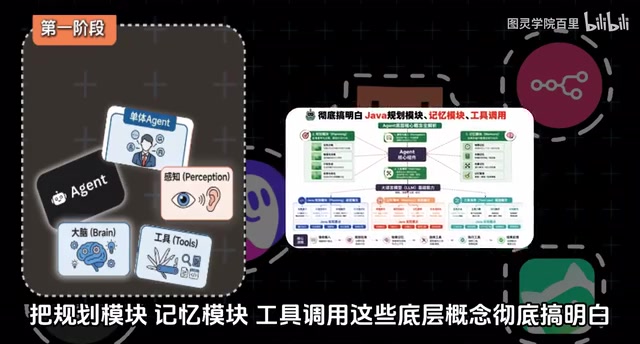
A structured 4-stage learning path for AI Agent development using the Hermes framework, from LLM fundamentals to enterprise multi-agent systems.
Based on a Bilibili Hermes Agent course, this article outlines a four-stage learning path for Agent development: mastering LLM fundamentals, deep-diving into ReAct and Code Agent paradigms, building multi-agent collaboration skills, and completing real-world projects. The framework section covers Hermes installation, Feishu integration, MCP service connections, and practical projects like news bots, automated blogs, and scheduled code reviews.
AI roles are undergoing a profound shift in required skills. The ability to call LLM APIs or build basic RAG knowledge retrieval pipelines is no longer enough to stand out when job hunting or shipping real products. The real differentiator is whether you can independently build intelligent Agents capable of autonomous reasoning, task planning, tool invocation, and end-to-end completion of complex tasks. This article is based on a Hermes Agent hands-on course from Bilibili, mapping out a complete learning path and engineering practices for Agent development.
Why Agent Development Has Become a Core Skill for AI Practitioners
The core value of large language models has long surpassed simple knowledge retrieval. A mature Agent system contains three fundamental capabilities — a planning module, a memory module, and tool invocation — enabling it to autonomously decompose goals, orchestrate external tools, maintain context across multiple interactions, and ultimately solve real business problems end-to-end.
This capability matters beyond just career advancement. Whether you're building intelligent decision assistants, automated office systems, or AI-powered products, Agent development is a foundational skill you can't avoid. Rather than cycling through basic RAG and API calls, it's worth systematically mastering the operating principles and engineering patterns behind Agents.
Four-Stage Learning Path: From Concept to Production
The original course outlines a clear progression, broken down into four sequential stages.
Stage 1: Large Language Model Fundamentals
Building solid foundational concepts is critical. The three core concepts — planning module, memory module, and tool invocation — need to be thoroughly understood, including what each is responsible for and how they work together. The goal of this stage is to lay the groundwork for what follows and prevent conceptual gaps from forming at the principles level.
Stage 2: Deep Dive into Principles and Paradigms
The core task here is moving from "understanding concepts" to "understanding principles." This means truly grasping how Agents operate and understanding the underlying logic of classic paradigms like ReAct and Code Agent. Without mastering these paradigms, you'll be copying existing code rather than identifying and avoiding common pitfalls.
ReAct (Reasoning + Acting) is one of the most widely used Agent paradigms today, introduced by a Google research team in 2022. Its core idea is to have the LLM perform explicit chain-of-thought reasoning before each action, producing a "Thought → Action → Observation" loop: the model first describes its current reasoning in natural language (Thought), then selects and executes a tool call (Action), then feeds the tool's return value as a new observation (Observation) into the next round — repeating until the task is complete. The strength of this paradigm is that the reasoning process is interpretable and debuggable; developers can clearly see what the Agent is "thinking" at each step, making it easier to identify and correct errors. Code Agent is another paradigm where the Agent completes tasks by generating and executing code snippets, making it well-suited for data processing and computation-heavy scenarios. Understanding the applicable boundaries of each paradigm is the key leap from "getting it to run" to "designing it well."
Stage 3: Advanced Skills and Multi-Agent Collaboration
A single Agent's capabilities are inherently limited, and enterprise scenarios often require multiple Agents working in concert. This stage focuses on understanding multi-agent collaboration — how multiple Agents divide responsibilities, pass information, and coordinate decisions. Prompt optimization is also a major focus, making Agent outputs more precise and controllable for real-world deployment.
The core challenge of Multi-Agent Systems lies in designing coordination mechanisms. Common architectural patterns include: the Orchestrator-Worker model, where a primary Agent handles task decomposition and delegation while sub-Agents each handle specific responsibilities and report results; the Pipeline model, where Agents pass intermediate results serially and each Agent handles only a specific step; and the Debate model, where multiple Agents provide different perspectives on the same problem and a judge Agent synthesizes a final decision. The right architecture depends on the task's parallelizability, consistency requirements, and fault tolerance needs. On the engineering side, message format between Agents, read/write permission control for shared memory, and deadlock prevention against circular calls are all detail-level pitfalls that need to be understood at the principles level before building.
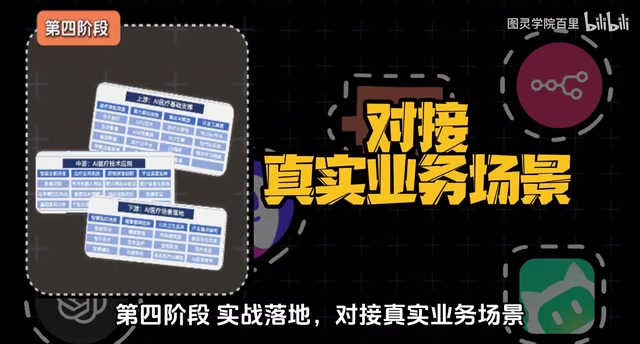
Stage 4: Hands-On Project Work
Technology ultimately speaks through projects. In this stage, the recommendation is to complete two to three full end-to-end projects — such as an intelligent decision assistant, an automated office Agent, or a multi-agent collaboration system — tying together all previous knowledge into a complete technical loop.
Hermes Framework in Practice: From Installation to Engineering Integration
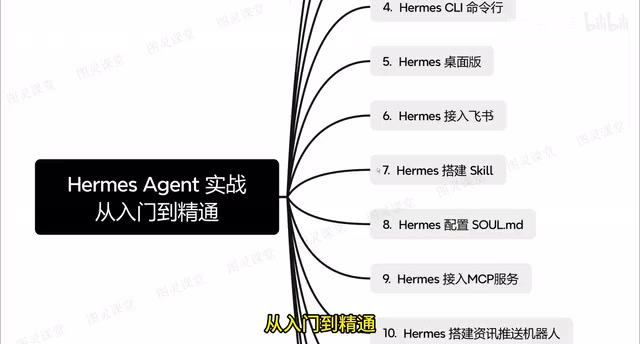
The core hands-on portion of the course revolves around Hermes, covering the complete chain from beginner to advanced usage.
Getting Started and Understanding the Architecture
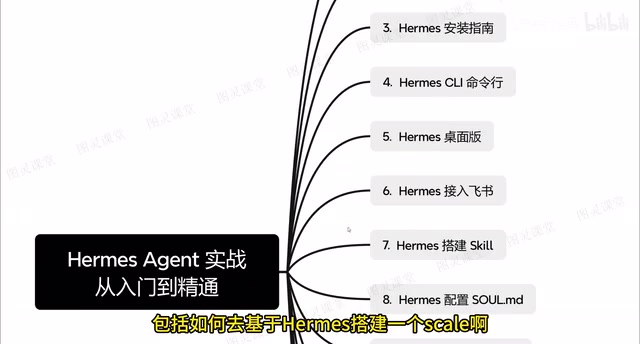
The course begins with Hermes fundamentals, first walking learners through its overall architecture and component modules to build a holistic understanding of the framework. It then moves into practical work, covering Hermes installation, common commands, and desktop version setup.
Real-World Workplace Applications
Hermes has a rich set of real-world use cases. The course demonstrates how to integrate Hermes with Feishu (Lark) for direct use within that environment, how to build Skills on top of Hermes, and how to configure SoulMD and connect to MCP services. These capabilities transform Hermes from an isolated tool into a productivity component that can be embedded into team collaboration workflows.
MCP (Model Context Protocol) is an open protocol spearheaded by Anthropic, designed to standardize how large models communicate with external tools and data sources. Think of it as the "USB port" of the AI world — as long as a tool implements the MCP protocol, any compatible Agent framework can invoke it plug-and-play, without writing custom adapter code for each tool. Hermes connecting to MCP services means you can directly reuse the large number of existing MCP tools in the community (such as browser control, file system operations, database queries, etc.), significantly reducing engineering integration costs. SoulMD is a configuration file format within the Hermes ecosystem used to describe an Agent's identity, capability scope, and behavioral constraints — similar to writing a "job description" for an Agent. It is the core configuration mechanism for controlling an Agent's output style and behavioral boundaries.
Representative Project Examples
The course uses a project-driven approach to teach concepts, with several representative scenarios:
- News Push Bot: Automatically pushes real-time AI trending news on a schedule to Feishu groups and other collaborative environments
- Integrating as a Python Library: Embedding Hermes as a library into your own projects to extend application boundaries
- Automated Tech Blog: Using Hermes to fully automatically develop a personal technical blog website
- Scheduled Code Review: Having Hermes periodically review project code and provide correction suggestions
These projects span content automation, development integration, and code quality management — all with strong practical reference value.
Advice for Learners
For technical practitioners looking to break into Agent development, the most common mistake is rushing into frameworks while neglecting fundamentals. The recommendation is to follow the four-stage path progressively — first solidify the foundational concepts of planning, memory, and tool invocation, along with paradigms like ReAct, before moving into framework-level work. Multi-agent collaboration and Prompt optimization may seem advanced, but they are precisely the factors that determine whether an Agent can truly be deployed in production.
Taking the full path from fundamentals to hands-on work in a disciplined way leads to a substantial improvement in technical competitiveness. Agent development is at a critical inflection point — moving from conceptual exploration to engineering deployment. The sooner you build a systematic understanding, the better positioned you'll be to stay ahead in this wave of AI capability upgrades.
Related articles

Claude Code + Codex Multi-Agent System Tested: The Real Problem Behind a 98% Cache Rate
Developer shares 7-day test of a Claude Code + Codex multi-agent system: 98% cache rate, 354:1 input/output ratio, but stuck on orchestration and output share.

Cursor SDK New Feature: Real-Time Steering of Running AI Agents
Cursor SDK adds run.steer(), letting developers inject messages in real time while an AI agent runs to adjust its direction. Subagents move to the background on steer.

AI Tools Are "Invading" Retro Games: A Game of Creativity vs. Copyright
AI tools are dramatically lowering the barrier to retro game porting—browser-based Halo, iPhone Wind Waker, and MR Smash Bros. are going viral, but sparking copyright disputes and regulatory concerns.