HF Trending Deep Dive: Qwen-Image-2.1 Ecosystem Dominates, Open-Source Models Hit an Inflection Point

Hugging Face trending reveals open-source AI shifting from parameter scale to ecosystem speed and deployment efficiency.
This article analyzes the top 30 models on Hugging Face's current trending list. Qwen-Image-2.1 dominates with unified text-to-image capabilities and explosive ecosystem growth — 5.67M downloads in three days. DeepSeek-V4.1-Flash uses CSA2 technology to compress its 763B MoE model's KV cache to 890 bytes per token, slashing long-context inference costs. LTX-2.5 generates a 10-second 720P video in 6.8 seconds. Further down the list, ternary quantization (27B→5.9GB), the decision-only CLEF-27B, a 99M speaker diarization model, and a 1.4B OCR model all signal the same shift: open-source AI competition has moved from parameter scale to real-world deployment efficiency.
Hugging Face has surpassed 2 million total models, and today's top 30 trending list is nearly half occupied by Qwen models. From a unified text-to-image model to a 763B-parameter MoE behemoth, to a video generation model faster than real-time playback, this live trending chart paints the most honest picture of the current open-source competitive landscape: it's no longer about parameter count — it's about deployment speed and operational efficiency.
Qwen-Image-2.1: One Model That Ignited an Entire Product Ecosystem
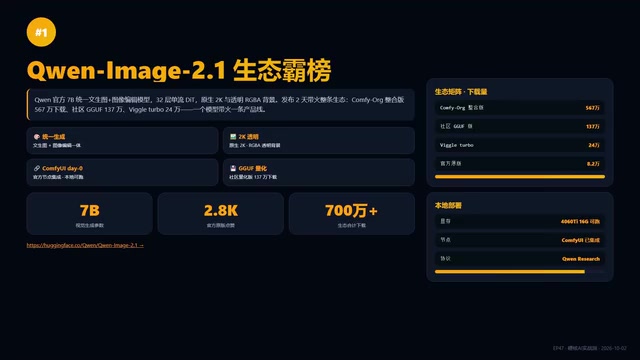
The top tier of the trending list is dominated by the Qwen-Image-2.1 ecosystem. The official release is a 7B-parameter unified model that supports both text-to-image generation and image editing. It uses a 32-layer single-stream DiT architecture with native support for 2K resolution and transparent RGBA background output.
What's truly striking is how fast the ecosystem spread. According to data compiled by Bilibili creator "硬核AI实战派," Comfy Org's integration build racked up 5.67 million downloads in just three days, Vigo's Turbo-accelerated version got 240K downloads, and a community GGUF quantized build added another 1.37 million. Two days after a model's release, it had already sparked a complete product chain — from integration packs and accelerated variants to quantized builds. This is the open-source flywheel effect in action.
The barrier to entry for regular users is also surprisingly low: a 4060Ti with 16GB VRAM is enough for local inference, and ComfyUI had node integration ready on Day 0.
DeepSeek-V4.1-Flash: A KV Cache Revolution Inside a 763B Behemoth
Second on the trending list is DeepSeekAd-V4.1-Flash — a 763B-parameter MoE (Mixture of Experts) model that activates only 8B to 16B parameters per token.
The real headline here isn't the parameter count; it's the KV cache compression technology. By assigning Fall/Reindex/Reuse modes per layer via CSA2 (absorbed attention), combined with an FP4 primary KV cache, the global KV footprint is compressed to just 890 bytes per token — a quarter of the previous generation, and 1/437th of the original DeepSeek.
The model is pretrained on 45 trillion tokens of multimodal data, supports continuously adjustable reasoning intensity from 1 to 100, and is released under the permissive MIT license. In short, it has driven the cost of long-context inference to rock bottom — a significant development for Agent applications that need to process very long documents.
Technical sidebar: The core idea behind MoE (Mixture of Experts) architecture is splitting a model into multiple specialized "expert" sub-networks, activating only a handful per inference pass rather than running the full parameter set. With 763B total parameters but only 8B–16B activated per token, the actual compute cost approximates a mid-sized dense model while retaining the knowledge capacity of a much larger one. KV cache (Key-Value Cache) is another major cost center in Transformer inference: during autoregressive generation, the attention key-value pairs for every generated token must be cached for reuse, and memory consumption grows dramatically with longer contexts and more concurrent requests. CSA2 dynamically assigns different caching strategies (reuse, rebuild, or index reorder) across layers, stacked with FP4 low-precision storage, compressing this overhead to 1/437th of the original DeepSeek. This is an architectural cost revolution on the inference side — not merely an engineering optimization.
LTX-2.5: Video Generation Faster Than Real-Time
Third on the list is LTX-2.5, an open-weight video model from LTX — a company spun out of Lightricks — with 1.58 million downloads and 5,900 likes.
Official demos show it generating a 10-second 720P video from a single image in just 6.8 seconds — faster than the clip itself plays back. It replaces the traditional VAE with a new diffusion video decoder, supports native multi-shot generation, and maintains consistency in character appearance, lighting, and audio across shots. The text encoder has been upgraded to Gemma 4's 2B version, with support for 4K HDR and RAW workflows.
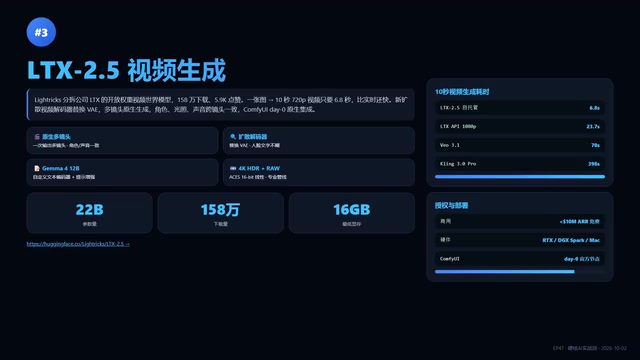
On the licensing front, teams with annual revenue under $10M can use it commercially for free. It requires 16GB VRAM to run, and ComfyUI has Day 0 native integration, making local deployment entirely feasible.
Technical sidebar: Traditional video generation models rely on a VAE (Variational Autoencoder) as a bridge between pixel space and latent space — compressing video into a low-dimensional latent representation, performing diffusion denoising there, then decoding back to pixels. The decode stage is often the speed bottleneck, and temporal consistency depends on implicit constraints in latent space. LTX-2.5 replaces the VAE with a diffusion video decoder, meaning the decoding itself participates in the diffusion process — making motion consistency and detail fidelity explicit optimization targets rather than byproducts. Upgrading the text encoder to Gemma 4's 2B version gives the model stronger semantic understanding and long-text following capability compared to the CLIP or T5 encoders common in earlier video models, directly improving execution precision on complex shot descriptions. The 6.8-second generation time for a 10-second 720P video makes real-time preview of video generation an engineering reality for the first time.
Ternary Quantization and Decision-Oriented Small Models Rise Together
The latter half of the trending list carries several directional signals worth noting.
Bonsai 2: Fitting a 27B Model on a Regular Laptop
PrismML's Ternary Bonsai 2 applies ternary quantization to Qwen3's 27B model, earning 3.87 million downloads. Ternary quantization constrains weights to just three values: -1, 0, and +1 — less than 2 bits per weight. The results are impressive: the language model shrinks from 54GB to 5.9GB, a 9.3× reduction, while the team claims it retains 98.2% of the FP16 model's capability, averaging 84.78 on 14 reasoning benchmarks. On an Apple M5 Max laptop, it runs at 47 tokens/second, with full support for CUDA, Metal, and CPU via llama.cpp.
Technical sidebar: Ternary quantization is a form of extreme low-bit quantization. Standard INT8 quantization uses 8 bits per weight; INT4 uses 4 bits; ternary quantization uses fewer than 2 bits to encode just three states: -1, 0, +1. The theoretical basis: a large proportion of neural network weights are near zero after training converges, and zeroing them out doesn't significantly hurt expressiveness. The remaining positive and negative weights can replace multiplications with additions and subtractions, dramatically reducing hardware compute load. Microsoft's BitNet research is the academic pioneer in this direction; PrismML's Bonsai 2 represents the engineering realization of that work on mainstream open-source models. The 9.3× compression from 54GB to 5.9GB marks a milestone: 27B-scale reasoning capability now fits within the VRAM budget of a consumer laptop — a landmark for edge deployment and offline privacy use cases.
CLEF-27B: A Decision Model That Doesn't Chat
Cloudflare's CLEF-27B multimodal decision model occupies a very specific niche: it doesn't chat, doesn't write code. Instead, it takes a state plus a set of typed multiple-choice options as input, and outputs the probability for each option in a single forward pass — no free-text generation, no output parsing required. It handles text, JSON, images, and video, and is purpose-built for click-style automated decision-making. It's released under Apache 2.0, and Cloudflare also released a lighter 9B CLEF Flash variant.
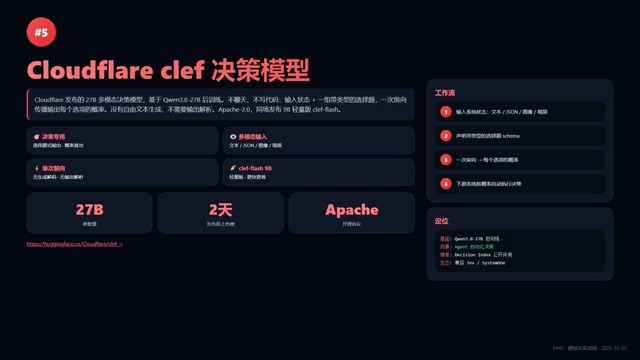
Technical sidebar: CLEF-27B represents a design philosophy of deliberately narrowing the output space. Traditional multimodal LLMs pursue generality with free text as a universal output interface, but this introduces a hidden cost in automated pipelines: you need an extra parsing layer to convert natural language into executable structured instructions, and output determinism is hard to guarantee. CLEF's approach is to abandon free-text generation at the training objective level, directly outputting a probability distribution over discrete options — essentially turning a language model into a high-dimensional classifier. This is structurally similar to a policy network in reinforcement learning: given a state, output action probabilities. The tradeoff is loss of generality; the gain is lower inference latency, outputs that are directly consumable by code, and a simpler deployment stack. Cloudflare's positioning for click-style automated decisions is effectively building a more deterministic "decision primitive" for future Agent workflows.
Vertical Small Models Find Their Niches
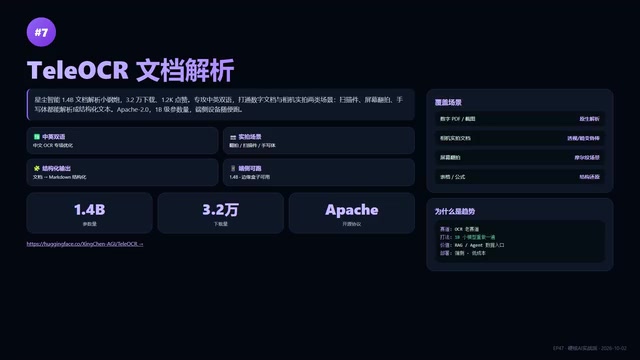
NVIDIA's Nemotron 3 speaker diarization model weighs in at just 99M parameters, supports both streaming and offline inference, handles up to 8 speakers, achieves streaming latency as low as 80ms, and targets meeting transcription, customer service quality inspection, and podcast transcription use cases. Tele-AI's Tele-OCR is a 1.4B-parameter document parsing specialist designed for Chinese-English bilingual documents, covering both digital documents and camera-captured images — it can parse scanned documents, screen photos, and handwritten text into structured output, and runs comfortably on edge devices.
From Parameter Racing to Deployment Racing: Three Clear Trends Emerge
Taken together, this trending list signals a fundamental shift in how open-source AI competes.
Ecosystem velocity determines survival. Two days after Qwen-Image-2.1's release, the ComfyUI integration had 5.67 million downloads and community quantized builds had 1.37 million. One model lit up an entire ecosystem chain. How fast the community responds has become a key variable in whether a model trends.
Efficiency is competitive advantage. DeepSeek compressed KV cache to 890 bytes per token; PrismML compressed a 27B model to 5.9GB. Every time cost drops by one order of magnitude, a new tier of users becomes reachable — falling VRAM requirements and inference costs directly determine how many people can access a model.
Small models solve specific problems. Cloudflare handles decisions, NVIDIA handles diarization, Tele-OCR handles documents. The collective appearance of vertical small models on the trending list signals that open-source competition has moved from "who has the biggest model" to "who can ship in the real world."
With 2 million models competing on the same platform, the ones that break through are rarely the ones with the most parameters — they're the ones with the fastest ecosystems, the lightest deployment footprint, and the most specific problem to solve.
Related articles

Why Does the Tesla Roadster Need to Fly? A Deep Dive into Musk's Wild Demo
Tesla's Roadster launch showed wall-climbing, upside-down driving, and flying stunts—but The Vergecast notes the demo car may lack a battery, the Rocket version is invite-only and not street-legal, and the website terms don't guarantee delivery. After nine years of delays, why does this car still need to exist?

AI Is Not a Replacement: Human-AI Collaboration Through the Lens of Factory Root Cause Analysis
Starting from factory root cause analysis, this article explains how AI accelerates evidence chain construction rather than replacing human experts, exploring the pragmatic implementation logic and business value of 'AI supporting people rather than replacing them.'

AI Agent Decision Auditing: Building an Evidence Chain in Regulated Workflows
Starting from a Reddit discussion, this article analyzes three core issues in AI agent decision auditing within regulated workflows: what fields audit records should contain, how to handle feedback latency for erroneous decisions, and how to continuously calibrate LLM judge consistency with human judgment.