Hidden Risks in Fine-Tuning Data? SimpleLoRIF Uses Gradient Tracing to Safeguard Against Safety Degradation

SimpleLoRIF uses gradient embeddings to filter implicitly risky samples in fine-tuning data, reducing safety attack success rates by up to 22%.
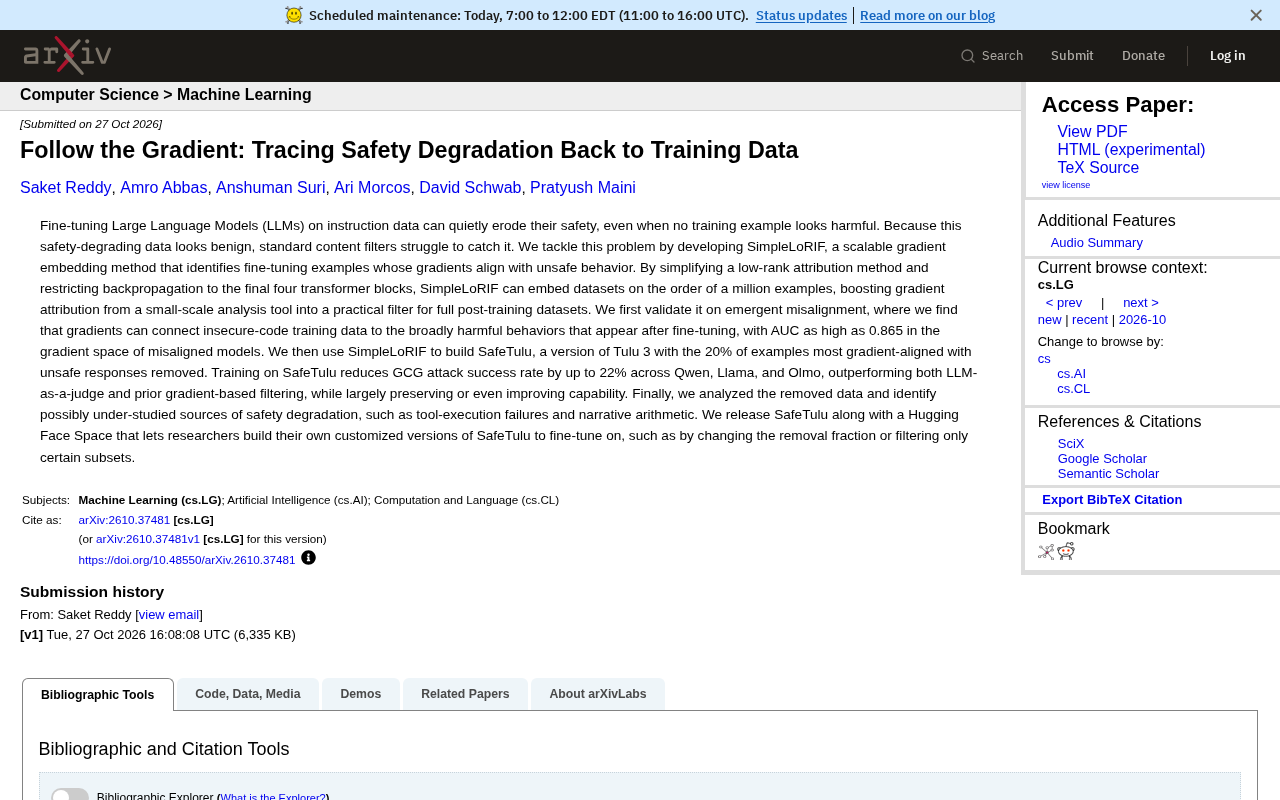
When fine-tuning LLMs, seemingly harmless training data can quietly degrade safety, and standard content filters struggle to detect it. SimpleLoRIF scales gradient attribution to million-level data filters by simplifying low-rank attribution and restricting backpropagation to the last four Transformer blocks. It computes alignment scores between samples and unsafe behavior gradients and builds SafeTulu by removing the 20% most aligned samples from Tulu 3. Across Qwen, Llama, and Olmo, GCG attack success rates drop by up to 22% with model capabilities largely maintained. Removed data also reveals understudied safety degradation sources like tool-execution failures and narrative arithmetic. SafeTulu and a customizable Hugging Face Space are open-sourced.
When fine-tuning large language models (LLMs), even seemingly harmless training samples can quietly erode model safety. Standard content filters struggle to identify these "safety-degrading data" because they appear completely normal. A recent study proposes SimpleLoRIF, which uses gradient embeddings to identify fine-tuning samples aligned with unsafe behaviors, transforming gradient attribution from a lab tool into a practical data filter.
The Stealth of Safety Degradation and the Bottleneck of Gradient Attribution
Fine-tuning LLMs on instruction data is a routine operation to enhance capabilities, but prior research has shown that this fine-tuning can degrade model safety—even when the dataset contains no obviously harmful samples. The problem is that these data are benign at the content level, and standard methods like keyword filtering and toxicity classifiers are ineffective.
Gradient attribution offers a new approach: if the gradient direction of a training sample is highly aligned with the gradient direction of unsafe behaviors (e.g., generating harmful content, refusing to follow safety instructions), then it is likely a culprit in safety degradation. However, traditional gradient attribution is computationally expensive and typically limited to small-scale data analysis, making it inapplicable to full post-training datasets.
Gradient Attribution is a class of gradient-based sample influence analysis methods. The basic idea is that the influence of a training sample on model output can be approximated by the gradient of the loss function with respect to model parameters. Specifically, if a sample's gradient direction is highly aligned with the gradient direction of a target behavior (e.g., generating harmful content), then that sample contributes more to the target behavior during training. Classic methods like TracIn estimate influence by computing the inner product of training sample gradients and test sample gradients, but require separate backpropagation for each sample, with computational complexity growing linearly with data size—making it difficult to apply to million-scale datasets. SimpleLoRIF's simplification directly addresses this bottleneck.
SimpleLoRIF: Scaling Gradient Filtering to Millions of Data Points
SimpleLoRIF's core contribution is engineering simplification and scalability. Researchers simplified a low-rank attribution method and restricted backpropagation to the last four blocks of the Transformer, dramatically reducing computational overhead. This makes gradient embedding feasible for datasets with millions of samples.
In simple terms, SimpleLoRIF upgrades gradient attribution from a "small-scale analysis tool" to a "full-data filter." It computes gradient embeddings for each fine-tuning sample and compares them with the gradient direction of unsafe responses, assigning each sample a "safety alignment score." Higher scores indicate a greater likelihood of inducing unsafe behavior.
Validation 1: From insecure-code to Broadly Harmful Behaviors
The study first validated the method in the "emergent misalignment" scenario. They found that gradients can link unsafe code training data to broadly harmful behaviors that emerge after fine-tuning. In the gradient space of misaligned models, the AUC reached 0.865. This means that even if the training data is merely "insecure code," gradient signals can point to broader safety issues downstream.
Low-Rank Attribution methods assume that the gradient or influence matrix has a low-rank structure, allowing low-dimensional embeddings to approximate the original high-dimensional gradients, greatly reducing storage and computation overhead. LoRIF (Low-Rank Influence Functions) is a representative method that maps gradients to a low-dimensional space via random projections or singular value decomposition, then computes influence scores between samples in that space. SimpleLoRIF further simplifies the LoRIF pipeline and restricts backpropagation to the last four Transformer blocks, because lower-layer parameters mainly encode general language features while higher-layer parameters are more strongly associated with specific behaviors (including safety), so backpropagating only high-layer gradients captures most safety-relevant signals.
SafeTulu: Removing 20% High-Risk Samples Significantly Reduces Attack Success Rate
Based on SimpleLoRIF, researchers built SafeTulu—a version of Tulu 3 with the 20% of samples most aligned with unsafe response gradients removed. Training SafeTulu on three model families—Qwen, Llama, and Olmo—reduced GCG attack success rates by up to 22%.
This result outperforms LLM-as-a-judge and previous gradient filtering methods, while model capabilities are largely maintained or even improved. This indicates that removing high-gradient-aligned samples does not sacrifice general performance and may even benefit from reduced noisy data.
Unexpected Findings in Removed Data
Analyzing the removed samples, researchers identified previously understudied sources of safety degradation, such as tool-execution failures and narrative arithmetic. These patterns appear unrelated to safety on the surface, but gradient signals show they are associated with unsafe behaviors. This suggests that safety data filtering needs to go beyond intuitive content review.
GCG Attack (Greedy Coordinate Gradient Attack) is an adversarial prompt attack method against aligned language models. It uses gradient-guided greedy search to iteratively replace tokens in the input sequence to maximize the probability of the model generating target harmful content. The GCG attack success rate (ASR) is often used as a metric for measuring the robustness of model safety alignment. In SafeTulu's evaluation, a 22% drop in GCG attack success rate means that after removing high-gradient-aligned samples, the model's resistance to such optimization-based adversarial attacks is significantly enhanced—reflecting a more substantive safety improvement than evaluating only static harmful prompts.
Open-Source Tools and Customizable Filtering
The SafeTulu dataset has been made public, along with a Hugging Face Space that allows researchers to build custom versions of SafeTulu, such as adjusting the removal ratio or filtering only specific subsets. This lowers the barrier to safe fine-tuning, enabling more teams to customize filtering strategies based on their own data distributions.
From a methodological perspective, SimpleLoRIF's value lies in bringing the lens of gradient attribution to data governance: not looking at what the data "says," but where the data "pushes the model." For teams building safe LLMs, this provides a scalable complementary tool that forms a multi-layered defense alongside content filtering and red teaming.
As fine-tuning data scales continue to expand, efficiently identifying implicitly risky samples remains an open problem. Whether SimpleLoRIF's simplification strategies—backpropagating only the last few blocks and low-rank approximation—are equally effective on other model architectures, and how strong the causal relationship is between gradient alignment scores and downstream safety metrics, still require more independent validation. But at least it points to a clear direction: clues to safety degradation are hidden in the gradients.
One-line Summary
SimpleLoRIF uses gradient embeddings to filter implicitly risky samples in fine-tuning data, reducing safety attack success rates by up to 22%.
Paragraph Summary
When fine-tuning large language models, seemingly harmless training data can quietly degrade model safety, and standard content filters struggle to identify this. A recent study proposes SimpleLoRIF, which simplifies low-rank attribution and restricts backpropagation to the last four Transformer blocks, scaling gradient attribution from a lab tool to a million-level data filter. It computes alignment scores between each sample and unsafe behavior gradients, and uses them to build SafeTulu—a version of Tulu 3 with the 20% most aligned samples removed. On Qwen, Llama, and Olmo, GCG attack success rates dropped by up to 22% while model capabilities were largely maintained. The removed data also revealed previously understudied sources of safety degradation such as tool-execution failures and narrative arithmetic. SafeTulu and a customizable Hugging Face Space have been open-sourced.
Related articles
Ollama+RAG Local Knowledge Base Setup: A Step-by-Step AnythingLLM Tutorial
Based on a Bilibili tutorial, this guide details building a local RAG knowledge base with Ollama + AnythingLLM: from general LLM knowledge limits and RAG principles to document upload, vector storage, and verification.
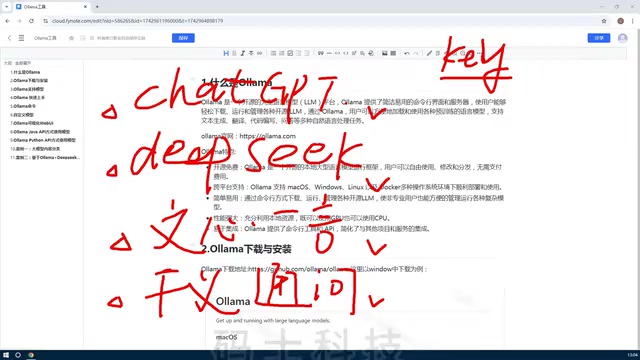
The Ultimate Ollama Tutorial: A Beginner's Guide to Running Large Models Locally for Free
Ollama is an open-source local large model management tool supporting free download and deployment of models like DeepSeek, with command-line and Web UI, cross-platform, automatic GPU/CPU scheduling — ideal for AI beginners and private deployment.
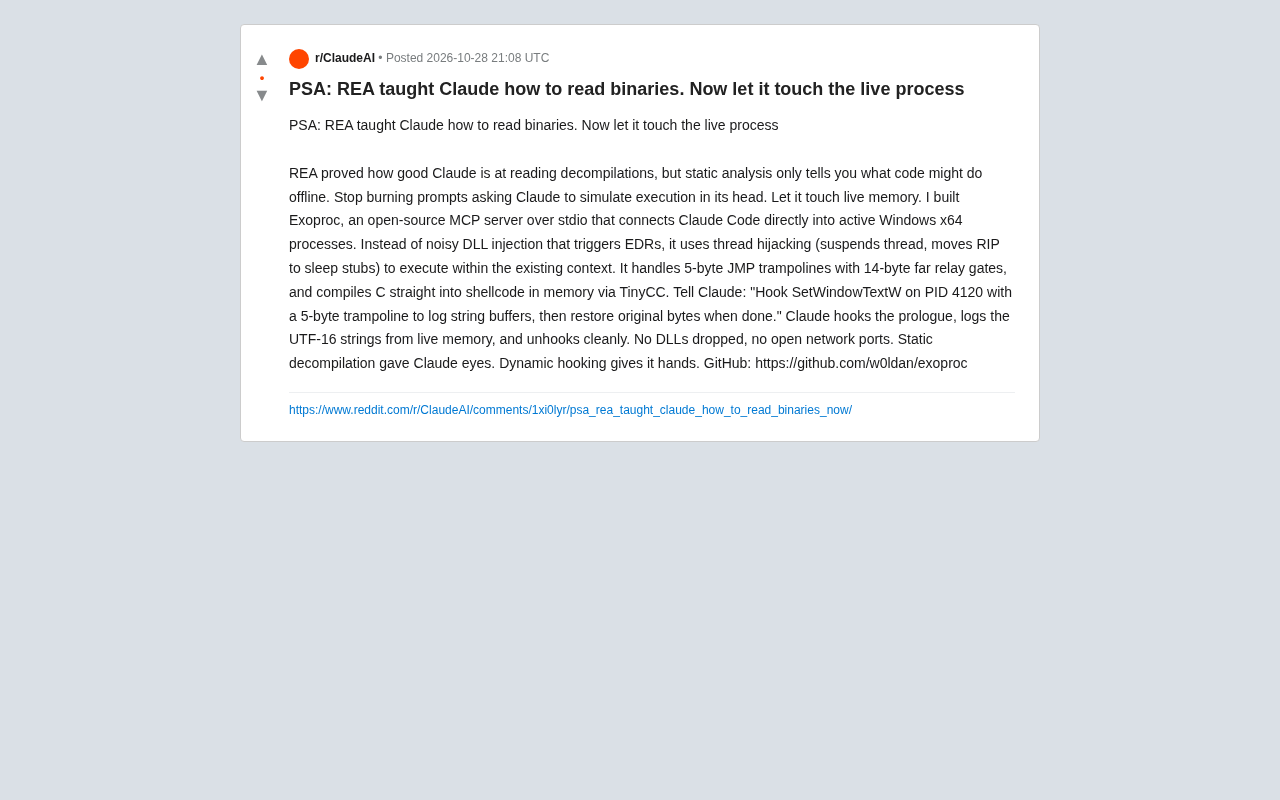
Giving Claude "Hands": Exoproc Open-Source MCP Server Enables Live Process Hooking
Exoproc is an open-source MCP server enabling Claude Code to hook live Windows x64 processes via thread hijacking, bypassing EDR for dynamic analysis. Static decompilation gave Claude eyes; dynamic hooking gives it hands.