Higgsfield MCP + Claude in Practice: Conversational UGC Video Ad Creation End-to-End

Higgsfield's MCP protocol lets users create AI-generated videos entirely through natural language conversations with Claude.
Higgsfield has launched an official MCP connector that enables users to access its full AI video generation capabilities through natural language conversations in Claude Desktop, eliminating the need to navigate complex UIs. The MCP protocol enables intelligent model recommendations, batch content generation, and automated workflows, upgrading UGC ad production from manual operations to an automated pipeline—significantly lowering barriers to entry and boosting creative efficiency, representing the industry trend of professional AI tools migrating toward conversational interaction.
When AI Video Generation Meets MCP Protocol: Say Goodbye to Complex UIs
Higgsfield is a powerful AI video generation platform, but its complex interface has deterred many users. Recently, Higgsfield launched an official MCP (Model Context Protocol) connector that lets users control all of Higgsfield's capabilities directly through the Claude desktop app using natural language conversations—from image generation and thumbnail replacement to complete UGC video ad production—all without switching back and forth in a cumbersome UI.
MCP is an open protocol standard introduced by Anthropic in late 2024, designed to establish a unified communication interface between large language models and external tools and data sources. Before MCP, every AI tool required its own dedicated API integration solution, resulting in high development costs and poor interoperability. MCP's design philosophy is similar to what USB does for hardware devices—providing a standardized "port" that allows any compatible AI assistant to plug-and-play with external services. The protocol uses a client-server architecture where the AI assistant acts as the client initiating requests, external tools act as servers responding and executing, and communication happens via JSON-RPC. MCP has already gained support from major tech companies including Google, Microsoft, and OpenAI, and is becoming an infrastructure-level protocol for the AI Agent ecosystem.
In other words, you can turn Claude into an intelligent creative agent that automatically selects the most suitable generation model, produces content in batches, and maximizes creative efficiency.
Higgsfield MCP Installation & Configuration: Three Steps to Connect
The entire setup process is remarkably simple, requiring virtually no technical background:
Step 1: Open the Claude desktop app, navigate to "Settings" → "Connectors" to view the list of enabled connectors.
Step 2: Add a custom connector, click "Add Custom Connector," paste the MCP connection URL provided by Higgsfield, name it "Higgsfield," then click Add.
Step 3: Authorize the connection, click the "Connect" button, allow Higgsfield to access your account, and refresh the page after completing OAuth authorization. OAuth (Open Authorization) is an industry-standard authorization protocol that allows third-party applications to securely access user resources without obtaining the user's password. Specifically, the Claude desktop app sends an authorization request to Higgsfield, the user confirms authorization on Higgsfield's login page, and then Higgsfield issues a limited-permission Access Token to Claude. This token acts like a "temporary key"—Claude can use it to call Higgsfield's API on behalf of the user, but cannot access the user's account credentials. The token expires after a set period and requires re-authorization, striking a balance between convenience and security.
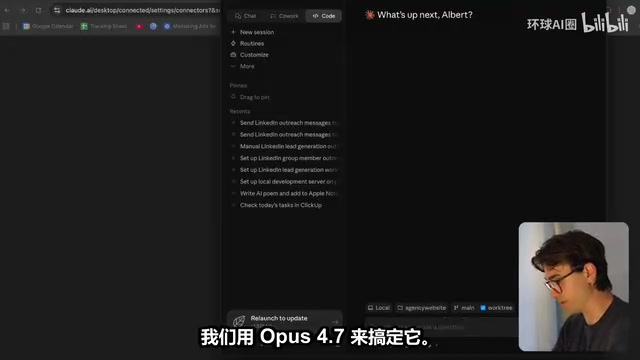
The configuration page displays all tools accessible through Higgsfield MCP. It's recommended to grant full permissions so Claude can access Higgsfield's complete feature set. Once configured, select the Opus 4 model and simply ask "Do you have access to Higgsfield MCP?" A confirmation reply means the connection is successful.
Hands-On Example 1: Quick Thumbnail Replacement via Conversation
With the connection established, let's try thumbnail editing—a common scenario. The traditional workflow requires several manual steps in Higgsfield's UI, but now you only need to:
- Save the original thumbnail and new icon to a local folder
- Tell Claude the file location and replacement requirements
- Claude automatically calls Higgsfield's NanoBanana 2 model to complete the processing

Throughout the process, Claude returns a task ID, and the processed result automatically appears in Higgsfield's workspace. Navigate to Higgsfield's NanoBanana panel to see the generated new thumbnail, saving considerable time on manual operations.
Hands-On Example 2: Creating a Complete UGC Video Ad from Scratch
This is the core highlight of this article—using Claude + Higgsfield MCP to complete the entire workflow for a UGC (User-Generated Content) ad.
UGC advertising is one of the fastest-growing ad formats in digital marketing in recent years. Unlike traditional brand advertising, UGC ads deliberately mimic the shooting style of everyday users—handheld phone footage, natural lighting, conversational language—to lower viewers' psychological defenses and improve ad credibility and conversion rates. According to Stackla's research, 79% of consumers say UGC content significantly influences their purchasing decisions. However, traditional UGC ad production relies on real actors, shooting locations, and post-production editing, with per-video costs typically ranging from hundreds to thousands of dollars. AI video generation technology is disrupting this model, allowing brands to generate virtual characters and scenes via AI, reducing per-UGC-ad production costs to near zero while enabling large-scale creative iteration.
Generating Character Images: MCP Auto-Recommends the Best Model
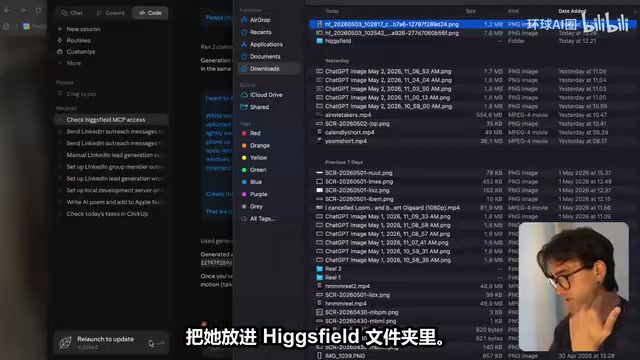
Send Claude the instruction: "Create an image of this woman in mobile phone resolution," along with a reference image. This demonstrates a key advantage of MCP: built-in model recommendation logic.
Higgsfield was founded in 2023 by Alex Mashrabov, a former Snap (Snapchat's parent company) engineer, focusing on AI-driven video generation and editing. The platform integrates multiple specialized models, each with its own strengths: the NanoBanana series specializes in image editing and thumbnail processing, excelling at local element replacement while maintaining overall visual style consistency; the Sol series (such as Sol 2) is deeply optimized for portrait generation, capable of creating highly realistic human figures, particularly suited for virtual character creation in UGC scenarios; and Kling 3.0 is a video generation model developed by Kuaishou, excelling at converting static images into smooth dynamic videos with support for complex character movements and camera motion. Higgsfield's core competitive advantage lies in integrating these models from different sources with different specializations into a unified platform, but this also significantly increases UI complexity—new users can easily become overwhelmed by choice.
MCP encodes Higgsfield team's recommendation logic—for portrait-related tasks, it automatically selects the most suitable Sol 2 model, so users don't need to manually determine which tool to use.
Generating Ad Scripts and Synthesizing Video
Provide Claude with the generated character image and a product photo (such as a hair spray), then send the instruction: "Please combine this character and this product, generate a script, and produce a complete UGC ad."
Claude automatically completes the following tasks:
- Analyzes product features and writes an ad script
- Composites the character with the product in the frame
- Calls the Kling 3.0 model for animation production
- Outputs the final video ad
From copywriting to finished video, the entire process happens within a single conversation window.
Batch Generation and Selection: The True Efficiency Game-Changer
This is the most disruptive capability of the MCP workflow. Video creator Albert Olgaard shared a key insight:
AI content generation is essentially a "numbers game." You might need thirty to fifty generations to get one perfect creative.
This observation reflects a fundamental characteristic of current AI generation models: randomness and unpredictability. Even with identical prompts, AI models produce different results each time because diffusion models introduce random noise sampling during generation. In real-world ad deployment scenarios, this characteristic is both a challenge and an opportunity—single generations rarely hit the mark immediately, but selecting from large batches often reveals creative directions that exceed expectations. This aligns closely with traditional advertising's A/B testing logic: Facebook and TikTok advertising best practices typically recommend running 5-10 different creative versions simultaneously, using data feedback to identify top performers.
In the traditional approach, you'd need to repeatedly perform manual operations in Higgsfield's UI—extremely inefficient. With Claude MCP, you can request 30 versions at once, then pick the ones you're most satisfied with. This batch capability improves creative efficiency by an order of magnitude, upgrading from "manual one-by-one production" to "one-click batch generation."
Three Layers of Value MCP Connectors Bring to AI Video Creation
From the hands-on examples above, we can extract the core value delivered by MCP connectors:
Lowering the Barrier to Professional Tools
Complex UIs are no longer obstacles. Users simply describe their needs in natural language, and Claude serves as a middle layer that automatically handles tool invocation, parameter configuration, and model selection—enabling complete beginners to produce professional-level videos. This shift in interaction paradigm means that creators' core competitiveness is moving from "tool proficiency" to "precisely articulating creative intent."
Intelligent Model Routing
The Higgsfield team has encoded years of accumulated expertise into MCP, enabling AI to automatically recommend the best model based on task type—Sol 2 for portraits, Kling 3.0 for animation—completely solving the pain point of "too many tools, don't know which to choose." This approach of "codifying expert knowledge" essentially transforms platform usage experience into structured rules that AI can understand and execute, giving every user access to expert-level tool selection strategies.
Batch Production Capability
Upgrading AI video generation from "single manual operations" to a "batch automated pipeline" is especially valuable for ad deployment and social media marketing scenarios that require extensive creative iteration.
Conclusion: From Operating Tools to Directing AI to Operate Tools
Higgsfield MCP's launch represents a clear industry trend: professional AI tools are migrating toward conversational interaction via the MCP protocol. Users no longer need to learn each tool's unique interface—instead, they orchestrate all capabilities through a unified AI assistant.
This isn't unique to Higgsfield; it's a structural trend across the entire AI tool ecosystem. Adobe has deeply integrated natural language interaction into Photoshop and Premiere Pro; Figma has launched an AI-powered design assistant; and Canva's Magic Studio is replacing traditional drag-and-drop with conversation. Two underlying forces drive this trend: first, large language models' reasoning capabilities are now sufficient to understand complex creative intent and decompose it into specific tool invocation sequences; second, standardized protocols like MCP have dramatically reduced the development cost of connecting tools to AI assistants. Gartner predicts that by 2028, over 50% of professional software will offer conversational interaction as one of its primary operation modes.
For video creators and marketing professionals, this isn't just a tool efficiency upgrade—it's a fundamental shift in workflow paradigm, evolving from "humans operating tools" to "humans directing AI to operate tools." Future creative competitiveness will increasingly depend on "the ability to describe requirements" rather than "proficiency in operating tools."
If you're using Higgsfield or similar AI video generation platforms, I strongly recommend trying the MCP connection method. Setup takes just a few minutes, but the efficiency gains could be several times or even tens of times greater.
Related articles
 Tutorials
ChatGPT Plus Subscription Guide: Are GPT-5.5, image-2, and Codex Worth the Upgrade?
A detailed look at ChatGPT Plus features — GPT-5.5, image-2, and Codex — with a Plus vs Pro comparison and a complete step-by-step subscription guide for users outside the US.
 Tutorials
Harness AI Engineering in Practice: Using Claude Code to Master Enterprise-Level E-Commerce Development
Deep dive into Harness AI Engineering: master enterprise e-commerce development with Claude Code using the Rules, Skills, Wiki, and Changes framework.
 Tutorials
Cursor + Codex Dual-IDE Collaboration: A Practical Methodology for Open-Source Project Customization
A complete methodology for open-source project customization based on real-world experience, detailing the Cursor+Codex dual-IDE workflow, seven-stage process, MVP validation, and AI source code reading techniques.