High-Scoring Code Models Don't Boost Real Output: Lessons from a Natural Experiment

A natural experiment shows that benchmark score gains for AI coding models do not translate into real productivity.
A natural experiment examined the relationship between AI coding model benchmark scores and real productivity. Using the 19-day ban on Claude Fable 5, the study tracked 297 developers forced to switch models against 8,908 developers consistently using Opus 4.8, employing difference-in-differences. Despite Fable 5 scoring 11 points higher on SWE-Bench Pro, users' 7-day PR merge rate rose only 1.4 percentage points (not significant); the weighted average effect of five upgrades was -0.9 points, also insignificant. Benchmarks focus on isolated tasks, while real development involves requirements, review, and collaboration—model advantages may be diluted. Teams should prioritize workflow fit, and the industry needs more realistic evaluation systems.
The Gap Between Benchmark Scores and Real Productivity
AI coding models typically advertise their capabilities through benchmark score improvements. But a fundamental question has remained unresolved: do models that score higher on benchmarks actually help developers accomplish more real work? A study based on a natural experiment delivers a surprising answer — there is no significant positive correlation between benchmark scores and real-world output.
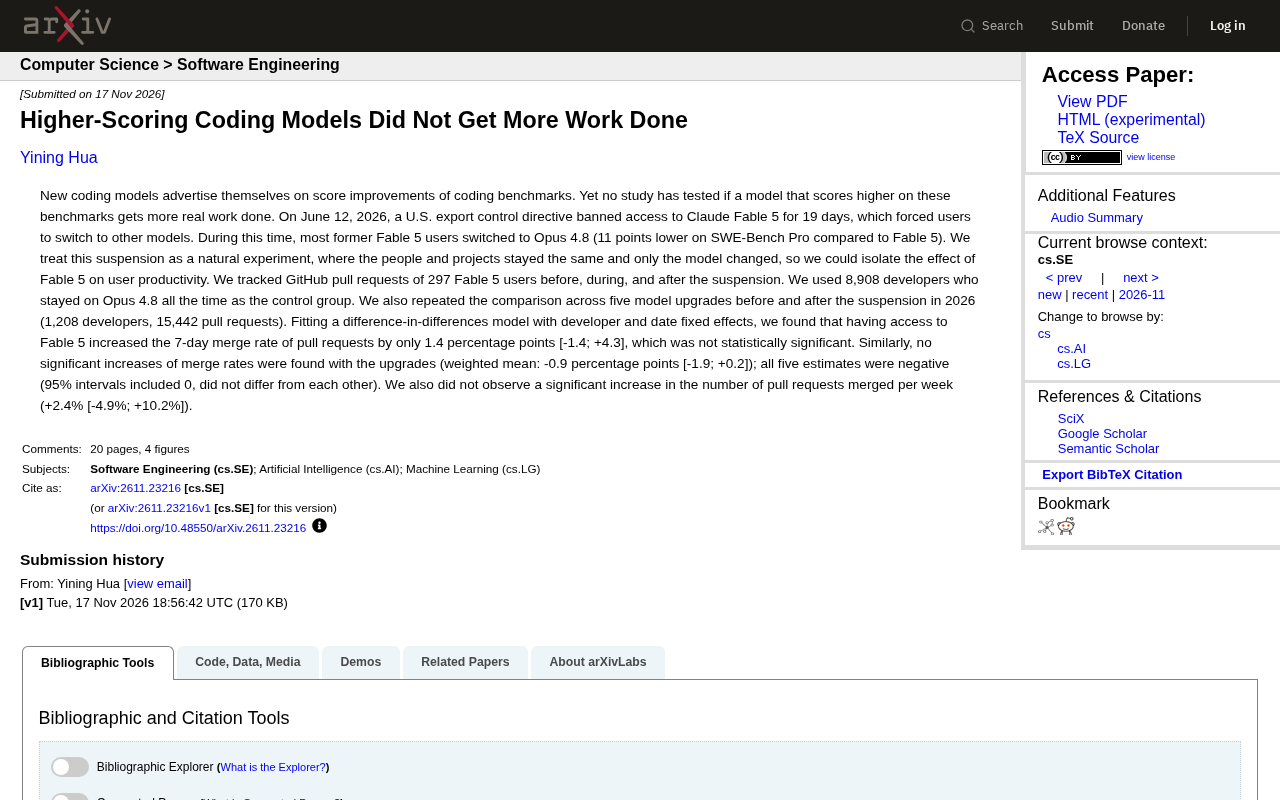
The study exploited the 19-day ban on Claude Fable 5 triggered by a US export control directive on June 12, 2026, treating users' forced model switch as a natural experiment. During this period, most former Fable 5 users migrated to Opus 4.8 — which scores 11 points lower than Fable 5 on SWE-Bench Pro. This provided researchers with an ideal scenario: the people and projects stayed the same, and the only variable was the model itself.
Study Design: Testing Model Value with Real Data
To isolate the impact of model switching on productivity, researchers tracked the GitHub pull request (PR) performance of 297 Fable 5 users across three phases: before, during, and after the ban. They also used 8,908 developers who consistently used Opus 4.8 as a control group and built a difference-in-differences model controlling for developer and date fixed effects.
The study was further extended to five model upgrades that occurred around the 2026 ban, covering 1,208 developers and 15,442 PRs. This multi-source cross-validation design strengthens the robustness of the conclusions — whether viewed through the forced switch during the ban window or the voluntary switches during routine upgrades, the data point to similar conclusions.
Difference-in-Differences (DiD) is a quasi-experimental method commonly used in causal inference. Its core idea is to identify causal effects by comparing the change differences between a "treatment group" and a "control group" before and after an intervention. In this study, the treatment group consists of developers who originally used Fable 5 and were forced to switch models due to the ban, while the control group consists of developers who consistently used Opus 4.8. The key assumption of DiD is that, absent the ban, the trends in PR merge rates for both groups would be parallel (the parallel trends assumption). Through two differences — first calculating the before-and-after change within each group, then comparing the difference between the two groups' changes — researchers can remove time-invariant individual differences and common time shocks (such as seasonal fluctuations or platform updates), thereby more cleanly estimating the net effect of model switching. The study also included developer fixed effects and date fixed effects to further control for individual heterogeneity and global time trends.
Key Finding: Merge Rate Improvement Is Marginal and Insignificant
The study's most critical quantitative result comes from the 7-day PR merge rate. Developers with access to Fable 5 saw their PR merge rate increase by only 1.4 percentage points, with a confidence interval of [-1.4; +4.3], which is statistically insignificant. In other words, even though the model scored 11 points higher on SWE-Bench Pro, this did not translate into observable improvements in merge efficiency.
Data from the five model upgrades was equally disappointing: the weighted average effect was -0.9 percentage points [-1.9; +0.2], with all five estimates negative and all 95% confidence intervals containing 0. Researchers also found that the number of PRs merged per week increased by only 2.4% [-4.9%; +10.2%], also insignificant. Together, these results paint a picture: progress in benchmark scores did not produce measurable returns in actual workflows.
Confidence intervals and statistical significance are key to interpreting this study's conclusions. The repeated appearance of "confidence interval contains 0" means that, at the 95% confidence level, the observed effect could be positive, negative, or zero — the data cannot rule out the null hypothesis that "model switching has no effect." Taking the PR merge rate as an example, the point estimate of 1.4 percentage points appears positive, but the interval [-1.4; +4.3] crosses zero, indicating that this improvement could entirely be due to random fluctuation. Similarly, the weighted average effect of the five upgrades, -0.9 percentage points [-1.9; +0.2], is entirely negative, but the interval also contains zero. Statistical insignificance does not equal "proof of no effect"; rather, it means "the existing sample size is insufficient to confirm a stable effect" — especially when the true effect itself is small, a larger sample or longer observation period would be needed to detect it.
Why Do Benchmarks and Real Output Diverge?
This finding challenges the industry's default assumption — that higher benchmark scores mean a more useful model. A possible explanation is that benchmarks typically focus on isolated task-completion ability, whereas real development work involves requirement understanding, code review, team collaboration, deployment processes, and many other stages. A model's advantage on a single task may be diluted or even offset by these complex stages.
Moreover, the developers in the study remained in the same project environment throughout, and the learning costs and toolchain adjustments brought about by model switching may also have eroded potential gains. The researchers' multi-source validation shows that this divergence is not accidental — whether through forced switching or voluntary upgrades, no significant efficiency leap occurred.
SWE-Bench Pro is a benchmark for evaluating AI coding models' ability to solve real GitHub software engineering problems. Its tasks typically come from real issues and corresponding PRs in open-source repositories, requiring the model to generate patches that pass tests. It measures a model's ability to independently complete code fixes under controlled conditions and against clear task descriptions. However, the real development workflow goes far beyond "generating a patch that passes tests": developers need to understand ambiguous requirements, discuss solutions with colleagues, write maintainable code, pass code review, and handle CI/CD pipelines and deployment risks. Benchmarks strip away these contextual and collaborative elements, so a high score only indicates a model's "problem-solving ability" on a specific task and cannot be directly extrapolated to "increasing a team's delivery speed." This is one of the mechanistic reasons why benchmark scores and productivity diverge.
Implications for Developers and Tool Selection
This study raises profound questions about how AI coding tools are evaluated. For development teams, model selection should not focus solely on benchmark leaderboards but should consider how well a model fits their own workflows. For model providers, there is a need to rethink how "productivity improvement" is defined and measured — perhaps requiring evaluation systems that are closer to real development scenarios.
The researchers also acknowledged limitations: the sample comes mainly from a specific user group and specific models, and the generalizability of the conclusions still requires validation by more independent studies. Regardless, this natural experiment provides an important warning: in the field of AI coding, there may be a gap between benchmark scores and real value that has not yet been fully recognized.
A natural experiment refers to a situation in which researchers cannot actively randomize treatment, but an external event (such as a policy change, ban, or platform outage) happens to create treatment assignment that is approximately random, allowing it to be used for causal inference. In this study, the export control directive led to the ban on Fable 5, forcing users to switch models. This exogenous shock was unrelated to developers' own abilities or project choices, and thus approximated random assignment. The advantage of natural experiments is high external validity — they occur in real work settings rather than laboratories. But the limitations are also obvious: treatment assignment is not truly random, selection bias may exist (such as which users originally used Fable 5), and researchers cannot control the timing or intensity of the intervention. Therefore, conclusions from natural experiments usually require cross-validation with multiple sources of evidence, which also explains why the study was extended to data from five model upgrades.
One-line Summary
A natural experiment shows that benchmark score gains for AI coding models do not translate into real productivity.
Paragraph Summary
A study based on a natural experiment examined the relationship between AI coding model benchmark scores and real productivity. Using the 19-day ban on Claude Fable 5, the study tracked 297 developers forced to switch models and used 8,908 developers who consistently used Opus 4.8 as a control, employing a difference-in-differences model to control for individual and time fixed effects. The results show that although Fable 5 scored 11 points higher on SWE-Bench Pro, its users' 7-day PR merge rate increased by only 1.4 percentage points, with a confidence interval crossing zero, statistically insignificant; the weighted average effect of five model upgrades was -0.9 percentage points, also insignificant. The study argues that benchmarks focus on isolated tasks, while real development involves requirement understanding, code review, and team collaboration, so model advantages may be diluted by complex workflows. This suggests that teams should focus on workflow fit when selecting tools, and the industry needs evaluation systems closer to real scenarios.
Related articles

Jensen Huang Returns to Nvidia: The Power Game Behind an "Aggro Reset"
Nvidia's board reappointed Jensen Huang as CEO less than two weeks after his scandal-driven resignation. This analysis explores the board's decision-making, Trump's political intervention, media power failure, and market reaction behind the dramatic return.

Why Voice AI Can't Understand Kenyans' Everyday Conversations
Swahili speech recognition hits 3.24% error on read text, but everyday Kenyan speech mixes English, Sheng slang, and accents—leaving mainstream voice AI struggling.

Data Centers Build Their Own Natural Gas Plants: AI Compute's Breakout Around a Decade-Long Grid Wait
Grid interconnection approvals can take a decade, so xAI and others are building off-grid natural gas plants to power AI clusters. This article analyzes the drivers, costs, and impact of behind-the-meter generation on AI infrastructure.