High-Speed Video Reveals the Mechanical Secrets of How a Bee's Stinger Injects Venom

High-speed video reveals that a bee's stinger uses a three-stage peristaltic valve pump to inject venom and can operate autonomously after detachment, offering new ideas for biomimetic micropumps.
This article presents a new discovery from research using high-speed video technology to study the pumping mechanism of a bee's stinger. The study shows that the stinger does not rely on simple squeezing, but instead uses a three-stage peristaltic valve system controlled by independent muscle groups to continuously inject venom in a wave-like propulsion manner, at frequencies of up to several times per second. More critically, the stinger can continue pumping venom autonomously after detaching from the abdomen, explaining why the stinger must be removed as quickly as possible after a sting. From an engineering perspective, this micropump structure is compact, energy-efficient, and nearly backflow-free, providing new design inspiration for biomimetic applications such as insulin sustained-release patches, microfluidic chips, and targeted drug delivery. The research also speculates that hymenopteran insects such as wasps and ants may have similar mechanisms, and demonstrates the enormous potential of high-speed videography in biomechanics research.
An Overlooked Micro-Mechanical Marvel
When a bee stings, most people's first reaction is pain and quickly pulling out the stinger. But few stop to ask: how does that stinger—just 2 millimeters thick—manage to inject venom into the skin in such a short time? Recently, a study using high-speed video technology has, for the first time, clearly revealed the intricate pumping mechanism inside a bee's stinger. This discovery not only refreshes our understanding of insect micro-anatomy but also provides biomimetic inspiration for the design of micro-injection devices.
The traditional view holds that a bee's stinger simply relies on muscle contraction to "squeeze" venom out. But high-speed video shows the reality is far more complex. The interior of the stinger is not a simple tubular structure, but rather consists of multiple independently moving valves and chambers that can push venom forward stage by stage in a wave-like peristaltic motion. This process resembles the beating of a human heart, just scaled down to the microscopic level.
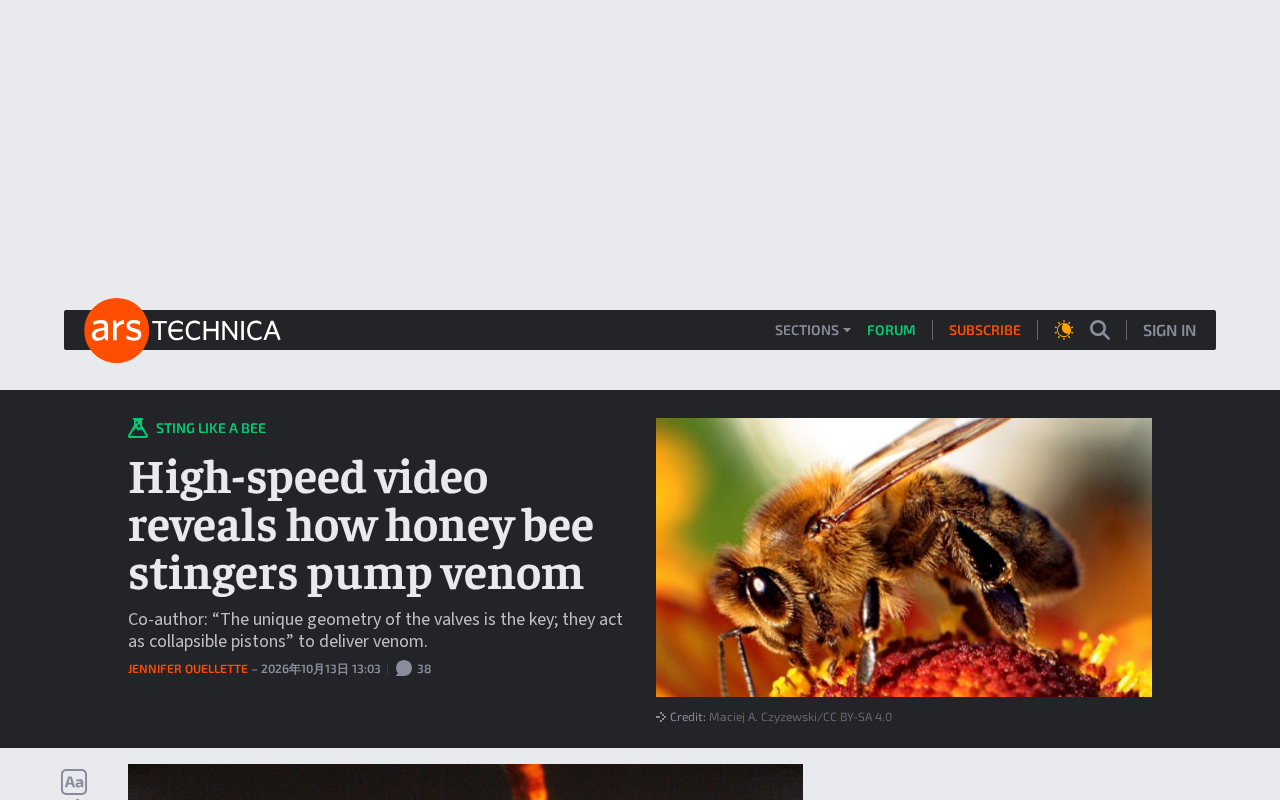
How the Stinger Becomes a Miniature Venom Pump
Three-Stage Peristaltic Propulsion Mechanism
Using high-speed cameras capturing thousands of frames per second, the research team tracked the complete path of venom from the venom sac to the stinger tip. They found that venom injection occurs in three distinct stages: first, the basal chamber contracts, pushing venom into the middle section; then, the middle valve closes and contracts, sending venom toward the tip; finally, the tip valve opens, and venom is injected into the target under pressure. These three stages cycle repeatedly, at a frequency of up to several times per second.
The key finding is that the valve opening and closing and chamber contraction at each stage are controlled by independent muscle groups, rather than being driven uniformly. This means the stinger can achieve continuous, stable venom output without relying on a single burst of overall muscle activity. This distributed drive strategy allows the bee to continue pumping venom after stinging, even after the stinger has detached from the abdomen.
Peristaltic pump principle: The working mechanism of a bee's stinger is highly similar to the peristaltic pump commonly used in industry. A peristaltic pump sequentially squeezes a section of flexible tubing, causing the fluid inside to be pushed forward segment by segment, rather than relying on impellers or pistons. Its greatest advantage is that the fluid only contacts the tubing, not the mechanical parts of the pump body directly, resulting in good sealing, low contamination risk, and precise metering. In organisms, the digestive tract (such as intestinal peristalsis) also uses the same strategy to propel chyme. The bee's stinger miniaturizes this principle to a 2-millimeter scale, replacing external rollers with distributed muscles and tubing squeeze points with flexible valves, thereby achieving unidirectional, backflow-free continuous pumping within an extremely small space—precisely the combination of performance characteristics that current artificial micropumps struggle to achieve simultaneously.
Why the Stinger Keeps "Working"
When a bee stings a mammal, the barbed stinger remains in the skin, pulled out along with the venom sac and some neuromuscular tissue. This was previously thought to be the bee's "suicidal attack," but high-speed video shows that the detached stinger can still autonomously complete pumping motions, continuously injecting venom into the wound. This explains why it is so important to quickly remove the stinger after being stung—every extra second it remains means more venom is pumped into the body.
From an engineering perspective, this micropump that can operate independently after detachment far exceeds most current artificial micropumps in energy efficiency and structural compactness. The research team points out that the stinger's pumping efficiency is extremely high, with almost no backflow, thanks to the precise timing coordination between valves and chambers.
Anatomical basis of the hymenopteran stinger: A bee's stinger is not a simple hollow needle, but a composite structure evolved from an ovipositor, typically comprising a stylet and sheath, with a venom channel formed inside. The venom sac connects at the base of the stinger, with nerve and muscle tissue attached around it. When the stinger detaches from the abdomen, these muscles and ganglia can still maintain autonomous rhythmic contraction for a short time, driving valve opening and closing. This is similar to the principle that a cockroach's legs can still move after decapitation, or an octopus tentacle can still grasp after being severed—the peripheral nervous system of insects has a certain degree of local autonomy. It is precisely for this reason that the detached stinger is not passively leaking but actively pumping, which is also the biological basis for 'quickly removing the stinger' becoming a first-aid consensus.
From Insect Anatomy to Biomimetic Applications
The significance of this research goes beyond satisfying curiosity. Micropumps have broad demand in the medical field, such as insulin sustained-release patches, microfluidic chips, and targeted drug delivery systems. Current artificial micropumps often face problems such as poor sealing, high energy consumption, and complex structures. The bee stinger's solution—using flexible valves and distributed muscles to achieve unidirectional, efficient fluid propulsion—provides a completely new design approach.
One detail worth noting: the stinger's pumping mechanism is not unique to bees. The researchers speculate that other hymenopteran insects such as wasps and ants may have evolved similar micropump structures, though with different details. This opens up new interdisciplinary directions for comparative biology and biomimetic engineering.
Microfluidics and micropump technology background: Microfluidic chips are technologies that manipulate microliter or even nanoliter fluids on centimeter- or millimeter-scale chips, widely used in point-of-care diagnostics, DNA analysis, and drug screening. One of its core challenges is how to achieve stable, low-energy, pulsation-free fluid actuation at microscopic scales. Existing micropumps are mainly divided into mechanical types (such as piezoelectric diaphragm pumps and pneumatic pumps) and non-mechanical types (such as electroosmotic pumps and capillary pumps), but they generally suffer from sealing leaks, backflow, high drive voltages, or complex structures. The bee stinger's flexible valve + distributed muscle approach precisely addresses these pain points with biomimetic reference: using passive valves to ensure unidirectionality, using local actuation to reduce overall energy consumption, and using flexible materials to adapt to microscopic scales. This approach has attracted attention in the biomimetic engineering field and may in the future drive iterations of devices such as insulin patches and implantable drug delivery devices.
Reunderstanding the Bee's Defense Strategy
Another insight from the high-speed video is a reexamination of bee defensive behavior. The stinger's continuous pumping capability means that a bee's attack is not a one-time "injection" but a continuous "infusion" process lasting several seconds. This has practical significance for beekeepers and people with allergies: quickly removing the stinger remains the key step in reducing reactions.
At the same time, this technology also demonstrates the enormous potential of high-speed videography in biomechanics research. Many microscopic-scale biological processes—from insect feeding to cell division—occur within milliseconds and cannot be captured by the naked eye or conventional cameras. As the cost of high-speed camera equipment decreases and resolution improves, it is expected that similar precision mechanical structures will be discovered in more species in the future.
The pumping mechanism of a bee's stinger reminds us: nature's micro-engineering solutions are often simpler and more efficient than human-designed ones. Understanding these solutions not only satisfies scientific curiosity but may also give rise to the next generation of microfluidic devices.
Related articles

A Single Prompt Triggers a Global PHP Security Storm: Is AI a Savior or a Hidden Risk?
A single AI prompt triggered a global PHP security crisis affecting Wikipedia and the Internet Archive. This article reviews the incident, analyzes the OpenAI-Amazon controversy, and explores the security paradox of lowered vulnerability discovery barriers in the AI era and developer response strategies.

When AI Is Taken Away: How Reliance on Shortcuts Undermines Your Problem-Solving Resilience
A study of 1,222 people found that after using AI to answer questions, once AI was removed, people gave up on more problems than a control group that never used AI. The article analyzes the impact of AI reliance on learning resilience and metacognition, and explores design implications for AI learning tools.

Carta and NewView Partner to Let Startup Employees Cash Out Equity Early
Carta and NewView Capital partner to simplify startup tender offers, helping employees sell equity early. Analysis of the mechanism, liquidity pain points, and impact.