Hinge Tests Lower-Priced Subscription: A Breakout Attempt Amid Dating App Payment Fatigue

Hinge tests a lower-priced subscription to respond to dating app payment fatigue and probe new boundaries of the subscription model.
Hinge is testing a lower-priced subscription plan against the backdrop of growing user fatigue with dating apps' "free to use + pay to unlock" model. The low-price subscription targets two groups: hesitant users who stay in the free tier because price doesn't match perceived value, and fatigued users tired of repeated payments. The core logic is to lower the barrier to payment decisions and expand the paying user base. This move reflects a deeper industry dilemma: slowing user growth and stronger resistance to paywalls are narrowing the room for simply raising prices or adding payment points. Whether the low-price strategy works depends on whether higher conversion rates can offset lower unit prices, and whether low-price users can generate secondary payments through value-added features. For users, this is a positive signal, but a test does not equal a full rollout, and the feature trade-offs of the low-price tier remain to be seen.
Dating apps are going through a trust crisis. As users grow increasingly weary of "paying for love," Hinge has chosen a seemingly counterintuitive path—testing a cheaper subscription plan.
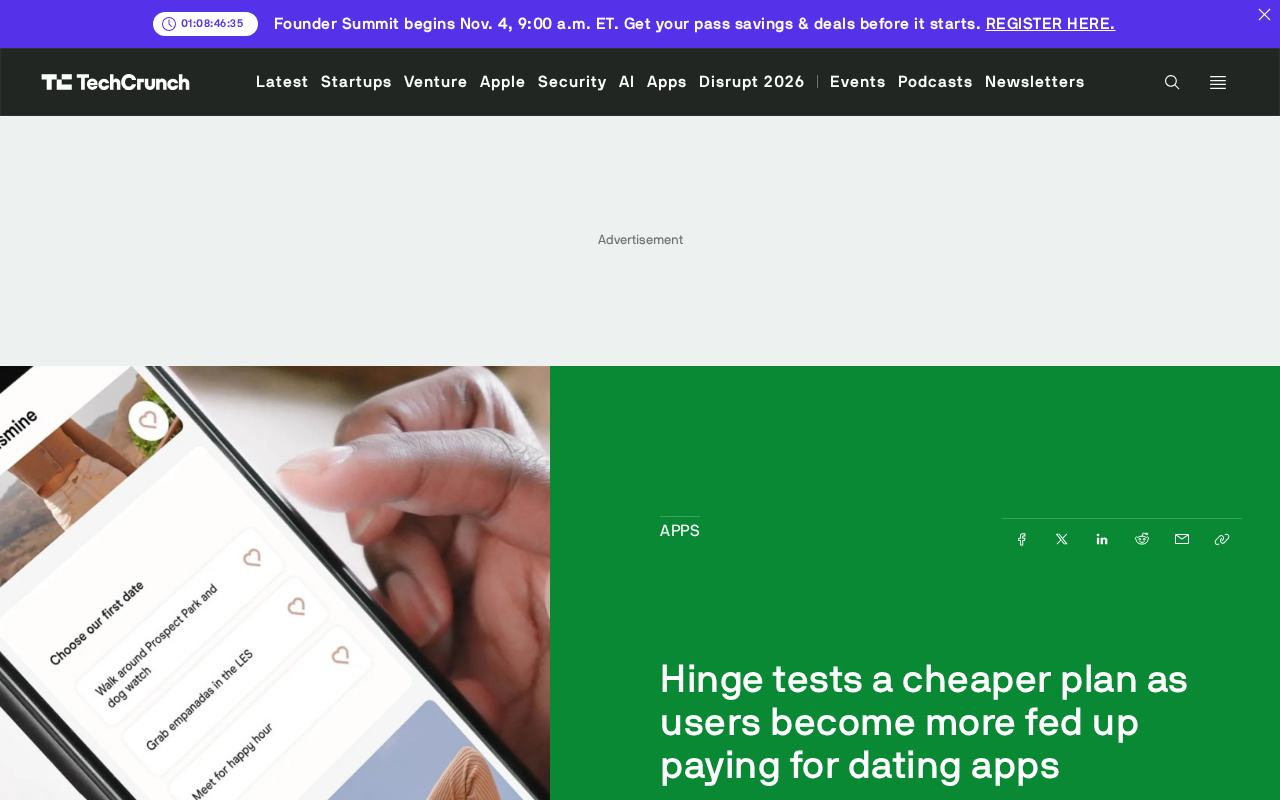
Payment Fatigue: A Shared Predicament for Dating Apps
According to foreign media reports, Hinge is testing a lower-priced subscription plan. The context behind this move is straightforward: people are becoming increasingly impatient with dating apps' payment models.
This judgment is not isolated. In recent years, mainstream dating apps have widely adopted a "free to use + pay to unlock" model, placing features like "who viewed me," "more likes," and "super likes" behind a subscription wall. Users already expend attention costs searching for matches, and layering on continuous payments creates an understandable psychological gap. Hinge's test of a low-price option is essentially a response to this sentiment—rather than continuing to squeeze core users willing to pay, it's better to lower the barrier and draw in the onlookers.
"Freemium" is the business model commonly adopted by dating apps: basic features are open for free to maximize user scale, while value-added features related to matching efficiency (such as seeing who liked you, unlimited swipes, and exposure boosts) are placed behind a subscription wall. The key to this model lies in the tight coupling between "payment points" and "core experience"—the more eager users are to obtain match results, the more easily they convert into paying users. But the side effects are also obvious: when the free-tier experience is deliberately weakened to drive payments, users easily feel "held hostage," which is precisely the structural cause of payment fatigue. Hinge's test of a lower-priced subscription can be understood as adjusting the height of the paywall within the freemium framework, rather than abandoning the subscription model itself.
What a Low-Price Strategy Can Solve
From a product logic perspective, a lower-priced subscription can at least activate two types of people.
The first type is the "hesitant user." They have a need for the platform but feel the existing subscription price doesn't match their perceived value, so they remain in the free tier long-term. A lower price point can significantly reduce decision costs and convert some marginal users into paying users.
The second type is the "fatigued user." They are already tired of repeatedly paying for dating apps, and a low-price plan at least sends a signal: the platform is willing to make concessions on pricing. This gesture itself helps retain users.
Low price does not equal low value. The key is whether the platform can still provide sufficiently clear reasons to pay at a lower price point, rather than simply moving free features into the low-price tier.
"Conversion rate" and "ARPU" (average revenue per user) are two core metrics for measuring the health of a subscription model, and the two often trade off against each other. Raising prices can lift ARPU but depress conversion rate, while lowering prices does the opposite. The bet behind low-price subscriptions is that the expansion of the paying user base brought by higher conversion rates can offset the ARPU loss caused by lower unit prices, thereby driving up total revenue. The premise for this logic to hold is sufficiently high price elasticity—that is, there exists a large pool of potential paying users who are "price-sensitive but have real demand." The user structure of dating apps is usually pyramid-shaped, with a large free tier and a narrow paying tier, so theoretical room for a low-price tier does indeed exist, but whether it can cover the added operational and payment costs still needs to be verified with real data.
The Dating App Business Model Is Being Reexamined
Viewed against the broader industry backdrop, Hinge's test points to a more fundamental question: how far can the subscription model of dating apps go?
For a long time, leading dating apps have relied on subscription revenue and one-time paid features (such as exposure boosts) for monetization. But as user growth slows and resistance to paywalls strengthens, the room for simply raising prices or adding payment points is narrowing. A low-price subscription is a compromise: sacrificing per-user revenue in exchange for expanding the paying user base and improving retention.
Whether this path can succeed depends on two variables. First, whether the conversion rate can rise enough to make up for the drop in unit price; second, whether low-price users can generate secondary payments through value-added features later on. Hinge is currently only testing, and the results remain to be seen, but the direction itself already shows that the industry is recalculating the question of "how much users are willing to pay for dating."
What It Means for Users
For ordinary users, the test of a lower-priced subscription is a positive signal. It means the platform is beginning to face up to payment fatigue, rather than continuing to use feature tiers to push users into upgrading.
But users should also stay clear-eyed: a test does not equal a full rollout, and the low-price tier is likely to involve trade-offs in features. What users really need to pay attention to is which benefits correspond to the lower price, and whether those benefits actually cover their core usage scenarios.
The core contradiction of dating apps has never been price itself, but whether users can obtain match results through them. Price adjustments are only a means; product experience is the foundation for retaining users. Hinge's test this time is worth adding to the watchlist.
Related articles

VERS: Editing Activation Explanations to Halve Reasoning Model Tokens
VERS guides reasoning models by editing activation explanations, cutting 45.8% of tokens on GSM8K with only a 0.82 pp accuracy drop and transferring to larger models, but losing accuracy on competition problems.

Finding Errors Is Not Enough: Selective Model Escalation for Entity-Targeted Sentiment Analysis
This study explores selective model escalation for entity-targeted sentiment analysis, comparing data collection ordering, uncertainty-driven re-examination, and model routing—finding that minority-class priority only helps at very small data volumes, the oracle upper bound far exceeds actual gains, and escalation must be tailored to each dataset.
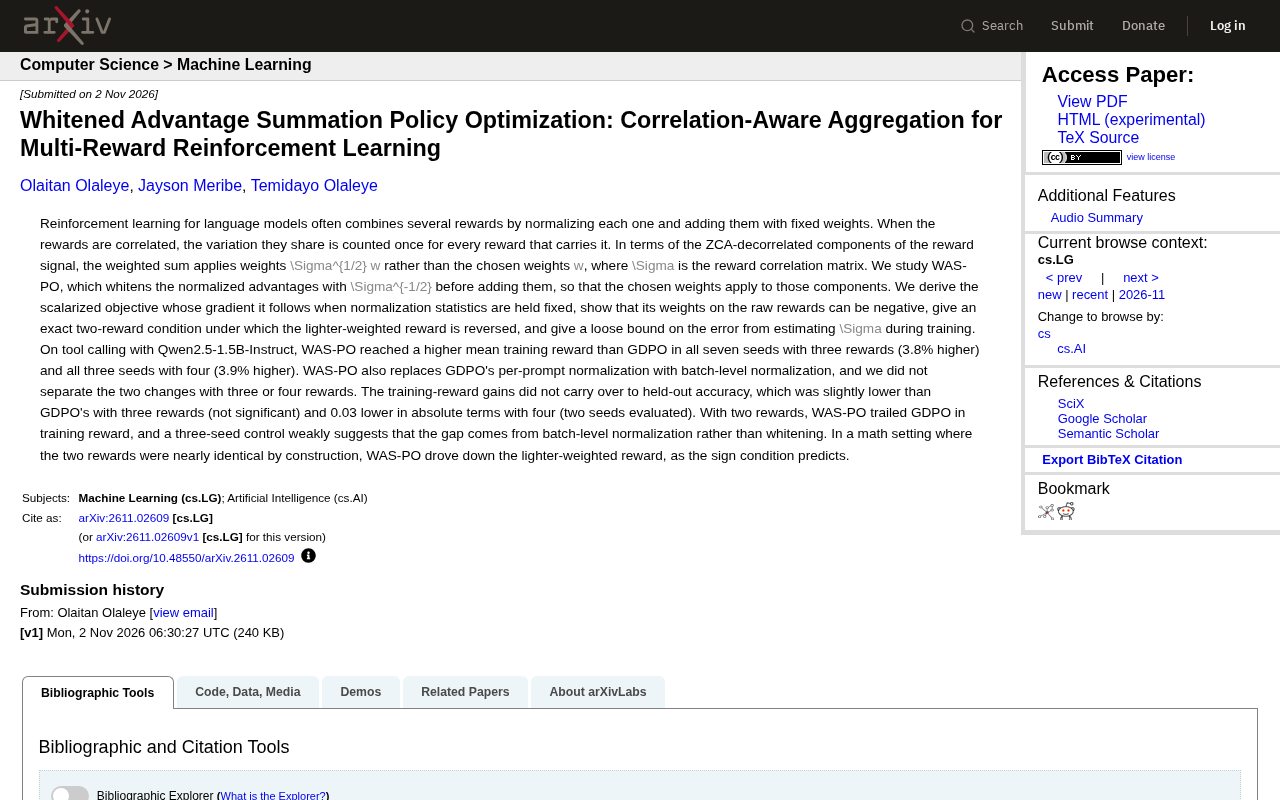
WAS-PO: Using Whitened Advantages to Solve the Correlation Trap in Multi-Reward Reinforcement Learning
WAS-PO paper proposes whitening advantages to correct correlation bias in multi-reward RL: when rewards are correlated, naive weighted summation effectively applies Σ^{1/2}w instead of w. Experiments show training reward improves steadily, but held-out accuracy does not improve in sync, and under two rewards it actually falls behind.