HIPAA Security Rule 2026 Updates: A Developer's Practical Compliance Guide

HIPAA Security Rule reform is delayed to 2027, but existing rules still apply — engineering teams should act now.
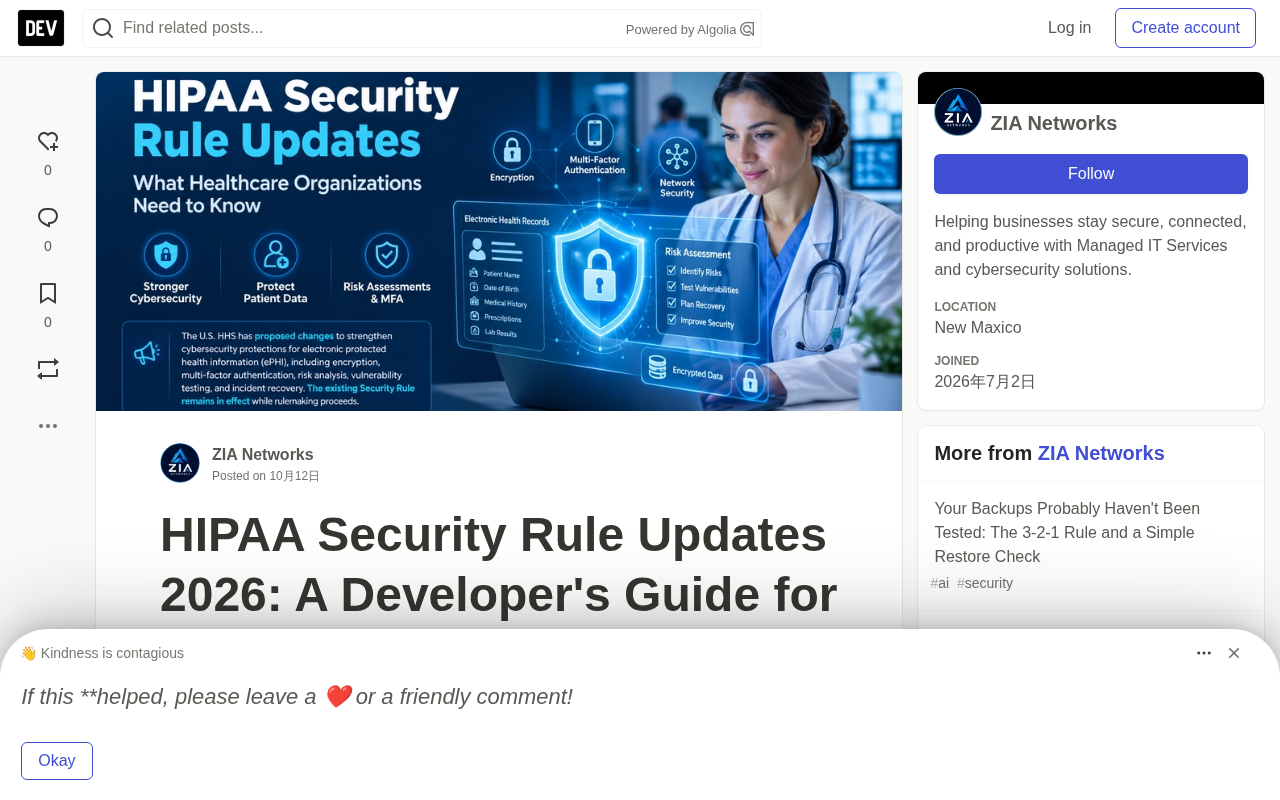
HHS's proposed HIPAA Security Rule overhaul, introduced in January 2025, has been pushed back to at least July 2027, but the current rule remains fully enforceable with penalties exceeding $2.1M per violation category annually. The updated Notice of Privacy Practices was already mandatory as of February 2026. The proposal clearly points toward mandatory encryption, MFA, network segmentation, and written documentation. Engineering teams should build toward these standards now, prioritizing a documented annual risk analysis — the deficiency OCR cites most in enforcement actions.
If you develop or maintain systems for medical clinics, the HIPAA Security Rule 2026 updates have probably made it onto your to-do list — but only as a vague note saying "we need to be ready for this." This article breaks down where things actually stand and what engineering teams should be doing right now.
Current Status: Reform Is Still a Proposed Rule
One of the most misunderstood facts about the major HIPAA Security Rule overhaul is this: it remains a proposed rule — not a final regulation.
The Office for Civil Rights (OCR) under the U.S. Department of Health and Human Services (HHS) published the proposed update on January 6, 2025. The original timeline called for a final rule by May 2026, but HHS has pushed finalization back to at least July 2027.
This means two things. First, the existing Security Rule is fully in effect and enforceable — nothing changes until a final rule replaces it. Second, don't treat compliance as a future problem. Penalties under the current rule are very real. After 2026 inflation adjustments, fines range from $145 to over $73,000 per violation, with annual caps exceeding $2.1 million per violation category.
What's Already Mandatory in 2026
The updated Notice of Privacy Practices (NPP) requirements, tied to the 42 CFR Part 2 final rule, became mandatory on February 16, 2026. If your clinic's patient portal or website still links to an older version of the notice, it needs to be updated now. This is an easy-to-overlook change for engineering teams — but it's a hard requirement that has already taken effect.
The HIPAA (Health Insurance Portability and Accountability Act) Security Rule has been in place since 2003, with full enforcement beginning in 2005. Its core framework hasn't undergone a comprehensive revision in over two decades. The rule requires Covered Entities (healthcare providers, health plans, healthcare clearinghouses) and their Business Associates to protect electronically Protected Health Information (ePHI). It organizes safeguards into three categories — Administrative, Physical, and Technical — and marks some controls as "addressable," allowing organizations to document their rationale and implement equivalent alternatives based on risk assessment. That flexibility made sense before the widespread adoption of AI and cloud computing, but it's increasingly insufficient given the modern threat landscape. That's one of the primary drivers behind this reform.
What the Proposal Means for Your Tech Stack
While the reform isn't finalized, its direction is clear enough to guide engineering decisions today. The proposed rule would mandate specific technical standards — encryption, multi-factor authentication (MFA), and network segmentation. It would also convert several currently "addressable" safeguards into "required" controls, and would mandate written documentation for all policies, procedures, plans, and analyses.
Translated into engineering terms, here's how these map to concrete work:
| Proposed Direction | What to Build or Audit |
|---|---|
| Encryption | TLS in transit, encryption at rest and for backups, endpoint encryption |
| Multi-Factor Authentication | Enforced on email, EHR, VPN, admin consoles, cloud dashboards |
| Network Segmentation | VLANs or separate subnets for clinical systems, isolated guest Wi-Fi |
| Asset Inventory | Automated discovery of all devices, servers, and SaaS tools that touch ePHI |
| Documentation | Policies, runbooks, and risk analyses in version control or a managed wiki |
None of these are radical new concepts — they're established security best practices. Building toward them now means your team won't be scrambling for a last-minute rework when the final rule lands.
The distinction between "addressable" and "required" has real implications for engineering decisions. Under the current rule, both MFA and encryption fall into the "addressable" category — meaning an organization can theoretically document its reasoning and opt not to implement them. The proposed rule aims to make both mandatory, removing that flexibility. Network segmentation is particularly critical in clinical environments: medical devices such as infusion pumps and imaging workstations often run legacy operating systems and can't be patched quickly. Placing them on isolated VLANs significantly limits lateral movement — the ability of an attacker who has compromised one node to spread across the entire network. This is the primary propagation path that enables ransomware to cause widespread outages in healthcare settings.
An Actionable Starting Checklist
Rather than staring at a legal document and not knowing where to start, break compliance down into checkable engineering items. The following checklist can be used directly as an internal readiness tracker:
hipaa_readiness_2026:
  risk_analysis: documented, reviewed at least annually
  mfa: enabled on all remote and admin access
  encryption:
    at_rest: true
    in_transit: true
    backups: true
  asset_inventory: maintained and current
  network_segmentation: clinical vs guest vs office
  backups: tested restores, not just scheduled jobs
  incident_response_plan: written and rehearsed
  business_associates: agreements reviewed
  staff_training: phishing and data handling
  nm_breach_rules: confirmed with legal counsel
Risk Analysis Is the Top Priority
If you can only do one thing on this list, do the risk analysis — and write it down. As the original guidance makes clear, inadequate risk analysis is the Security Rule deficiency OCR cites most often during enforcement investigations. In other words, it's where regulators most frequently find problems, and it's a hotspot for enforcement penalties.
The key words here are "documented" and "reviewed at least annually." Many teams have scattered security measures in place but lack a written, auditable risk analysis. If a breach investigation happens, saying "we've always done this" carries almost no weight.
Risk analysis under the HIPAA framework carries specific methodological requirements: you must identify all systems and processes in your organization that touch ePHI, assess the likelihood and impact of potential threats and vulnerabilities, document existing controls, and produce a risk rating to guide a subsequent risk management plan. NIST SP 800-30 provides a widely referenced framework for this process. The "at least annually" review requirement isn't just formalism — when system architecture changes, new third-party integrations are added, staff turn over, or new attack vectors emerge, previous risk assessment conclusions may no longer hold. The recurring pattern OCR finds in enforcement cases is organizations that have security measures in place but have never systematically evaluated whether those measures address their most significant risk exposures.
Why You Shouldn't Wait Until 2027
Since the final rule has been pushed to 2027, can this work be deprioritized? The answer is clear: no.
The delay does give organizations more time to build out asset inventories, expand encryption coverage, and roll out MFA — but ransomware and phishing attacks aren't waiting for a final rule to take effect. Every item on that checklist is reducing your data breach risk today, regardless of when the final rule lands.
Looked at another way, the direction of the proposal is highly predictable, so acting now carries almost no sunk-cost risk. The encryption, MFA, and network segmentation you build now will be part of your compliance foundation no matter how the final 2027 text is worded. Treat this as paying down technical debt, not as a one-time compliance sprint.
The Reality for Small Clinics
Small clinics typically don't have a dedicated security team — and that's the biggest practical barrier to compliance. Developers or outsourced IT staff often carry responsibility for system maintenance, feature development, and security simultaneously, making it hard to systematically identify compliance gaps.
In this situation, the pragmatic approach is to bring in outside expertise to review network and security configurations, identify compliance gaps, and prioritize fixes by actual risk — tackle the high-risk, high-enforcement-probability items first (like risk analysis and MFA), then work through documentation and segmentation as longer-term projects.
One important note: this article is general information and does not constitute legal advice. For compliance questions specific to your clinic, consult a qualified HIPAA compliance specialist or healthcare attorney — especially when state-level breach notification rules (such as those in New Mexico) are involved.
Related articles

curl 8.23.0 Fixes 24 CVEs, AI-Assisted Research Contributed 20
curl 8.23.0 fixes 24 CVEs, 20 found by AI-assisted research, including a High-severity HTTP/2 use-after-free that could become RCE. Here's the source, fix details, and upgrade checklist.

MP3 vs WAV: Which Format Should You Choose for Voice Recording
MP3 vs WAV for voice recording: compare lossy vs uncompressed formats for interviews, transcription, and archiving—and learn the common mistake of converting formats after the fact.

Multi-Agent Voice Command Center in Practice: Deconstructing the VAPI + Supabase Architecture
Deconstructing the Load Bearing Empire multi-agent voice command center: VAPI voice pipeline, Supabase Edge Functions for Webhooks, 8 Postgres tables tracking agent state, and Vercel-managed frontend design.