History Monk: A Local-First Search Tool That Reimagines Browser History

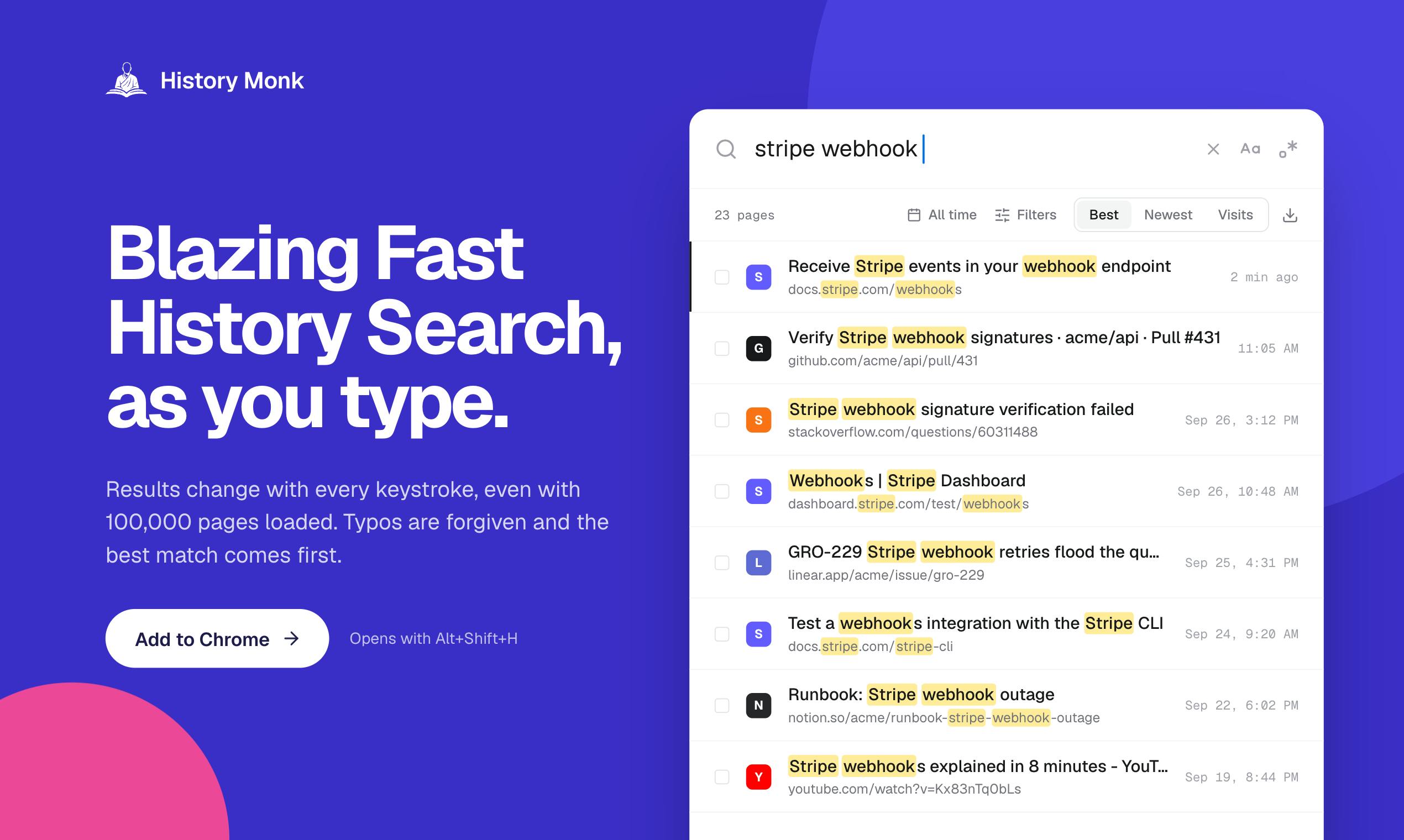
History Monk is a local-first Chrome extension that brings fuzzy search and smart filtering to your browser history.
History Monk is a Chrome extension launched on Product Hunt that aims to replace the browser's outdated native history page. It offers instant fuzzy search, multi-dimensional filtering by site/day/hour, bulk deletion, data export, and a browsing time visualization feature. All data is processed locally with no cloud uploads, delivering both strong privacy and fast search. It targets power users and knowledge workers, though cross-browser support and large-scale stability remain to be verified.
Why the Browser History Page Needs a Replacement
The built-in browser history page has barely changed over the years: a long, chronologically sorted list of links, a weak search bar, and an exhausting scroll-fest whenever you're trying to track down something you visited days ago. History Monk is a Chrome extension launched on Product Hunt with a straightforward mission — replace the browser's native history page with a faster, more controllable experience.
The product ranked 14th on its Product Hunt launch day, earning 66 upvotes under the Browser Extensions / Chrome Extensions category. While it received zero comments, it addresses a real and long-neglected pain point: browser history, as a core piece of user data, has always lacked decent management tooling.
Core Features: Search, Filter, and Bulk Clean
According to the official description, History Monk's capabilities fall into three main areas.
Instant Fuzzy Search
The product promises that "type a few letters and the page you want appears." Compared to the native history page — which requires exact matches and tends to load slowly — this instant, responsive search is the primary selling point. For power users who open dozens of tabs every day, quickly locating a previously visited page can save meaningful time.
Fuzzy Search is a technique that allows approximate rather than exact matching — even if there are typos, missing words, or you only remember fragments of a title, it still surfaces relevant results. Common implementations include Levenshtein distance and the Bitap algorithm, and popular JavaScript libraries like Fuse.js make this capability easy to integrate in the browser. For history search in particular, fuzzy matching is critical — users typically only remember one or two words from a page title, or have only a vague impression of what they saw. Exact string matching fails in this scenario almost by design. Chrome's native history page (
chrome://history) relies on simple substring matching and becomes sluggish under large history volumes, whereas a local fuzzy search engine can load the entire history index into memory for millisecond-level responses.
Multi-Dimensional Filtering
The tool supports filtering by website, by day, and by hour. This means users can not only find a specific page, but also review "what did I browse through that afternoon?" This level of time granularity transforms history from a plain link list into a traceable record of behavior.
Export and Bulk Delete
The product name itself highlights two key features: Export and Bulk Delete. Native browsers typically offer only item-by-item deletion or a full wipe — with nothing in between. History Monk lets users selectively clean up "clutter" while keeping what matters, and supports exporting history data as a backup.
Time Visualization: See Where Your Attention Actually Goes
Beyond search and cleanup, History Monk includes the ability to "see where you spend your time." This kind of analytics view translates browsing behavior into readable data, giving users a clear picture of how their time is distributed across different sites.
This pushes the extension beyond a pure utility tool and nudges it toward "digital habit reflection." Screen time and attention management have become popular topics in recent years, and History Monk's design philosophy echoes that trend — your browsing history isn't just for looking things up; it can also serve as a mirror for understanding your own online habits.
A Local-First Privacy Promise
As privacy sensitivity continues to rise, History Monk emphasizes that it is "100% local and private." All history data is processed on the user's device and never uploaded to the cloud. For an extension that needs access to a user's complete browsing history, this is a crucial trust signal — after all, browser history often contains highly sensitive information.
Local-first is also a clear trend among productivity tools today. Users are increasingly wary of having their data collected and analyzed, and keeping computation on-device both protects privacy and eliminates network latency — a two-for-one benefit for a product that leads with "instant search."
Local-First is a software design philosophy that has gained traction in recent years, formally articulated by the Ink & Switch research team in their 2019 paper of the same name. The core principle: user data lives primarily on local devices, the app works fully offline, and cloud sync (if present) is an optional enhancement rather than a hard dependency. For Chrome extensions specifically, the browser's built-in
chrome.historyAPI already provides direct access to local history data, making local-first architecture a natural fit — developers don't need a backend to deliver all core functionality. This also means the privacy promise is technically verifiable: users can confirm whether any data is being transmitted externally using the browser's own network monitoring tools (such as the DevTools Network panel), which is far more convincing than relying on a privacy policy statement alone.
Who It's For — and Where the Gaps Are
History Monk has a clear target audience: heavy tab users, researchers and knowledge workers who frequently need to retrace their steps, and anyone who wants to manage or back up their browsing data. It addresses a high-frequency but low-profile pain point — the kind of tool that isn't flashy, but quietly delivers value every day.
That said, there are a few open questions based on what's publicly available. It's currently focused on the Chrome ecosystem, with no clear information on cross-browser support. The product is still early-stage (zero reviews), so real-world search performance and stability under large history volumes still need to be validated. The depth and accuracy of the time-tracking feature will also depend on future development.
For users who have long been frustrated by the native history page, History Monk offers a lightweight alternative worth trying. It doesn't change how you browse — it just makes the small act of "finding something you once saw" feel effortless. And that's precisely where good utility tools earn their keep.
Related articles

Gemini 4 Argon Hands-On: AI Builds Board Games, Constructs Temples, and Trains Robots Autonomously
Gemini 4 Argon hands-on roundup: AI autonomously builds a desk racetrack and temple in Blender, writes a ray tracing engine, trains a humanoid robot to sink 7 shots, plus API pricing and developer access.

The Magic Octagonal Coin: Why Only 9% of People Can Predict Its Flip?
Only 9% of people can correctly predict the Magic Octagon coin flip. This article explains its spatial rotation mechanism, common cognitive pitfalls, and a new hypothesis based on Relevance Theory, exploring the limits of human spatial reasoning.

Sam Altman: AI Is Entering the Era of Scientific Discovery — Math Breakthroughs Will Replicate in Biology and Energy
Sam Altman says AI is entering the era of scientific discovery — math breakthroughs will replicate in biology, materials science, and energy to help develop new drugs and energy sources.