HKU Open-Sources Supervisor-Skills: Packing a Decade of PhD Advising Experience into AI

HKUST's team split an advisor's research experience into 12 AI skills spanning the full paper workflow.
The article introduces the GitHub open-source project Supervisor-Skills, created by Professor Luo's team at HKUST, which has gained over 10,000 stars and partnered with several mainstream AI platforms. Targeting the heavy "AI tone" and lack of academic insight in model-assisted research writing, it offers not a single prompt template but two sections: a research theory guide covering paper quality evaluation, idea conception and refinement, writing conventions, and submission workflow; and a repository of 12 independently installable skills spanning idea feasibility assessment, literature research, de-AI-ifying drafts, academic expression and figure generation, pre-submission mock review, and reviewer responses. Users can configure it fully automatically via a one-sentence instruction to an AI agent. The article also cautions that skills can standardize processes and provide checklists but cannot replace a researcher's understanding of the field or genuine academic judgment.
When AI-Written Papers Always Smell "Fake," Where's the Problem?
Many people use large models to assist with research, but the resulting text always reads with an indescribable "AI flavor": neatly structured yet lacking insight, piled with jargon yet loosely argued. The root of the problem isn't the model itself—it's that ordinary large models don't have the academic thinking of a seasoned PhD advisor. It knows the format of a paper, but not why a paper is worth writing or why an idea holds up.
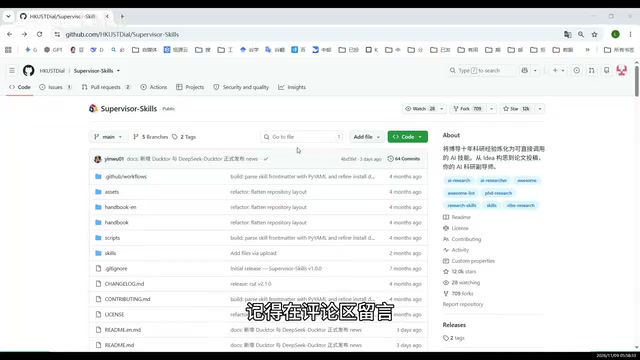
According to a Bilibili video, an open-source project on GitHub called Supervisor-Skills attempts to solve this problem: created by Professor Luo's team at the Hong Kong University of Science and Technology, it distills a PhD advisor's decade of tacit research experience from mentoring students into a set of skills that AI can invoke, letting AI serve as a research mentor around the clock. The project has already gained over ten thousand stars on GitHub and has partnered with several mainstream AI platforms.
Not a Prompt Template, but a Dual "Theory + Execution" Structure
After thoroughly reviewing the project, the video's author notes that Supervisor-Skills is not a single prompt template of the kind commonly seen on the market, but a systematic repository made up of two major sections.
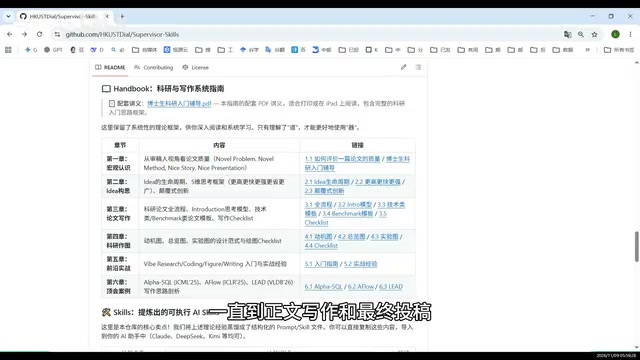
Section One: Research Theory Guide
This part focuses on the underlying problems of research confusion: how to evaluate the quality of a paper, how to conceive and refine a high-value idea, all the way through paper-writing conventions and the final submission process. It organizes the most core thinking frameworks of doing research into theoretical tutorials, addressing the question of "not knowing how to think."
Tacit Knowledge is the key background for understanding the value of this project. Coined by philosopher Polanyi, the concept refers to experience that is hard to fully articulate in words and is mainly acquired through mentor demonstration and long-term practice—such as "seeing at a glance whether an idea is worth pursuing" or "what reviewers care about most." A long-standing pain point in research training is that an advisor's judgment often belongs to tacit knowledge, and students can only gradually grasp it through repeated trial and error and face-to-face conversations. Supervisor-Skills' approach is to transcribe this kind of experience, as much as possible, into executable judgment criteria, checklists, and questioning frameworks—what is called "explicitation." It should be noted that explicitation inevitably comes with loss—what can be written down is usually the part that can be rule-ified, while judgments that truly rely on domain intuition remain hard to fully encode. This also explains why the project positions itself as a "process mentor" rather than a "replacement for academic judgment."
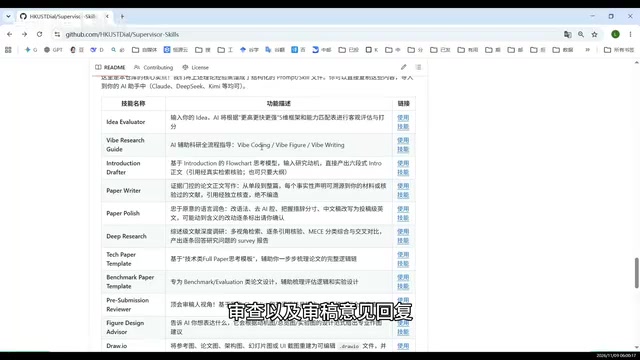
Section Two: A Skill Repository Spanning the Entire Workflow
The repository contains 12 independent skills that can be split apart and installed individually as needed. The coverage is quite complete: in the early stage, idea feasibility assessment and in-depth literature research; in the mid stage, when writing the first draft, removing stiff AI tone, generating idiomatic academic expression and research figures; in the late stage, pre-submission mock review and responding to reviewer comments. Each stage has a corresponding skill that can be invoked directly—equivalent to breaking an advisor's guidance actions at different stages into reusable modules.
The Skill mechanism is a key concept in the current AI agent ecosystem, and understanding it helps grasp the project's design logic. Unlike prompt templates, a skill usually refers to a reusable module that encapsulates a specific capability, with clear input/output interfaces and invocation conditions; an agent can invoke it by name when needed without stuffing all instructions into a single conversation. The benefit of this mechanism is that it is composable, detachable, and version-manageable—researchers can install only the stages they need, such as only "literature research" or only "de-AI-ification," without loading everything. It also facilitates continuous iteration: when the process for a certain stage is updated, only the corresponding skill needs to be replaced, without affecting other parts. Supervisor-Skills splits an advisor's guidance actions into 12 independent skills, and it is precisely through this mechanism that scattered research experience becomes "parts" that AI can schedule on demand.
The "de-AI-ification" mentioned in the article has a specific meaning in the context of academic writing. Common problems in large-model-generated text include: excessive use of connectives and parallel structures, giving every argument a balanced amount of space without distinguishing priority, replacing concrete evidence with abstract nouns, and empty wrap-ups in the style of "in summary." Academic writing, by contrast, demands that arguments make choices, that terms be defined, and that conclusions have boundaries. Corresponding approaches typically include: constraining sentence-pattern diversity, requiring every claim to be backed by citations or data, adjusting person and tense to journal style, and compressing redundant transitions. Such skills are essentially executors of a set of writing conventions; they can improve how idiomatic the expression is, but they cannot generate genuinely weighty arguments on the author's behalf—"removing the AI flavor" of expression and "having insight" in content are two different levels of the problem.
Installation and Use: Configuration in a Single Sentence
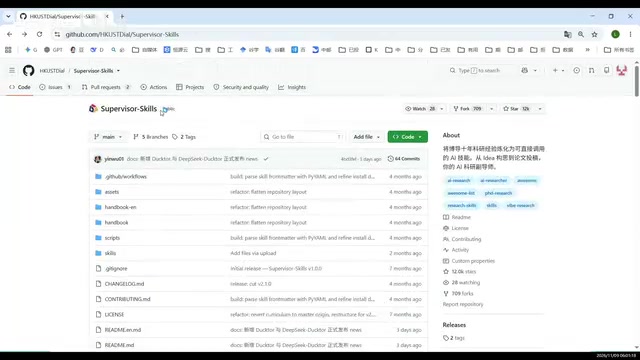
The project can be found by searching its name directly on GitHub to view the detailed directory. Take entries such as "How to evaluate the quality of a paper" and "The lifecycle and conception of an idea"—clicking into each reveals a corresponding skill explanation, making it easy to judge whether it fits your needs.
An even easier way is to send a one-sentence instruction directly to an AI agent, for example: "Please find and install Supervisor-Skills on GitHub; once configured, list the installed skills, the purpose of each skill, and the specific way to invoke them." The agent can then complete the installation and configuration fully automatically.
A Bit of Sober Judgment
"Distilling" an advisor's experience into skills is essentially making tacit knowledge explicit and procedural, and for graduate students lacking systematic research training, it is indeed a productivity tool. But note: skills can standardize processes and provide checklists, but they cannot replace real academic judgment—the innovativeness of an idea ultimately still depends on the researcher's depth of understanding of the field. Treating it as an always-online "process mentor" rather than a "ghostwriter" is the right way to use this kind of tool.
The video's author says that follow-up content will further analyze the theory guide and the practical use of specific skills; interested researchers can stay tuned.
AI Agents are the technical prerequisite that makes the project's one-sentence installation possible. Unlike a plain chat model, an agent has the ability to call external tools and perform multi-step operations, such as visiting web pages, reading and writing files, and running commands. That is why instructions like "Please find and install Supervisor-Skills on GitHub and list the installed skills" can be broken down into a series of actions—search, download, configure, verify—and completed automatically. This also brings risks to watch for: when granting an agent file and network permissions, confirm that the source is trustworthy and that the installed content matches its description, to avoid unknowingly introducing uncontrollable code or configuration. For research scenarios, process automation improves efficiency, but permissions and data security still need to be safeguarded by researchers themselves.
Related articles

Hermes Agent Beginner's Guide: Hands-On with a Self-Evolving AI Agent
A beginner's guide to Hermes Agent, the open-source self-evolving AI agent that gained 41.7K GitHub stars in two months—covering Harness Engineering, the learning loop, three-layer memory, WSL installation, and hands-on configuration.

AI Agent in Action: Building a Smart Office Assistant with WorkBuddy
A practical case study shows how Tencent WorkBuddy batch-converts and archives files, compares chat LLMs with AI Agents, and analyzes WorkBuddy's credit system, use cases, and positioning for office automation selection.

From Single-GPU Bottlenecks to Hundreds of Billions of Parameters: 6 Key Questions in Large Model Distributed Parallelism
Based on a Bilibili tutorial, this article organizes core knowledge of large model distributed parallelism: starting from decoder-only architecture's token-by-token generation and the essence of X times W computation, it analyzes six key questions including data parallelism, tensor parallelism, and pipeline parallelism under single-GPU bottlenecks. Suitable for learners in private deployment and model training scenarios to build systematic understanding.