Holant Dichotomy Theorem Derived from Finite Subgroups C₂ of SO(3)

The paper establishes a complete complexity dichotomy theorem for binary signatures satisfying M(B(F))≅C₂ in the Holant framework.
This paper studies the complexity dichotomy theorem for counting problems in the Holant framework, focusing on the case where binary signatures induce a group structure and satisfy M(B(F))≅C₂. The authors find that projective equivalence classes of signature matrices can be embedded into finite subgroups of SO(3), enabling classification via group theory. They distinguish normal and isotropic cases, analyze their complexity, and use gadget constructions, decomposition, interpolation, and realnumberization to prove the dichotomy: the problem is either polynomial-time computable or #P-hard. Additionally, they introduce a Pauli-basis representation as a natural language for organizing signatures, revealing structural relationships not obvious in the standard basis. This work fills a gap for a specific case and provides a template for general complex-valued even-arity signatures.
In computational complexity theory, counting problems within the Holant framework have long relied on the establishment of complexity dichotomy theorems. For a set of signatures with value constraints, determining whether the corresponding Holant problem is polynomial-time computable or #P-hard is key to understanding the intrinsic difficulty of counting problems. A recent paper focuses on a fundamental and open case: binary signatures induce a group structure and satisfy (M(B(\mathcal{F}))\cong C_2), thereby establishing a complete dichotomy theorem in the setting of general complex-valued even-arity signatures (without auxiliary unary signatures). This work not only fills the gap for this specific case but also reveals deep connections between signature matrices and finite subgroups of (SO(3)) through an algebraic geometry perspective.
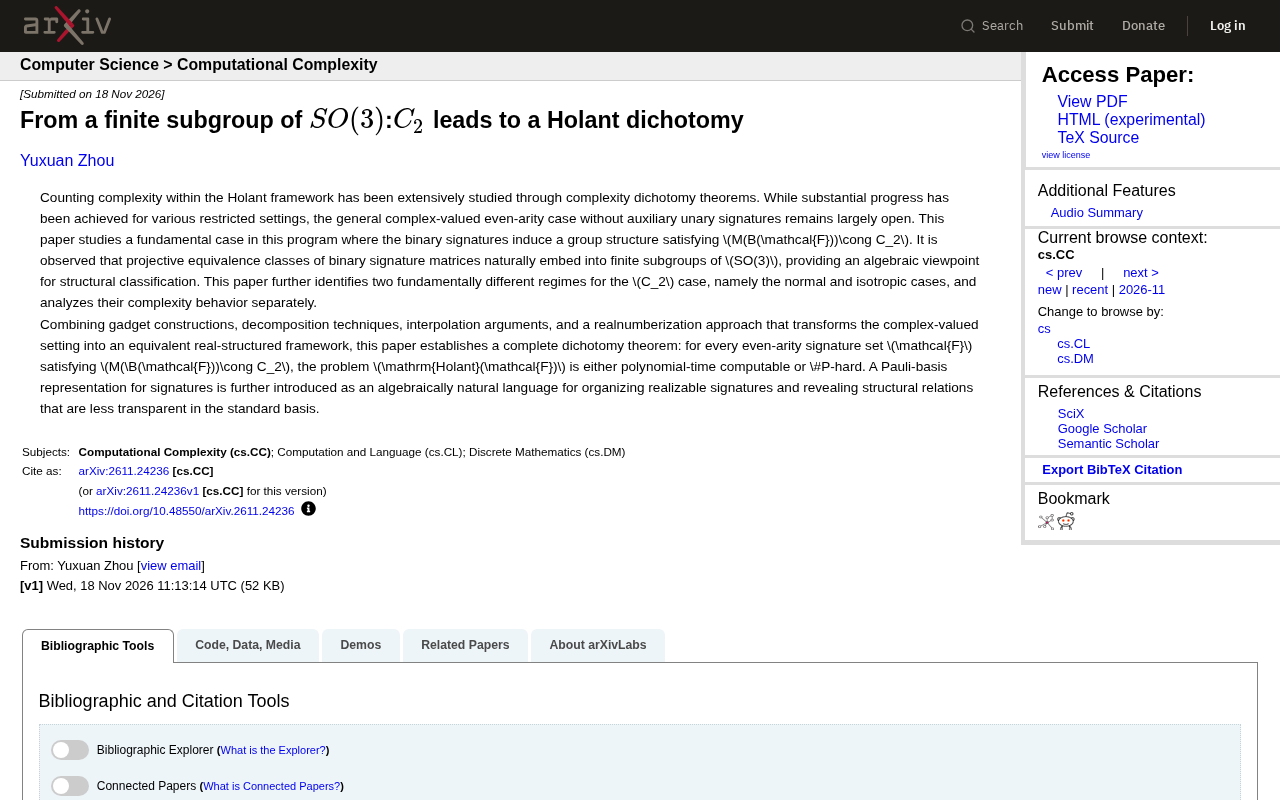
From Signature Matrices to Embedding into Finite Subgroups of SO(3)
The core observation of the paper is that the projective equivalence classes of binary signature matrices can be naturally embedded into finite subgroups of (SO(3)). This algebraic viewpoint provides a new language for structural classification. Previous analyses of Holant problems often relied on combinatorial constructions or interpolation methods, whereas here, by mapping signature matrices to finite subgroups of the 3D rotation group, researchers can leverage tools from group theory and representation theory to characterize the behavior of different signature sets.
Specifically, the condition (M(B(\mathcal{F}))\cong C_2) means that the group structure generated by binary signatures is isomorphic to the cyclic group of order 2. In this setting, the projective equivalence classes of signature matrices fall into some finite subgroup of (SO(3)), allowing the properties of that subgroup to distinguish different complexity regions. This embedding is non-trivial; it requires the signature matrices to satisfy specific orthogonality conditions, and the classification of finite subgroups of (SO(3)) (cyclic, dihedral, tetrahedral, octahedral, and icosahedral groups) provides a clear classification framework for subsequent analysis.
Holant framework is a framework in counting complexity theory used to uniformly describe counting problems. In a Holant problem, the input is a graph where each vertex is associated with a signature (i.e., a function), and the goal is to compute the sum over all assignments satisfying edge constraints of the product of signatures. The complexity classification of signature sets is central to Holant research: determining whether for a given signature set the corresponding Holant problem is polynomial-time computable or #P-hard. The generality of the Holant framework allows it to naturally express many classical counting problems, such as counting perfect matchings and graph homomorphisms, so establishing its dichotomy theorem is of great significance for understanding the intrinsic difficulty of counting problems.
Two Cases: Normal Case and Isotropic Case
Based on the algebraic embedding above, the paper identifies two essentially different mechanisms in the (C_2) case: the normal case and the isotropic case. The distinction between these two cases arises from the orbit structure of signature matrices under the action of the (SO(3)) subgroup. In the normal case, the behavior of signature matrices is relatively regular, and their projective equivalence classes maintain a certain stability under the subgroup action; in the isotropic case, signature matrices exhibit stronger symmetry, leading to different complexity behavior.
The authors analyze the complexity of these two cases separately. The normal case can often be reduced to known tractable cases via decomposition techniques or interpolation reductions, while the isotropic case may require more refined treatment and may even directly lead to #P-hardness. This divide-and-conquer strategy is a key step in establishing the complete dichotomy theorem.
Projective equivalence classes refer to the classification of signature matrices under a certain equivalence relation. Specifically, two signature matrices belong to the same projective equivalence class if they can be transformed into each other via row and column permutations and nonzero scaling. In the complexity analysis of Holant problems, projective equivalence classes are often used to characterize the basic structure of signatures because this equivalence relation preserves the computability of the problem. By studying projective equivalence classes of signature matrices, researchers can categorize complex signature sets into a finite number of types, thereby simplifying complexity classification. In this paper, the embedding of projective equivalence classes into finite subgroups of SO(3) is achieved through this equivalence relation, providing a foundation for analyzing signatures using group-theoretic tools.
Proof Techniques: Gadget Constructions and Realnumberization Approach
To prove the dichotomy theorem, the paper employs a combination of technical tools. Gadget constructions are used to simulate auxiliary signatures, thereby expanding the expressible signature sets; decomposition techniques break complex signature sets into simpler components; and interpolation arguments are used to reduce problems in polynomial time, proving that the computational power of certain signature sets is equivalent to known hard problems.
A notable innovation is the realnumberization approach. Since the problem involves complex-valued signatures, directly handling complex numbers is highly complex. The realnumberization approach transforms the complex-valued setting into an equivalent real-valued structural framework, allowing operations and equivalence relations originally in the complex domain to be reformulated in the real domain. This transformation preserves the complexity essence of the problem while simplifying the analysis, facilitating a unified treatment of the normal and isotropic cases.
#P-hardness is a core concept in computational complexity theory used to describe the difficulty of counting problems. A counting problem is called #P-hard if there exists a polynomial-time Turing reduction from any problem in #P to that problem. Intuitively, #P-hard problems are believed to have no polynomial-time algorithms unless P=NP. In the Holant framework, proving that the Holant problem corresponding to a signature set is #P-hard is usually achieved by constructing gadgets that simulate known #P-hard problems (such as counting perfect matchings). The goal of a dichotomy theorem is precisely to prove that for a given signature set, the problem is either polynomial-time computable or #P-hard, thereby fully characterizing its complexity.
Pauli-Basis Representation: A New Language for Organizing Realizable Signatures
Beyond the dichotomy theorem itself, the paper introduces a Pauli-basis representation of signatures. In the standard basis, the structural relationships of signatures are often not transparent enough, especially when signature matrices are related to (SO(3)) subgroups. The Pauli basis is a matrix basis commonly used in quantum information, consisting of the identity matrix and three Pauli matrices, with orthogonality and trace properties. Expanding signatures in the Pauli basis allows for more natural organization of realizable signatures and reveals structural relationships that are difficult to observe in the standard basis.
For example, in the Pauli basis, the projective equivalence classes of signature matrices may correspond to certain combinations of Pauli matrices, directly reflecting the generator structure of the (SO(3)) subgroup. This representation not only aids theoretical analysis but may also inspire future algorithm design. The authors point out that the Pauli-basis representation is an algebraically natural language that simplifies the formulation of signature classification and reveals hidden connections between different signature sets.
Pauli basis is a set of matrix bases commonly used in quantum information, consisting of four 2×2 matrices: the identity matrix I and the three Pauli matrices σ_x, σ_y, σ_z. This basis has orthogonality (under the Hilbert-Schmidt inner product) and trace properties (traceless except for the identity matrix), so any 2×2 complex matrix can be uniquely expressed as a linear combination of them. In Holant problem research, signature matrices are usually even-dimensional, but the Pauli basis can be generalized to higher dimensions (via tensor products), providing a natural expansion for signatures. This representation helps reveal symmetries and structural relationships of signature matrices that are not obvious in the standard basis, particularly properties related to the generators of SO(3) subgroups.
Significance and Outlook
This paper takes a solid step in the complexity dichotomy research of the Holant framework. Although the general complex-valued even-arity case (without auxiliary unary signatures) remains open, the complete solution of the (C_2) case provides a template for future research: by transforming signature classification problems into group theory problems through algebraic embedding, and then combining with reduction techniques from complexity theory, it is expected that more general cases can be gradually tackled.
At the same time, the introduction of the Pauli-basis representation may inspire more research on the relationship between signature representations and complexity. Future work could explore cases corresponding to other finite subgroups or generalize the realnumberization approach to broader signature sets. For researchers interested in the intersection of counting complexity, quantum computing, and algebraic methods, this work provides rich tools and perspectives.
In summary, from finite subgroups of (SO(3)) to the Holant dichotomy theorem, this path intertwining algebra and complexity theory demonstrates the power of structural classification. As more cases are solved, we will get closer to a complete understanding of the complexity landscape of Holant problems.
Related articles

Jensen Huang Returns to Nvidia: The Power Game Behind an "Aggro Reset"
Nvidia's board reappointed Jensen Huang as CEO less than two weeks after his scandal-driven resignation. This analysis explores the board's decision-making, Trump's political intervention, media power failure, and market reaction behind the dramatic return.

Why Voice AI Can't Understand Kenyans' Everyday Conversations
Swahili speech recognition hits 3.24% error on read text, but everyday Kenyan speech mixes English, Sheng slang, and accents—leaving mainstream voice AI struggling.

Data Centers Build Their Own Natural Gas Plants: AI Compute's Breakout Around a Decade-Long Grid Wait
Grid interconnection approvals can take a decade, so xAI and others are building off-grid natural gas plants to power AI clusters. This article analyzes the drivers, costs, and impact of behind-the-meter generation on AI infrastructure.