HomePod Mini 2 Hands-On: Three Surprises and One Disappointment

HomePod Mini 2 hands-on: minor upgrades to lighting and sound quality, with the $50 price hike as the biggest disappointment
Apple has updated its entry-level smart speaker HomePod Mini 2 after six years, priced at $149. After testing it, the author finds the colorful glowing elements make interaction more refined, the chip upgrade brings perceptible improvements in low frequency and soundstage, and AirPlay stability and smart home response speed are optimized. However, limited by its compact size, the sound quality improvement is not dramatic; more importantly, the price is $50 higher than the previous generation, while substantive innovations such as smarter Siri and full spatial audio are absent. The author's conclusion: existing users have no need to upgrade, while new users deeply invested in the Apple ecosystem can still consider it, but its value for money is not as strong as its predecessor.
Apple has finally updated its entry-level smart speaker, the HomePod Mini, after six years, priced at $149. A tech journalist got hands-on with the product right after the "Welcome Home" event and shared three things he liked and one thing that disappointed him.
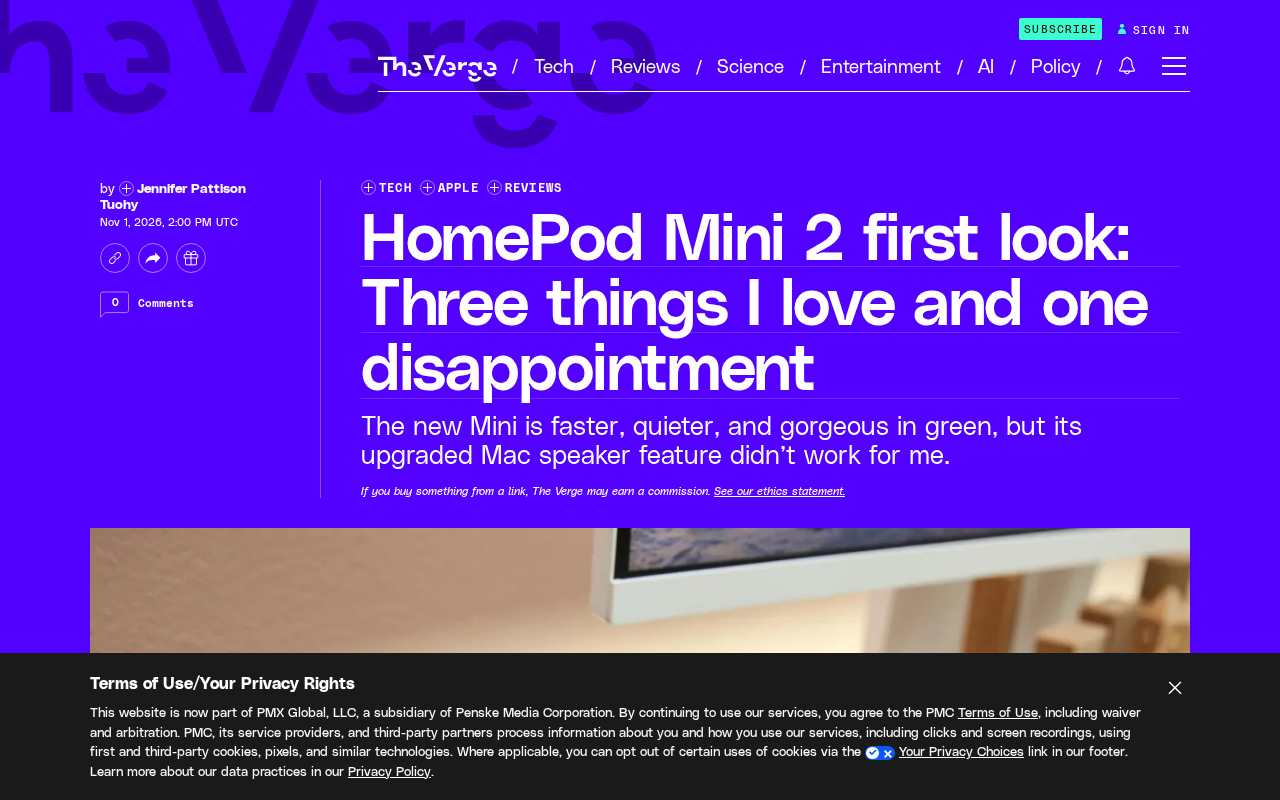
Design and Appearance: The Return of Colorful Glowing Elements
The HomePod Mini 2 retains the compact spherical design of its predecessor but adds new "colorful glowing" elements. The author notes that these color light effects make the device more recognizable when playing music or waking Siri, and easier to blend into different home styles. Although at first glance it seems like just a "chip upgrade + color change," in actual use the interplay between lighting and interaction is more refined than before.
Sound Quality Improvements from the Chip Upgrade
The second-generation HomePod Mini is equipped with a new-generation chip, and Apple claims it delivers better computational audio performance. During his listening tests, the author found perceptible improvements in low-frequency extension and soundstage width, especially when playing pop and electronic music—kick drums sound punchier and vocals clearer. However, he also points out that due to physical size constraints, the improvement is not dramatic and remains at the level of a "mini speaker."
Computational audio refers to a speaker using its built-in chip to analyze audio signals in real time and dynamically adjust output based on factors such as the physical characteristics of the speaker drivers and the room's acoustic environment, thereby optimizing the listening experience as much as possible within limited hardware conditions. Apple has championed this concept since the original HomePod: microphones capture room reflections, and the chip then computes compensation for the frequency response curve and separates and localizes sound sources. For size-constrained mini speakers, computational audio is especially important because it can use algorithms to compensate for physical shortcomings such as limited low-frequency extension and a narrow soundstage. This also explains why chip generations often bring sound quality improvements—what improves is not the speaker itself but the real-time processing and adaptive calibration compute.
Improved AirPlay and Smart Home Integration
AirPlay improvements are another point the author likes. The new version has optimized transmission stability and latency control, making it smoother to switch audio from an iPhone or Mac to the HomePod Mini 2, and multi-room audio synchronization is more reliable. In addition, as a smart home hub, its response speed to HomeKit devices has also improved, and voice commands are executed more crisply.
Spatial audio is an immersive listening technology based on object audio formats such as Dolby Atmos. It treats sound as localizable independent objects rather than fixed channels, and with head tracking it can create a surround sensation of sound coming from all around. On its HomePod product line, Apple has added spatial audio support to some models through software updates, but on the entry-level Mini, related capabilities have always been relatively limited. This is one reason the original author felt disappointed: users expected a product released six years later to offer full support for this feature rather than remain at the basic stereo level.
HomeKit is Apple's smart home platform framework, and the HomePod series can serve as a home hub responsible for relaying and scheduling various compatible accessories and executing automation scenes. The hub's chip performance directly affects the parsing speed of voice commands and device response latency, so chip upgrades often improve the smart home experience more noticeably than sound quality.
The Disappointment: Higher Price, Features Don't Keep Up
The author's biggest disappointment is the price: the HomePod Mini 2 is priced at $149, $50 more than its predecessor, yet core feature upgrades are limited. He believes that for a product updated only once every six years, users expect more substantive innovation—such as a smarter Siri, full spatial audio support, or better third-party service compatibility. Instead, what we see is only a minor iteration of "chip + lighting effects + AirPlay."
Is It Worth Buying?
If you are already a HomePod Mini user, there is little need to upgrade; but if you are a new user and deeply invested in the Apple ecosystem, the HomePod Mini 2 remains the most affordable entry point to Apple's smart speakers. It's just that the $149 price makes its value for money less outstanding than its predecessor. The author concludes: "It's a little better, but also more expensive."
One-line Summary
HomePod Mini 2 hands-on: small upgrades to lighting and sound quality, with the $50 price hike being the biggest disappointment
Paragraph Summary
Apple has updated its entry-level smart speaker HomePod Mini 2 after six years, priced at $149. After testing it, the author believes the new colorful glowing elements make interaction more refined, the chip upgrade brings perceptible improvements in low frequency and soundstage, and AirPlay transmission stability and smart home response speed are also optimized. However, limited by its compact size, the sound quality improvement is not dramatic; more importantly, the price is $50 higher than the previous generation, while substantive innovations such as smarter Siri and full spatial audio are absent. The author's conclusion: existing users have no need to upgrade, while new users deeply invested in the Apple ecosystem can still consider it, but its value for money is not as strong as its predecessor.
Related articles

VERS: Editing Activation Explanations to Halve Reasoning Model Tokens
VERS guides reasoning models by editing activation explanations, cutting 45.8% of tokens on GSM8K with only a 0.82 pp accuracy drop and transferring to larger models, but losing accuracy on competition problems.

Finding Errors Is Not Enough: Selective Model Escalation for Entity-Targeted Sentiment Analysis
This study explores selective model escalation for entity-targeted sentiment analysis, comparing data collection ordering, uncertainty-driven re-examination, and model routing—finding that minority-class priority only helps at very small data volumes, the oracle upper bound far exceeds actual gains, and escalation must be tailored to each dataset.
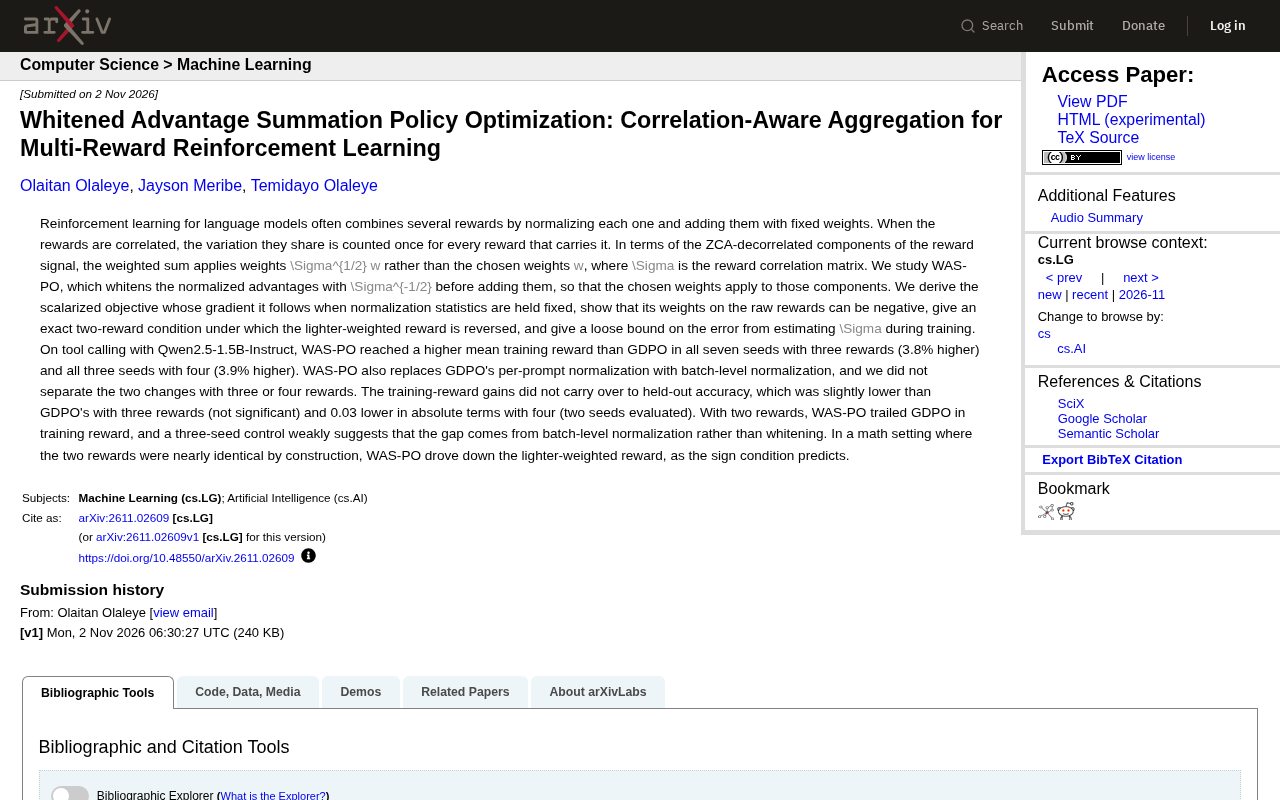
WAS-PO: Using Whitened Advantages to Solve the Correlation Trap in Multi-Reward Reinforcement Learning
WAS-PO paper proposes whitening advantages to correct correlation bias in multi-reward RL: when rewards are correlated, naive weighted summation effectively applies Σ^{1/2}w instead of w. Experiments show training reward improves steadily, but held-out accuracy does not improve in sync, and under two rewards it actually falls behind.