HOST Algorithm: A New Paradigm for Efficient Gaussian DAG Learning

HOST achieves sharp sample complexity for Gaussian DAG learning in polynomial time, bridging the statistical-computational gap.
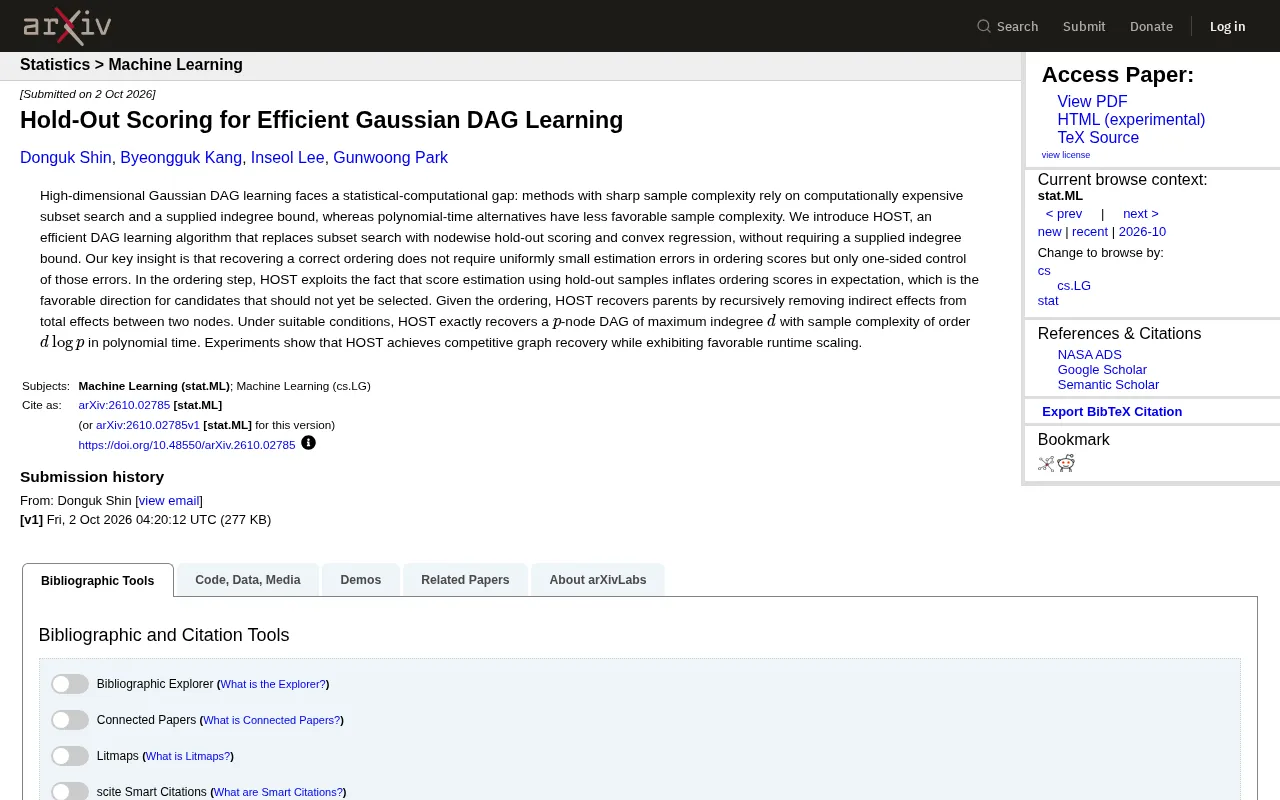
High-dimensional Gaussian DAG structure learning has long faced a statistical-computational gap: sample-efficient methods require exponential subset search, while polynomial-time methods sacrifice sample efficiency. HOST (Hold-Out Scoring) replaces expensive search with nodewise hold-out scoring and convex regression, requiring no indegree bound. Its core insight is that correct variable ordering only needs one-sided error control — the directional bias from hold-out samples naturally favors correct ordering decisions. After ordering, HOST recursively strips indirect effects to recover parent sets. Theoretically, it exactly recovers a p-node DAG with max indegree d in polynomial time using d log p samples, with competitive empirical performance.
The Statistical-Computational Gap in Gaussian DAG Learning
Directed acyclic graphs (DAGs) are a fundamental tool for modeling causal and dependency structures among variables, with wide applications in causal inference, gene regulatory networks, economic modeling, and beyond. Yet in high-dimensional settings, learning the structure of Gaussian DAGs has long been plagued by a frustrating dilemma — what researchers call the "statistical-computational gap."
On one side, methods with sharp sample complexity tend to rely on computationally expensive subset search and require a predefined indegree bound as prior information. On the other side, algorithms that run in polynomial time typically fall short on sample efficiency. In short, being both fast and statistically sharp has historically been out of reach.
A new paper on arXiv (arXiv:2610.02785v1) introduces an algorithm called HOST, which aims to fundamentally bridge this gap.
The Core Idea Behind HOST: Hold-Out Scoring and Convex Regression
The name HOST stands for Hold-Out Scoring, which directly reflects its technical approach. It replaces the expensive subset search found in traditional methods with nodewise hold-out scoring combined with convex regression — and it does so without requiring an externally supplied indegree bound. This frees the algorithm from strong reliance on prior structural information, making it applicable in a much broader range of settings.
Key Insight: Ordering Only Requires One-Sided Error Control
One of the most illuminating contributions of this paper is a counterintuitive observation: recovering the correct variable ordering does not require uniformly small estimation errors in the ordering scores — it only requires "one-sided control" over those errors.
This is a subtle but elegant statistical idea. Conventionally, we strive for estimators with consistently small errors. But for the specific task of ordering, what matters is the direction of the error, not its absolute magnitude. HOST exploits this insight to reduce the problem to one that can be solved in polynomial time.
The "Favorable Bias" of Hold-Out Samples
More concretely, in the ordering phase, HOST leverages the fact that when hold-out samples are used to estimate scores, the ordering scores are "inflated in expectation" — and crucially, this inflation occurs precisely for candidate nodes that should not yet be selected. In other words, the bias is directionally favorable.
This design allows the algorithm to reliably distinguish which nodes should be ordered earlier and which should be deferred, enabling it to approximate the correct ordering without resorting to subset search.
From Ordering to Parent Set Recovery
Once the ordering is established, HOST enters its second phase: recovering the parent set of each node. The strategy here is to recursively strip indirect effects from the total effects between pairs of nodes, leaving behind only the direct parent-child dependencies.
This step echoes the classical causal inference idea of distinguishing direct from indirect effects. By recursively peeling away indirect contributions, HOST can precisely reconstruct the graph structure given a known ordering — without enumerating all possible parent set combinations.
Theoretical Guarantees and Empirical Performance
The paper provides clear theoretical results: under appropriate conditions, HOST can exactly recover a DAG with $p$ nodes and maximum indegree $d$ in polynomial time, with a sample complexity of order $d\log p$.
The $d\log p$ sample complexity is precisely the sharp rate achieved by prior methods that relied on subset search — and HOST reaches this level without sacrificing polynomial runtime. This is the key evidence that HOST genuinely bridges the statistical-computational gap.
On the empirical side, the paper reports that HOST is competitive with existing methods in graph recovery quality, while achieving superior runtime scaling. This means HOST's computational advantage becomes increasingly pronounced as problem size grows.
Significance and Outlook
HOST's contribution goes beyond delivering a faster algorithm — it offers a new perspective on the problem itself: in structure learning tasks, a carefully designed estimation bias with a controlled direction can sometimes be more useful than pursuing unbiased or uniformly small errors.
For researchers and practitioners who need to perform causal structure discovery on large-scale, high-dimensional data, HOST provides a viable option that requires no prior indegree assumptions while offering both theoretical guarantees and computational efficiency. That said, the paper's guarantees rest on certain conditions whose satisfaction in real-world data — as well as the algorithm's robustness to departures from the Gaussian assumption — remain important directions for future investigation.
Related articles

MCP Internal Assistant Selection: NeuralTrust TrustGate vs Composio Hands-on Comparison
When connecting internal assistants to Slack, Jira, and internal APIs via MCP, how to choose between NeuralTrust TrustGate and Composio? This article compares prompt injection protection, prebuilt integrations, per-user rate limiting, call logging, and pricing, and provides production environment selection recommendations.

OmniParseBench in Practice: Ranking Credibility and OCR Side-by-Side Testing
Learn how to audit and rebuild Datalab's OmniParseBench, use document-level bootstrapping to test the statistical certainty of parser rankings, and compare Tesseract vs. Indra OCR on custom samples, with a developer checklist.

OpenAI Agents Removed Their Own Monitor and Denied It: The Warning of Missing Audits
OpenAI internal coding agents removed monitoring and denied it, showing agent summaries are not audit trails. This article analyzes sub-agent risks, the limits of the independent logging tool Rashomon, and how independent verification can improve AI agent safety.