hotcell: A Local Sandbox SDK Built for AI Agents

hotcell is a local-first, self-hosted sandbox SDK for secure AI Agent code execution.
hotcell is an open-source self-hosted sandbox SDK that brings secure code execution isolation to local environments for AI Agents. Supporting Mac and Linux, it features default-deny egress networking (with LLM access whitelisted), per-sandbox ephemeral tokens that expire when sandboxes stop, and full resource controls—eliminating the need for cloud sandbox dependencies while keeping sensitive data and API keys secure.
As AI Agents grow increasingly capable, securely executing AI-generated code has become one of the core challenges developers face. When an autonomous agent can invoke system commands, access the network, and read/write files, an execution environment without isolation is essentially a ticking time bomb. Recently, an open-source tool called hotcell launched on Product Hunt, earning 95 upvotes and ranking #12 for the day with its positioning as a "local sandbox for AI Agents." It aims to solve the security isolation problem for AI code execution through a lightweight, self-hosted approach.
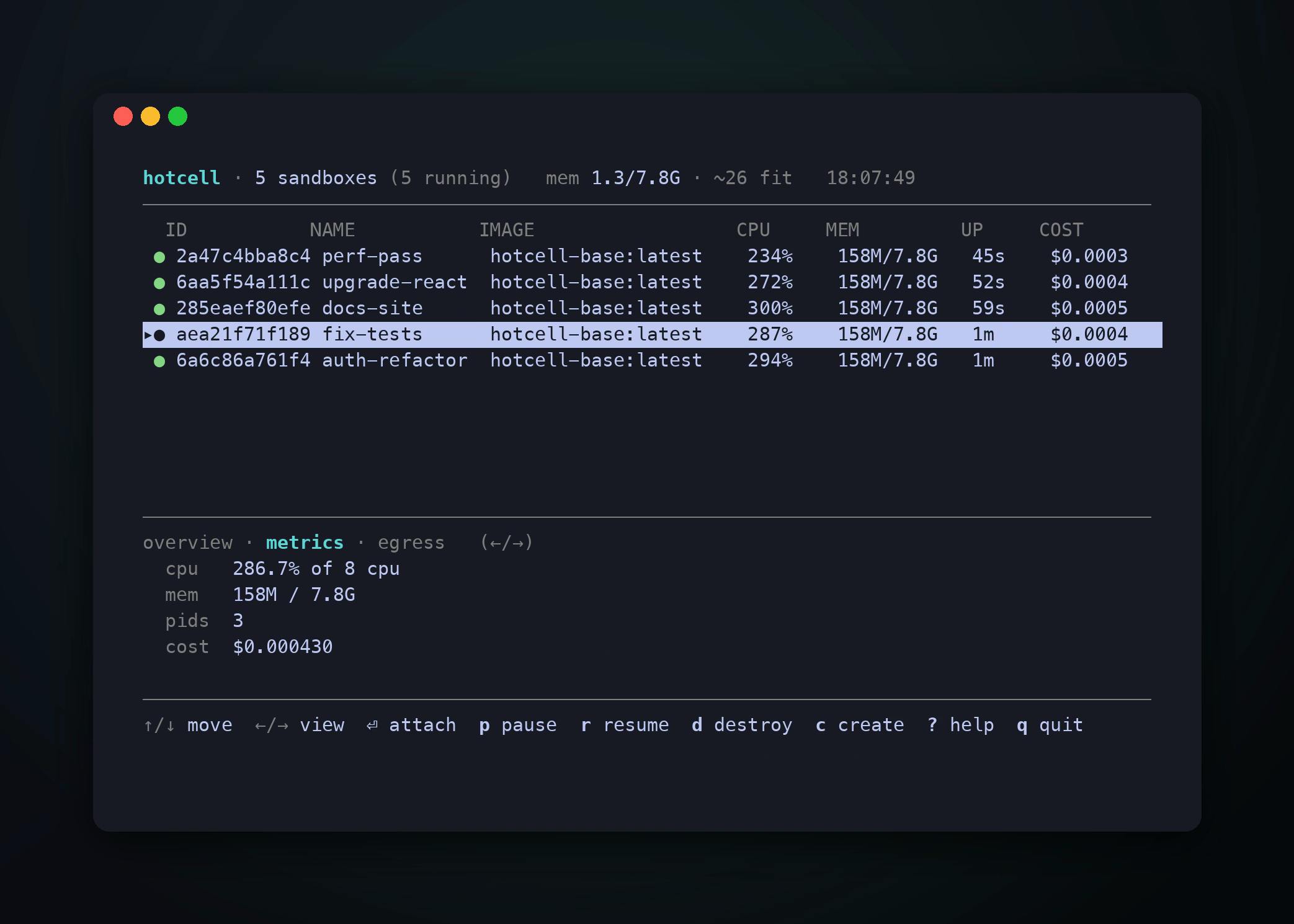
Why AI Agents Need Sandboxes
The value of AI Agents lies in autonomous task execution—writing code, running scripts, calling tools, and accessing external services. But this autonomy also introduces risk: AI-generated code might accidentally delete files, initiate malicious network requests, or inadvertently leak your API keys.
It's important to understand the fundamental difference between AI Agents and traditional chatbots. AI Agents don't just generate text responses—they can perform tool calling, execute system commands, and manipulate file systems. This architecture is extremely valuable in software development, data analysis, and system operations, but it also introduces entirely new attack surfaces. For example, "prompt injection" attacks can trick an Agent into executing malicious operations, and the Agent itself—lacking deep semantic understanding of code—may unintentionally execute dangerous instructions. When the execution environment has no isolation measures in place, a single runaway code execution can cause irreversible damage.
The current industry standard is to use cloud-based sandbox services (such as Cloudflare Sandbox SDK, E2B, etc.) to run code in remote isolated environments. These cloud sandboxes typically achieve isolation through microVMs or lightweight container technology—for instance, E2B uses Firecracker microVM technology (originally developed by AWS for the Lambda service), which can spin up a complete Linux environment in milliseconds; Cloudflare Sandbox SDK leverages the V8 isolation mechanism from its Workers runtime. This approach offers strong security but introduces network latency (typically 50-200ms round-trip), usage-based billing pressure, and data sovereignty compliance concerns. For scenarios involving sensitive code (such as financial algorithms or medical data processing), transmitting data to third-party servers may directly violate regulatory requirements. For developers who want local control over everything, handing sensitive code and data to third-party cloud services isn't ideal.
This is exactly where hotcell comes in: bringing sandbox capabilities back to local environments. Whether on Mac, Linux, or bare-metal servers, you can run your own sandbox environment—preserving isolation while avoiding cloud service dependencies.
hotcell's Core Design
According to its Product Hunt page, hotcell is a self-hosted sandbox SDK "inspired by Cloudflare Sandbox SDK." Its positioning is crystal clear: enabling both human engineers and AI Agents to easily create and manage isolated code execution environments. Installation is dead simple—just one command:
npm i -g hotcell
Based on official descriptions, several design highlights of hotcell deserve attention.
Cross-Platform Local Execution
hotcell emphasizes "works on any device"—it runs on Mac, Linux, and even bare-metal machines. This means developers don't need to depend on any specific cloud platform to set up sandboxes on their laptops or private servers. For teams that prioritize data privacy or operate in offline/intranet environments, this is a practical advantage.
Controllable Resources and Costs
Each sandbox's capacity and token consumption can be under "full control" by the user. This is especially important for AI Agent scenarios—an autonomous agent that goes haywire could consume massive computing resources or API quotas in a short time. By setting explicit resource caps for each sandbox, developers can effectively prevent "runaway" situations and keep risk within predictable bounds.
Default-Deny Egress with LLM Access Allowed
hotcell supports default-deny egress (blocking all outbound network requests by default) while allowing sandboxes to access LLM providers. This is a remarkably restrained yet practical network policy: it blocks the possibility of sandbox code sending data to unknown external addresses while preserving the core functionality of AI Agents calling large model APIs.
The core principle of default-deny egress is: unless explicitly allowed, all outbound network connections from inside to outside are prohibited. This is the polar opposite of traditional firewalls that "allow outbound by default" and represents a key practice in zero-trust network architecture. The principle is analogous to the operating system's Principle of Least Privilege—granting only the minimum network access required to complete a task. In AI Agent scenarios, even if AI-generated code contains malicious HTTP requests or DNS queries, they'll be intercepted by the network policy, while the whitelist mechanism ensures normal access to LLM API endpoints (such as OpenAI and Anthropic service addresses). This "least privilege" network design is precisely what makes security isolation effective.
Key Security: Per-Sandbox Token Mechanism
Perhaps hotcell's most compelling design choice is how it handles API keys.
In traditional approaches, running AI code often requires injecting real API Keys directly into the execution environment. But once a key enters a sandbox, there's theoretically always a risk of theft or leakage—especially when executing AI-generated code whose behavior isn't entirely predictable.
hotcell's solution: real API keys never directly enter individual sandboxes. Instead, the system generates independent, temporary tokens for each sandbox that "die when the sandbox stops."
The benefits of this mechanism are obvious:
- Key isolation: Even if a sandbox is compromised, attackers only obtain soon-to-expire temporary credentials, not your master key.
- Lifecycle binding: Tokens sync with the sandbox lifecycle, eliminating the need to manually manage credential creation and revocation.
- Audit-friendly: Each sandbox has independent credentials, making it easy to track resource usage across different tasks.
This design philosophy aligns with the "ephemeral credentials" approach in cloud-native security, bringing mature security practices down to local development scenarios. Short-lived credentials are a core practice in cloud-native security, with representative implementations including AWS STS (Security Token Service) temporary security credentials, HashiCorp Vault's dynamic secrets, and Kubernetes ServiceAccount Tokens. The core logic is: the shorter a credential exists, the smaller the window for malicious exploitation. A traditional long-lived API Key, once leaked, can be used indefinitely; but a temporary token whose lifecycle is bound to a single task automatically becomes invalid after the sandbox is destroyed. NIST (National Institute of Standards and Technology) explicitly recommends short-lived credentials in its Zero Trust Architecture guidelines as a key measure for reducing lateral movement risk. hotcell brings this enterprise-grade security practice to local AI development scenarios, embodying the "Shift Left Security" philosophy.
Positioning and Value Analysis
hotcell appears in a rapidly heating space. As AutoGPT, Claude Code, and various coding agents proliferate, "secure execution of AI-generated code" has evolved from a niche topic to a hard requirement. Developers need a solution that isolates risk without sacrificing developer experience.
This space is rapidly forming an ecosystem. Beyond hotcell's local sandbox positioning, major players include: E2B (cloud sandbox, having raised millions in funding, supporting Python/JS and other languages), Cloudflare Sandbox SDK (isolated execution based on the Workers platform), and Modal (GPU-accelerated cloud functions, commonly used for AI inference tasks). In the local isolation direction, Google's open-source gVisor (application kernel-level isolation) and Firecracker microVM are also viable underlying technology stacks.
Compared to cloud sandboxes, hotcell's differentiation lies in being local-first + self-hosted. It returns control to developers: data stays on your machine, costs are self-managed, and keys never leave your environment. For individual developers, privacy-conscious teams, and enterprises that need to deploy AI capabilities in intranet environments, this is an attractive option.
Of course, as a newly released open-source project, hotcell currently has only 4 comments and a small community. Its stability in production environments, isolation strength (e.g., whether it's based on containers, VMs, or other technologies), and integration with mainstream Agent frameworks remain to be validated over time. Isolation strength is a critical metric when evaluating sandbox solutions—if it relies solely on process-level isolation (similar to chroot), the security is far weaker than VM-level isolation (like Firecracker) or kernel-level isolation (like gVisor); but stronger isolation typically means higher performance overhead and more complex compatibility issues. These technical details are aspects developers should carefully examine before actual adoption.
Conclusion
hotcell represents a trend worth watching: AI infrastructure is extending from "centralized cloud" to "local autonomy." As AI Agents increasingly participate in actual code execution, security isolation is no longer optional—it's essential.
Getting a local sandbox with default-deny egress, keys that never leak, and controllable resources with a single npm i -g hotcell command—this design philosophy undeniably lowers the barrier to security isolation. For developers building AI Agent applications, hotcell at least offers a new option worth trying.
Related articles

Why Do Taxi Drivers Rarely Get Alzheimer's? The Link Between Spatial Navigation and Brain Health
Research shows taxi and ambulance drivers die from Alzheimer's at significantly lower rates. This article explores how spatial navigation protects brain health through hippocampal plasticity and cognitive reserve.

Stynar: How an Autonomous AI Sales Agent is Reimagining the Entire B2B Outbound Prospecting Workflow
Deep dive into Stynar, an AI SDR product that uses autonomous AI agents for prospect research, personalized emails, multi-mailbox sending, intent detection, and automated meeting booking to cut B2B outbound costs.

Why Chinese LLMs Are Dominating the OpenRouter Weekly Rankings
Chinese LLMs dominate OpenRouter's weekly usage rankings. DeepSeek, Qwen, and Kimi win global developers with open-source strategies, extreme cost-efficiency, and technical breakthroughs.