How AI Agents Handle Tool Call Failures: Retry, Switch, or Ask for Help

The key to a reliable AI Agent is designing tool failure handling into the workflow from the start.
AI Agents depend on external tools like APIs, search, and databases, which fail via timeouts, authentication errors, permission denials, and stale results. The article distinguishes technical errors from semantic failures and lays out a core recovery flow: execute, check, classify, choose a strategy (retry, switch tools, or escalate), then validate. It covers retry limits, exponential backoff, idempotency, fallback tools, and human-in-the-loop design.
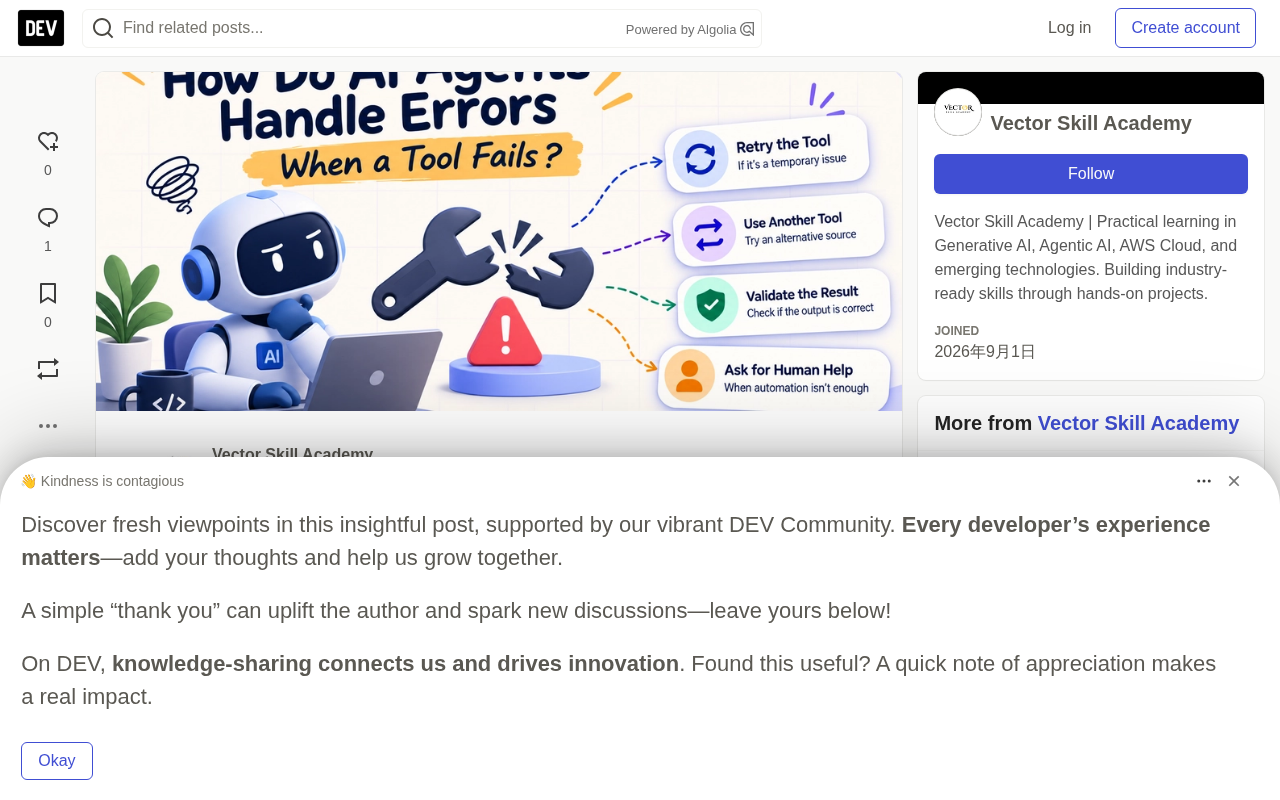
An AI Agent is asked to search for flights, compare prices, and put together a travel plan. Halfway through, the flight search API suddenly stops responding, or only returns partial data. What should the Agent do now? Retry the request, switch to another tool, continue with the incomplete data it has, or stop and ask the user?
There is no single correct answer, and that is precisely the problem. AI Agents depend on tools and external systems, and those systems fail in all sorts of ways. A reliable Agent is not one that never makes mistakes — it is one that has error handling designed in from the start.
Why AI Agents Cannot Do Without Tools
A language model on its own can only generate text. To accomplish tasks beyond text, an Agent must rely on external tools: APIs that return real-time data, web search, databases, file retrieval, calculators, calendars, and other external applications.
Tools give an Agent access to information or capabilities it cannot generate on its own. But every tool sits on top of networks, servers, third-party services, and permission layers, and an Agent is only as reliable as those underlying components — which is exactly where errors originate.
What Types of Tool Failures Exist
Tool failures come in far more forms than you might imagine. API timeouts, network errors, rate limits, authentication failures, malformed input parameters, missing critical fields, unexpected return formats, stale or irrelevant search results, service outages, insufficient permissions, and two tools giving contradictory answers to the same question.
Here we need to distinguish between two fundamentally different situations. Technical errors are when the call clearly fails: timeouts, error codes, rejected requests. But a tool can also succeed technically while returning wrong or useless content — for example, a search that runs fine but delivers confident yet outdated pricing information. The second case is often harder to detect because everything looks normal on the surface.
How Agents Detect Tool Failures
Detection comes not only from the model itself but more from the surrounding application. Signals include error messages and status codes returned by the tool, validation checks on outputs, missing required fields, and responses whose format does not match expectations.
Beyond these mechanical checks, there is a subtler question: does the result actually satisfy the task requirements? A flight search that returns hotels will not trigger any error code, but for the current task it is a failure. LLMs do not automatically detect every error correctly — they may treat a malformed response as normal, or mistake partial results for complete ones. This is precisely why the application layer needs active verification mechanisms rather than assuming the model will always notice anomalies.
Output validation is a separate layer of checks sitting between "call succeeded" and "task succeeded." Common practices include: validating the return structure with JSON Schema, checking that required fields are present, checking that values fall within reasonable ranges, checking whether dates have expired, and checking whether results align with user constraints (such as budget or location). These checks are usually performed by application code rather than the LLM, because models tend to be blind to malformed or semantically shifted responses.
A related concept is hallucinated success: the tool returns a plausible-looking answer, but the content is actually fabricated or outdated. Countermeasures include cross-validating multiple sources, requiring tools to return timestamps and source identifiers, and setting thresholds for high-risk fields. The goal of the validation layer is not absolute correctness, but rather to intercept clearly unacceptable outputs before they enter the Agent's reasoning chain, preventing errors from being amplified in subsequent steps.
What Happens After a Tool Failure
A practical recovery flow typically looks like this: execute tool → check result → detect failure → classify error → choose recovery strategy → retry, switch tools, or escalate → validate result.
The critical step is error classification. A timeout means the problem may be temporary; an authentication failure means retrying is useless; a permission error requires an entirely different path. Based on the classification, the system selects a strategy: retry, switch tools, or escalate to a human. Finally, any returned result must be validated before use. Treating all errors the same way — either retrying everything or giving up on everything — wastes time in some scenarios and can cause real harm in others.
When to Retry
Retrying makes sense when the failure is likely temporary: brief network interruptions, service timeouts, short-term server unavailability, or rate limits that are about to lift.
Good retry design has clear boundaries. Systems typically set a maximum retry count to avoid infinite loops, add a retry delay, and often adopt exponential backoff — progressively longer wait times (say 1 second, 2 seconds, 4 seconds) — giving a struggling service room to recover rather than hammering it continuously.
Equally important is not retrying calls that cannot possibly succeed. Repeatedly requesting with invalid parameters, or repeating a call the Agent has no permission to execute, only consumes time and resources. For operations that change the external world (such as submitting an order or initiating a payment), there is an additional special risk: the first attempt times out, but the operation may have actually succeeded, and a retry would produce a duplicate. This is where idempotency matters — idempotent operations can be safely repeated without changing the outcome beyond the first execution. When an operation is not idempotent, the safer approach is to first check the operation's status to confirm whether the initial attempt already completed.
Exponential backoff is the standard strategy for handling transient failures in distributed systems. The core idea is to let the retry interval grow exponentially with the number of failures (e.g., 1 second, 2 seconds, 4 seconds, 8 seconds) rather than using a fixed interval or retrying immediately. This avoids the "thundering herd" effect — where a large number of clients simultaneously hammer an already overloaded service, actually prolonging the outage. In practice, it is often combined with jitter, which adds a random amount to the backoff time to prevent multiple Agents from retrying in sync at the same moment.
Idempotency is the key property for determining whether a retry is safe. An idempotent operation produces the same effect on the external world no matter how many times it is executed — for example, querying weather, reading a file, or sending a notification with a unique ID. Operations like transferring money, placing orders, or creating resources are typically not idempotent. When it is unclear whether the first request already took effect, the safer pattern is to check status before deciding: query whether an order exists, compare operation IDs, or introduce an idempotency key so the server can deduplicate, rather than blindly resending.
When to Switch Tools
Sometimes the primary tool is unavailable or simply unsuitable. Suppose an Agent is collecting product information and the search service fails — the application might try another approved source, query an available database, or state that the information cannot currently be obtained.
Choosing a fallback requires considering several points: which alternative tools are actually available, whether they meet the task requirements, how results from different sources compare, and whether the alternative is reliable enough. Fallbacks should not be used blindly. If the backup source cannot provide the needed information, or provides lower-quality data, quietly substituting it may be worse than honestly acknowledging the limitation. Different sources are not inherently equivalent.
How to Leverage Error Feedback
Error messages are information. In a well-designed Agent loop, the observation of a failed action feeds into the next step.
For example, if an Agent tries to fetch customer information but receives a permission-denied response, the wrong approach is to retry the same request repeatedly. The better path depends on system design: check whether the Agent was supposed to have that permission, use an authorized workflow, or request administrator intervention.
It is important to be careful about this distinction: this is designed system behavior, where failure information flows into the current task's context so the Agent can make a different choice. It does not mean every Agent permanently learns from every failure. Unless the system is deliberately designed to store and leverage these experiences, the next session may start from scratch.
An Example: The Agent That Cannot Find a Flight
A user asks the Agent to find a suitable flight within a given budget. The recovery process might look like this: understand requirements (route, dates, budget) → call the flight search tool → receive a timeout or incomplete results → classify the problem type → if the failure is temporary and retry is safe, retry (read-only searches are typically safe to repeat within a retry limit) → if necessary, use an approved alternative source → validate that returned flight details match the request → explain remaining limitations to the user, such as "I could only check one source."
Different failures lead to different decisions. A timeout points to limited retries; an authentication failure points to escalation, because retrying cannot fix expired credentials; incomplete results point to validation and possibly a second source; and if a flight is returned but exceeds the budget — no error occurred at all, and the Agent simply needs to recognize that the result does not satisfy the task requirements.
How Developers Can Design Reliable Agent Workflows
Several principles run through most designs: define clear tool inputs and outputs, validate parameters before execution, and validate results before use. Set reasonable timeouts and retry limits, and use backoff for transient failures. Restrict permissions to exactly what each task requires. Provide approved fallback mechanisms rather than letting the Agent improvise source selection on its own. Log errors and important execution events, and monitor repeated failures. Require human approval for sensitive operations, and establish clear stopping conditions.
These principles matter even more in multi-step workflows, where errors compound. A single bad result at step two can quietly contaminate steps three through eight, and an Agent that cannot stop itself may exhaust resources or cause real damage.
How to Prevent Repeated Failures
Recovering from a failure and improving the system so it fails less often are two different things. The latter is achieved through evaluation and monitoring.
This means independently testing tools, deliberately testing error scenarios (what happens when the API times out?), monitoring API availability, and tracking trends in successful and failed tool calls. It also includes evaluating output quality, testing fallback paths to ensure they actually work when needed, and reviewing failure patterns to find recurring causes. These findings can feed back into updated tool descriptions and validation rules.
When to Ask a Human for Help
Automatic recovery is not always the right choice. Certain situations call for stopping and asking: repeated tool failures, missing critical information, contradictory results the Agent cannot resolve, insufficient permissions, sensitive or irreversible operations, uncertainty about the user's true intent, and high-impact decisions.
Human-in-the-loop design deliberately incorporates these situations into the system, preventing the Agent from pushing forward when the honest answer is "I am not sure, and the cost of guessing is too high."
Human-in-the-loop (HITL) is a design pattern that embeds human judgment into automated workflows, rather than being a fallback after the flow fails. It typically takes two forms: first, pre-approval, where the Agent pauses before executing a sensitive or irreversible operation and waits for human confirmation; second, post-hoc escalation, where the Agent hands over complete context to a human when it encounters unresolvable contradictions or permission obstacles.
When designing HITL, three questions must be clarified: what conditions trigger escalation, what information is presented to the human during escalation, and how the flow continues after the human makes a decision. Escalation conditions should be as specific and determinable as possible, such as "the same tool fails three times in a row," "the result conflicts with user constraints," or "the operation involves payment or data deletion." The information presented to the human should include attempted actions, failure reasons, and available paths — otherwise the human can only start investigating from scratch, which actually reduces overall efficiency.
Getting Started with AI Agents from an Error-Handling Perspective
A reasonable learning path is: first master generative AI fundamentals and core LLM concepts, then APIs and tool calling, followed by the Agent loop. Error handling basics, retry strategies, and timeout mechanisms come next, along with input/output validation. RAG and external data retrieval demonstrate how Agents handle external information, while logging, monitoring, and AI evaluation show how to keep the system healthy. Security and permissions run throughout, and building and testing small AI applications turns concepts into experience.
For those who want systematic learning, structured courses are more efficient than piecing together a path from scattered resources. The key is to design for failure from the start — tools will time out, services will go down, and results will sometimes be wrong. The Agents worth trusting are the ones built to handle these situations gracefully.
One-line Summary
The key to a reliable AI Agent is not never making mistakes, but designing tool failure handling into the workflow from the start.
Paragraph Summary
AI Agents depend on external tools like APIs, search, and databases, and these underlying systems fail in many ways: timeouts, authentication failures, permission denials, stale results, and more. The article distinguishes technical errors from semantic failures, noting that the latter are harder for LLMs to detect automatically and therefore require active validation at the application layer. The core recovery flow is execute, check, classify, choose a strategy (retry, switch tools, or escalate to a human), then validate. Retries need limits, delays, and exponential backoff, and non-idempotent operations should check status first. Fallback tools should not be substituted blindly, as data quality from different sources is not equivalent. Ultimately, reliable Agent design principles include validating inputs and outputs, restricting permissions, logging events, setting stopping conditions, and introducing human approval before sensitive or irreversible operations.
Related articles

RAG Getting Started in Practice: From Principles to Building an Enterprise Knowledge Base
Bilibili RAG course highlights: from retrieval-augmented generation principles, document chunking and vectorization, to five accuracy factors and enterprise knowledge base boundaries, with fine-tuning vs RAG selection advice.

AI Model Selection Guide: DeepSeek vs. Qwen3 in Practice
How should AI developers choose models? Based on a Bilibili tutorial, this article breaks down the Function Calling differences between DeepSeek V3 and R1, Qwen3's programmatic thinking mode switching and agent capabilities, and outlines a multi-model learning path and practical selection logic.

Anchoring, Loss Aversion, and Nudges: 5 Psychological Tactics Retailers Use to Make You Spend
Behavioral economics reveals how retailers use anchoring, framing, loss aversion, and nudge theory to manipulate your spending decisions. This article breaks down 5 common psychological tactics and offers counterstrategies like slowing down decisions and setting your own anchors to see through the pricing design behind discounts.