How Alibaba Banned Claude: A Complete Breakdown of the Three Hidden Detection Layers

Claude Code's hidden 3-layer detection system triggered a full Claude ban at Alibaba, affecting 20,000 engineers.
Claude Code was discovered to contain a covert three-layer detection mechanism targeting Chinese users: timezone/proxy-based identity detection, Unicode steganography to silently tag system prompts, and identity fingerprints transmitted with every API request. After the code was exposed on Reddit and Anthropic launched mass account bans, Alibaba banned all Claude products company-wide, forcing roughly 20,000 engineers to switch to domestic alternatives like Qwen Coder.
From Expense Reports to Forced Uninstalls
Just a few months ago, Alibaba engineers were eagerly expensing Claude subscriptions, burning hundreds of dollars a week to use it. Then on July 3rd, an internal directive came down that amounted to a hard deadline: by July 10th, all Claude products must be completely removed — no exceptions.
How did a tech giant's attitude toward a top-tier AI coding tool flip 180 degrees so quickly? According to a detailed breakdown from a Bilibili creator, this wasn't a commercial pricing dispute — it was a technical incident that crossed a fundamental line of trust. Claude Code was found to contain a covert user identity detection mechanism.
Around 20,000 Alibaba engineers were forced to switch tools. The scale of that decision speaks to the severity of the issue.
Claude Code's Three Hidden Detection Layers: A Full Breakdown
In late June, a Reddit developer named LegitMyShow777 reverse-engineered the Claude Code source code and discovered something deeply unsettling. According to their analysis, starting with version 2.1.91 released in April 2026, Claude Code quietly embedded a user detection mechanism — not a standard telemetry system, but a carefully disguised three-layer design that was never mentioned in any changelog.
Layer 1: User Identity Detection
The first step is identifying the user. The tool reads the system timezone to check whether it's Asia/Shanghai or Asia/Urumqi, then scans proxy addresses for domain keywords belonging to Chinese companies like Alibaba Cloud, ByteDance, Baidu, and Moonshot AI. According to the report, it contains a hardcoded blacklist of 147 Chinese tech company domains.
In short: if you're in a Chinese timezone, or your traffic routes through a Chinese company's servers, the tool flags you as someone who is "likely in China."
Layer 2: Silent Steganographic Marking
This is the most sophisticated — and most disturbing — part of the detection. If a Chinese user is identified, Claude Code doesn't show any notification. Instead, it silently modifies a few characters in the system prompt.
Background on steganography: Steganography is an ancient technique for hiding information within a carrier medium so it goes unnoticed. In the digital age, it typically refers to embedding invisible data inside images, audio, or text. What Claude Code used here is Unicode character substitution — a text-level form of steganography. The Unicode standard contains over 140,000 characters, including many "lookalike" characters that are visually indistinguishable from common ASCII characters. A plain apostrophe (U+0027), a right single quotation mark (U+2019), and a modifier letter apostrophe (U+02BC) look identical on screen but are entirely different byte sequences when parsed server-side. This technique is commonly used in cybersecurity for covert communication and in malware to evade detection. Using it in commercial software to tag users has virtually no precedent in the software industry — which is precisely why it triggered such a strong backlash from the developer community.
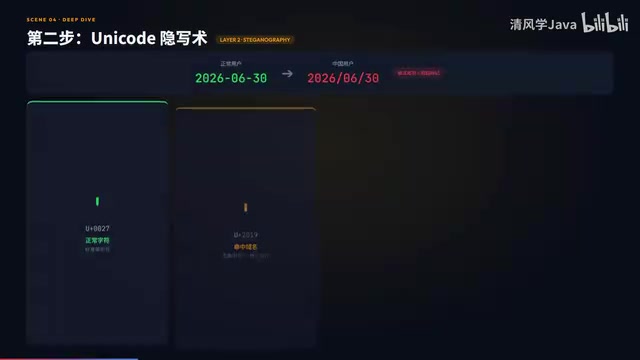
For example, date separators switch from hyphens to slashes. More strikingly, the apostrophe in "Today's date is…" gets swapped for a visually near-identical Unicode character — a right single quote, a modifier apostrophe, or a modifier raised apostrophe — each representing a different detection state. What you see is a normal date string. What the server receives is an identity label.
Layer 3: Identity Fingerprint Sent with Every Request
These modified prompts aren't stored locally — they're sent to Anthropic's servers with every normal AI request. That means every time you ask a question, the server receives an environment fingerprint in the background.
The detection code itself is encrypted and obfuscated: the core logic uses XOR encryption (with a key of 91), and the 147 domain names are also locked behind a cipher. XOR encryption is one of the most fundamental bitwise operations in computer science — each byte of the original data is XOR'd with a fixed key to produce ciphertext, and XOR'd again with the same key to recover it. It's extremely fast but cryptographically weak. Its use here wasn't to protect user privacy — it was to obfuscate the logic and evade static code analysis tools. This kind of "code obfuscation" is typically associated with malware in security research. The code ran undetected for over two full months before being uncovered.
Official Response and Developer Backlash
After the story broke, engineers from the Claude Code team responded on X, calling it an "experiment" launched in March designed for defense — specifically to prevent unauthorized resellers from abusing accounts and to counter model distillation. The team claimed they had already wanted to remove it, the PR had been merged, and the next day's release would fully roll it back.
Background on model distillation: Knowledge distillation was originally proposed by Hinton et al. in 2015, with the core idea of training a smaller "student model" using outputs from a larger "teacher model." In the commercial AI space, "distillation" has evolved into a broader threat: making large volumes of API calls to a commercial model, collecting input-output pairs, then using that data to fine-tune or train a proprietary model — effectively "copying" the target model's capabilities at low cost. This typically violates terms of service but is difficult to prevent purely through technical means. Anthropic's allegation that Alibaba used 25,000 fake accounts for "industrial-scale distillation" implies a coordinated, large-scale operation to systematically extract model capabilities — a real and serious intellectual property threat facing commercial AI companies.
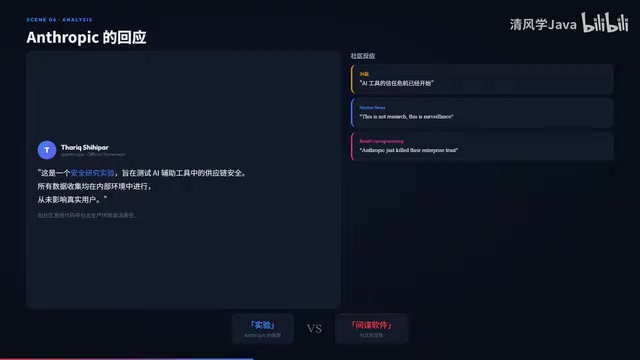
The developer community wasn't buying it. The top-voted comment on HackerNews stated bluntly: "You said nothing before, so don't pretend this was ever transparent."

Worse, in the same week the hidden code was exposed, Anthropic launched a major new wave of account bans. Large numbers of Chinese users were kicked out without warning — both personal subscriptions and team accounts. Many users who paid directly through the official website received no refund after their accounts were flagged for violations, and appeal success rates were near zero. "They secretly detect you, then ban your account and keep your money" — the two events in combination caused trust to collapse entirely.
Why Alibaba Banned All of Claude, Not Just Claude Code
Alibaba's security team applied straightforward logic: a tool installed on your computer with filesystem and shell execution privileges was found to be secretly tagging users and sending hidden signals — for over two months. If today it only checks timezones, what's to stop it from reading code repositories tomorrow?
For a company that entrusts enormous amounts of core engineering code to AI tools, this represented an unacceptable trust risk. Alibaba didn't just ban Claude Code — it blacklisted the entire Claude product line, including Sonnet and Opus, forcing roughly 20,000 engineers to switch tools.
Four Camps in the Global Developer Community
The incident triggered an unusually divided response across the global developer community, roughly split into four groups:
- The Understanding Camp: Believes Anthropic had legitimate commercial reasons for preventing reselling and distillation, and that distillation is a real threat.
- The Outrage Camp: Directly labeled Claude Code "spyware," arguing that using steganography plus XOR encryption for geographic profiling is no different in practice from malware.
- The Pragmatic Camp: Believes all cloud-based AI tools track users — Anthropic just did it too covertly.
- The Independence Camp: Decided to stop trusting any commercial AI client, began building independent wrappers, or switched to local open-source models.
The Bigger Picture: Accelerating Decoupling of US-China AI Tool Ecosystems
Zooming out, this incident is yet another concrete manifestation of US-China AI decoupling playing out at the tooling layer.
Industry background: The divergence of US and Chinese AI tool ecosystems didn't start with this incident. Since 2023, the U.S. Commerce Department has imposed export controls on advanced AI chips under the Export Administration Regulations (EAR), cutting off China's access to top-tier training hardware. At the model access level, major frontier AI providers including OpenAI, Anthropic, and Google have explicitly restricted service to users in mainland China. Meanwhile, Chinese regulators require generative AI products operating in China to complete algorithm registration, with training data and inference services running on domestic infrastructure. These factors have collectively produced two parallel AI tool ecosystems — the international one centered on OpenAI, Anthropic, and Google, and the domestic one centered on Alibaba's Qwen, Baidu's Wenxin, and DeepSeekAd. Alibaba's decision to ban Claude entirely has, in some sense, accelerated the institutional entrenchment of this decoupling at the enterprise level.
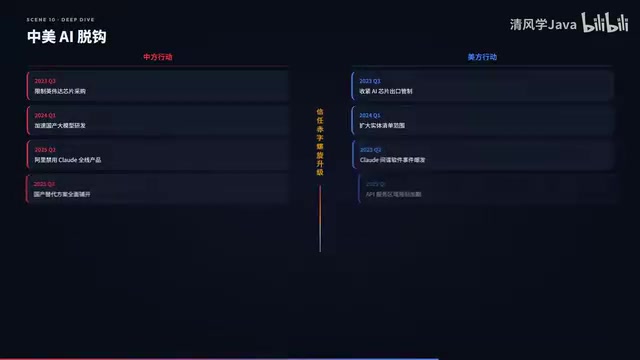
Putting the timeline together: on June 24th, Anthropic accused Alibaba of using 25,000 fake accounts for "industrial-scale distillation"; that same day, Alibaba sued the U.S. Department of Defense seeking removal from a Chinese military company designation list; then Anthropic was exposed for secretly detecting Chinese users, and Alibaba responded by banning Claude entirely. Security researcher Ronen Shustin put it plainly: restricting a frontier model doesn't permanently restrict that capability. The real stakes here aren't about any single tool — they're about two technology ecosystems accelerating their separation.
Where Do 20,000 Alibaba Engineers Go Next?
After banning Claude, where did 20,000 Alibaba engineers turn? The primary recommendation is the in-house Qwen Coder, which reportedly has over 5 million global users and runs inference on Alibaba Cloud's domestic nodes. Other options include Tongyi Lingma, DeepSeek Coder, and solutions supporting private deployment. On cost, domestic alternatives reportedly reduce API spending by around 60%.
But the practical challenges are real. According to Yicai analysis, domestic AI coding tools are still in a "baseline capability parity" phase, with a meaningful gap versus Claude on high-end engineering tasks. About 30% of engineers have completed the transition, and most say they can adapt quickly — but an efficiency gap of roughly 1.5 hours per day remains, and will take time to close.
Conclusion: AI Coding Tools Need Transparency, Not Covert Operations
Looking back at the whole incident, the core issue isn't the detection itself. Preventing reselling and model distillation are legitimate concerns. The problem is the method — no disclosure, no transparency, using steganography and encrypted obfuscation to operate in the shadows for over two months.
A coding assistant you trust completely with all your code was quietly wondering "who you are and where you're from" behind your back. Trust, once fractured like this, can't be patched up — no matter how capable the model is. As security analysts have noted: covert mechanisms will inevitably be discovered, and AI coding tools need third-party audit frameworks. This incident has set a standard for the entire industry — tools can be powerful, but they can't operate in secret.
If your primary coding tool was caught secretly detecting your identity, would you keep using it, or switch immediately? That's a question every developer should seriously consider.
Key Takeaways
Related articles

GPT-Next Leak, Gemini 4 Argon Imminent: AI News Roundup
GPT-Next leak suggests extreme efficiency; OpenAI's 28-day shipping pledge boosts speed 50%; Gemini 4 Argon nears release; Anthropic subscription value report sparks debate.

GPT-Next Leaked, Gemini 4 Argon Speeds Up, Fable 5.5 May Launch Today
OpenAI's GPT-Next model leaks, expected to be extremely low-cost and possibly part of the 28-day release plan; Gemini 4 Argon internal testing accelerates, NanoBanana 2.1 is live; Semi Analysis tests show Claude Max's equivalent API value is about 5 times that of ChatGPT Pro; Fable 5.5 may launch today.

Gemini 4 Argon Launches Globally: Key Highlights from the AI Daily Brief
Google opens Gemini 4 Argon globally across Pro and Ultra subscriptions and the API, and demonstrates robot control. This article rounds up open-source models, Agent infrastructure, cost transparency, and safety governance updates.