How arXiv's Endorsement System Works: A Guide for First-Time cs.AI Submitters

A Reddit plea for arXiv endorsement explains what the system actually is — an access filter, not peer review.
Using a researcher's Reddit post seeking arXiv endorsement as a starting point, this article explains how arXiv's endorsement system works. Endorsement is not peer review — it's a quick two-minute confirmation from an existing arXiv author that a new submitter is broadly legitimate. Endorsers must have publishing history in the relevant subject category, with eligibility determined automatically by arXiv's system. Many independent researchers and developers get stuck at this step due to a lack of academic connections. The article recommends reaching out to advisors or collaborators first, building academic networks, or applying directly through arXiv's official support channels — rather than posting endorsement codes publicly online.
A Reddit Post That Sparked a Broader Conversation
Recently, a researcher posted a plea on Reddit asking community members to endorse their upcoming arXiv submission to cs.AI (Artificial Intelligence). According to the poster, they had spent about four months completing the research paper and accompanying code — only to hit one final hurdle: as a first-time submitter, they needed an existing arXiv author to endorse them before their submission could go through.
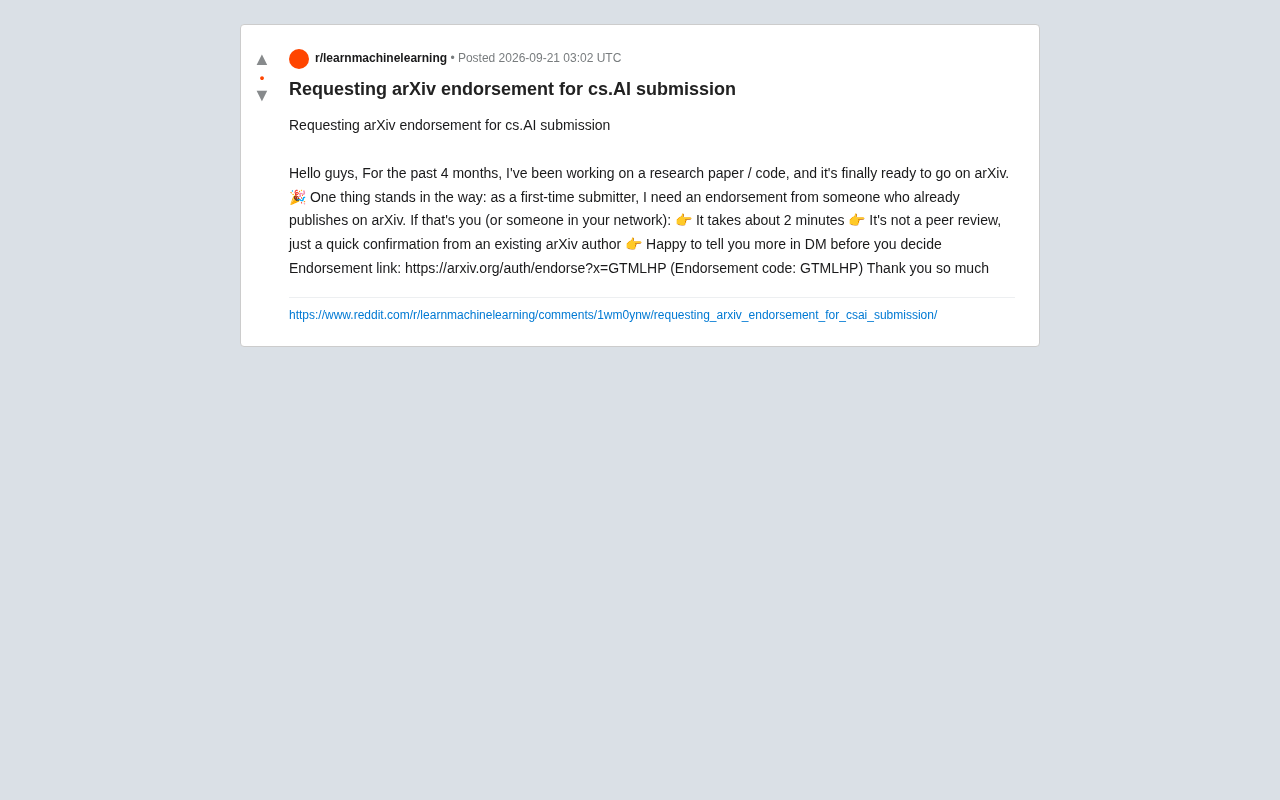
This seemingly simple request touches on a challenge that many newcomers to academic publishing share: What exactly is arXiv's endorsement system? Why are first-time submitters blocked from uploading directly? Using this case as a starting point, this article breaks down how arXiv's endorsement mechanism works — and what you can do about it.
What Is arXiv's Endorsement System?
arXiv is one of the world's most important preprint platforms, covering physics, mathematics, computer science, and more. Its cs.AI category has seen a dramatic surge in submissions in recent years. To maintain content quality and prevent spam or clearly non-compliant material from flooding the platform, arXiv introduced an endorsement system.
In simple terms: if you have never published in a particular subject area on arXiv, the system may require you to obtain confirmation from a "qualified endorser" before completing your first submission. As the Reddit poster emphasized, this process has a few key characteristics:
- It takes very little time — typically around two minutes
- It is not peer review — the endorser does not need to evaluate the scientific quality of the paper
- It is simply a quick confirmation from an existing arXiv author that the new submitter is "broadly legitimate"
In other words, endorsement is an access filter, not an academic judgment. The endorser is not vouching for the correctness or conclusions of the paper — they are simply helping the platform confirm that the submitter is not a bad-faith actor.
arXiv was founded in 1991 by physicist Paul Ginsparg at Los Alamos National Laboratory, originally to accelerate the dissemination of high-energy physics papers. A preprint is a draft paper that has not yet undergone formal peer review; authors publish it early to gather feedback and establish priority. arXiv now hosts over 2.3 million papers, and submissions to cs.AI have skyrocketed since the deep learning boom of 2017 — which is part of why endorsement requirements for this category are more complex than for less active ones. It's also worth noting that an arXiv paper is not the same as a "published paper" — formal publication requires passing peer review and appearing in a journal or conference proceedings, a distinction that carries significant weight in academic credibility.
Who Qualifies as an Endorser?
arXiv has clear requirements for endorsers. Generally, an endorser must have already published a certain number of papers in the relevant subject category within a specific time window. The system automatically determines whether a given author is qualified to endorse for a particular category — not every arXiv author can endorse for every field.
For a category like cs.AI, endorsers typically need to be researchers with a track record of successful submissions in computer science-related areas. This is precisely why the Reddit poster turned to a community like Reddit, where many technical practitioners and researchers are active.
It's also worth noting that endorsement links and codes (such as the code GTMLHP mentioned in the post) are tied to a specific submitter. When an endorser clicks the link, they see the applicant's identity information and then decide whether to confirm.
arXiv's endorsement eligibility uses a point-based logic: the system counts an author's submissions in a given category within a specific time window (typically the past five years), and once a threshold is reached, that author automatically gains endorsement rights for that category. An author might be qualified to endorse in hep-th (high energy physics theory) but not in cs.LG (machine learning) — so when looking for an endorser, you need to confirm they have rights in the specific category, not just any category. arXiv also provides a portal where eligible users can log in to check which categories they are authorized to endorse, so endorsers can verify their own status if unsure.
The Common Struggle of First-Time Submitters
The situation this Reddit poster describes is quite typical. Many independent researchers, career-changers entering academia, or developers at non-traditional institutions simply lack the network of senior arXiv authors they can turn to. They've done solid research work, and then get stuck at the "can't find an endorser" step.
The tone of the post reveals a genuine and professional approach — the poster proactively explains that endorsement is not the same as peer review, and offers to share their research privately before asking anyone to commit. This approach is worth emulating: when requesting an endorsement, clearly explaining what endorsement actually entails and reducing the perceived burden for the other party can significantly increase your chances of getting help.
That said, publicly posting an endorsement code on social media does carry some risk. Endorsement exists to prevent content abuse on arXiv, and asking strangers to endorse you is essentially asking someone to vouch for a person they don't know — which sits in some tension with the system's original intent.
More Reliable Ways to Get Endorsed
For researchers who genuinely have solid work but simply lack connections, the following approaches tend to be more reliable than posting publicly on forums:
Start with Advisors or Collaborators
If your research involved collaborators, advisors, or colleagues who have published on arXiv, they are the most natural candidates for endorsement. Even academic contacts who were involved in discussions at some point are worth reaching out to first.
Leverage Academic Social Networks
Attending academic conferences, joining research communities, and building connections on professional platforms all help you gradually accumulate the kind of relationships you can call on for help. Contacts with even a small degree of prior interaction are far more likely to respond positively than cold outreach to strangers.
Contact arXiv Directly
If you genuinely cannot find a suitable endorser, you can try explaining your situation through arXiv's official support channels. The platform will sometimes provide assistance under certain conditions, particularly when the research clearly meets their standards.
arXiv offers a formal "submission without endorser" process (submit a ticket via help.arxiv.org), where applicants can provide an institutional email address, personal homepage, or other materials demonstrating their academic standing. Platform staff will manually review the case and decide whether to waive the endorsement requirement. This channel is relatively low-profile and not widely known, but for researchers with a clear institutional affiliation who simply can't find an appropriate endorser, it is often the most direct solution — turnaround time is typically a few business days.
What This Case Reveals About Barriers in Open Scholarship
This brief Reddit post reflects a long-standing tension in the academic publishing ecosystem: on one hand, arXiv as an open preprint platform dramatically lowers the barrier to disseminating research; on the other, to maintain content quality, it must implement access controls like endorsement — and those controls are not particularly friendly to newcomers without academic connections.
This kind of barrier deserves attention, especially as the community of independent AI researchers and developers continues to grow. As the backgrounds of AI researchers become increasingly diverse, how to strike the right balance between preventing abuse and lowering the barrier for newcomers may be something platforms like arXiv will need to continuously refine.
For readers preparing to submit to arXiv for the first time: understanding the true nature of endorsement — that it is an access confirmation, not a quality judgment — and seeking help through legitimate, trustworthy channels is the most reliable path forward.
Related articles

Why Does the Tesla Roadster Need to Fly? A Deep Dive into Musk's Wild Demo
Tesla's Roadster launch showed wall-climbing, upside-down driving, and flying stunts—but The Vergecast notes the demo car may lack a battery, the Rocket version is invite-only and not street-legal, and the website terms don't guarantee delivery. After nine years of delays, why does this car still need to exist?

AI Is Not a Replacement: Human-AI Collaboration Through the Lens of Factory Root Cause Analysis
Starting from factory root cause analysis, this article explains how AI accelerates evidence chain construction rather than replacing human experts, exploring the pragmatic implementation logic and business value of 'AI supporting people rather than replacing them.'

AI Agent Decision Auditing: Building an Evidence Chain in Regulated Workflows
Starting from a Reddit discussion, this article analyzes three core issues in AI agent decision auditing within regulated workflows: what fields audit records should contain, how to handle feedback latency for erroneous decisions, and how to continuously calibrate LLM judge consistency with human judgment.