How ChatGPT Is Reshaping the Way the World Works: An Analysis of OpenAI Signals Data

OpenAI Signals provides the first systematic picture of ChatGPT usage across global work scenarios and its evolution.
OpenAI's Signals data covers 165 work activities across nearly 100 countries, systematically presenting ChatGPT usage in work scenarios worldwide for the first time. It shows both the static task distribution and how usage patterns change over time, helping distinguish novelty-seeking use from stable work habits. The article notes that AI penetration has reached specific workflow steps with finer task granularity, and that usage intensity and preferences vary by country, which is useful for multinational team tool selection. It also cautions that the data reflects only the ChatGPT platform, does not represent the entire AI tool market, and is not direct quantitative evidence of productivity gains; it should be treated as citable facts and a signal source to track continuously.
OpenAI's recently released Signals data offers the first systematic look at how ChatGPT is used across work scenarios worldwide. Covering 165 work activities across nearly 100 countries, this dataset not only shows how people use AI to assist with work but also traces how usage habits have evolved over time. For anyone following the real-world adoption of AI, this is a rare piece of "field research."
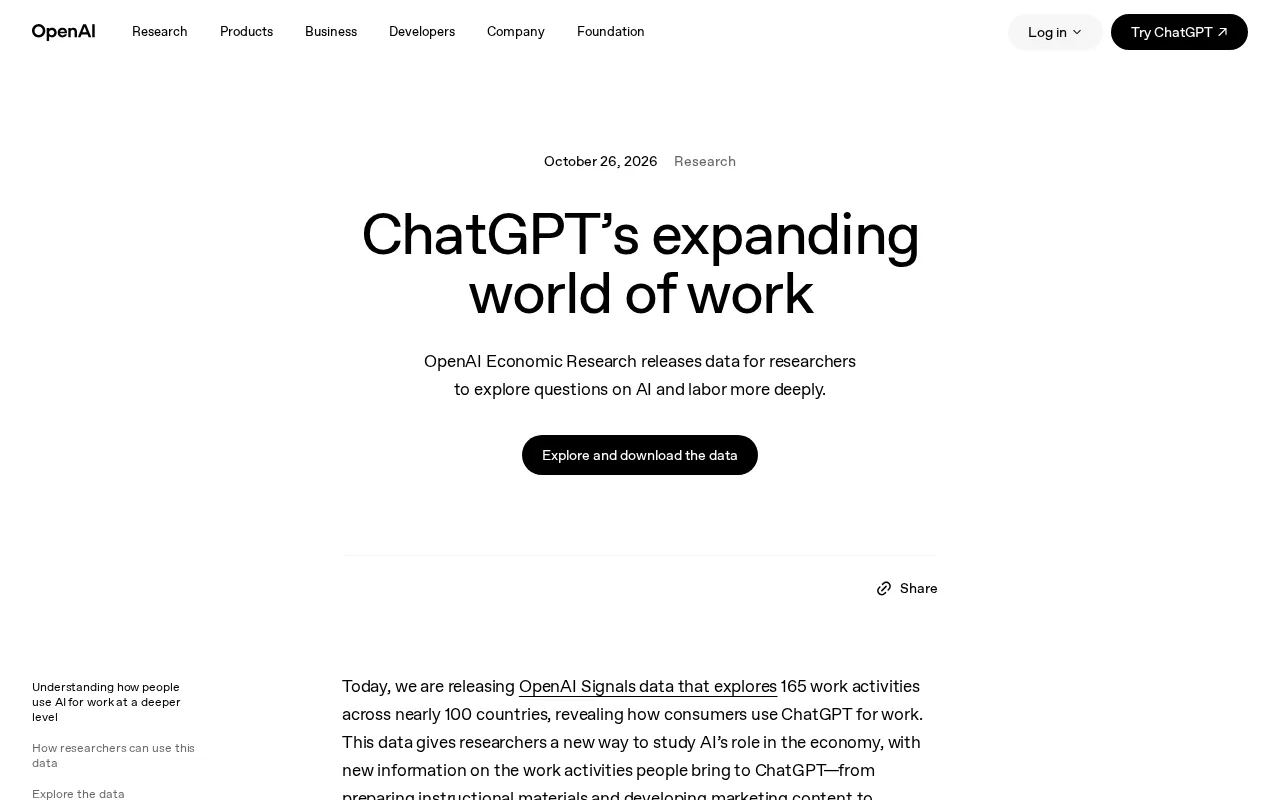
A global sample of "work activities"
OpenAI Signals is not a simple user-growth report. It focuses on specific work activities—from drafting emails and debugging code to summarizing meeting notes—in an attempt to answer a more granular question: what exactly are people asking ChatGPT to do?
Coverage of nearly 100 countries means the data is highly comparable across markets, allowing differences in usage preferences to emerge. The classification of 165 work activities provides vertical depth, so that "AI for work" is no longer a vague slogan but an observation that can be broken down to the level of specific tasks.
OpenAI Signals is a set of data insights about ChatGPT usage that OpenAI publishes externally. Its core is not financial or user-growth metrics but task-level classification statistics around "what people use ChatGPT for." Such data typically comes from de-identified, aggregated platform-side logs, summarized by dimensions such as work activity, geography, and time, and therefore supports cross-sectional comparison and trend tracking. Compared with traditional user surveys, platform logs have the advantage of large sample sizes and objective behavioral records, but their limitation is that they cover only in-platform behavior and that the classification framework is defined by the platform. Understanding this data source helps to accurately grasp the applicable scope of its conclusions.
Signals of changing usage patterns over time
One dimension worth noting in the data is time. OpenAI Signals not only presents a static distribution of usage but also tracks how usage patterns change over time.
The value of this dynamic perspective is that it helps determine which work scenarios involve "novelty-seeking" use and which have settled into stable habits. For enterprises evaluating the long-term value of AI tools and for developers prioritizing features, this kind of trend information is more useful than a snapshot at a single point in time.
In behavioral data analysis, "novelty-seeking use" and "stable habits" are usually distinguished by usage frequency, retention curves, and task concentration. Novelty-seeking use often shows a short-term peak followed by a rapid decline, with scattered task types that lean toward entertainment or experimentation; stable habits show steady usage frequency, task types converging on specific workflows, and persistence over time. The value of the time dimension in OpenAI Signals lies precisely in providing an observation window to distinguish these two patterns—activity categories that continue to grow are more likely to represent genuine workflow embedding, while short-term peaks need to be interpreted with caution.
Implications for enterprises and individuals
Several practical takeaways emerge from this data.
The granularity of work tasks is becoming finer. When 165 work activities are counted separately, it means AI penetration has moved beyond broad scenarios like "writing copy" and into more specific workflow steps. Individuals can consciously check this list of activities to see which of their own tasks are not yet covered by AI assistance.
Geographic differences deserve attention. Coverage of nearly 100 countries reminds us that AI use at work is not globally homogeneous. Different markets may differ markedly in usage intensity and task preferences, which has a direct impact on AI tool selection and training strategies for multinational teams.
Trends are more valuable than the status quo. How usage patterns change over time is a key indicator of whether AI is truly embedded in workflows. Short-term usage peaks do not necessarily represent long-term habits; activity categories that continue to grow deserve more attention.
The boundaries of this data
It is important to view this objectively: OpenAI Signals reflects usage within the ChatGPT platform. It cannot represent the entire AI tool market, nor is it direct quantitative evidence of productivity gains. The classification framework of 165 work activities itself also carries a platform perspective.
But as a rare public dataset spanning countries and tasks, it provides citable foundational facts for discussing "how AI is changing work," rather than remaining at the level of individual anecdotes. For researchers, product managers, and business decision-makers, it is a signal source worth tracking continuously.
There is a causal-inference gap between platform-side usage data and productivity gains. High usage frequency does not directly equal efficiency gains, because factors such as task difficulty, output quality, and the cost of human review are not included in the statistics. In addition, the classification framework of 165 work activities is set by the platform, which may amplify certain easily identifiable tasks (such as writing emails and debugging code) while underestimating complex work that is difficult to categorize. Cross-country comparisons should also take into account differences in digital infrastructure, language coverage, and occupational structure. Treating such data as a trend reference rather than performance evidence is the more prudent approach.
One-line Summary
OpenAI Signals provides the first systematic picture of ChatGPT usage across global work scenarios and its evolution.
Paragraph Summary
OpenAI's Signals data covers 165 work activities across nearly 100 countries, systematically presenting for the first time a picture of ChatGPT usage in work scenarios worldwide. The data not only shows the static distribution of tasks but also tracks how usage patterns change over time, helping distinguish novelty-seeking use from stable work habits. The article notes that AI penetration has entered specific workflow steps, with task granularity becoming finer; usage intensity and preferences differ across countries, offering reference value for tool selection by multinational teams. It also cautions that the data reflects only conditions within the ChatGPT platform, cannot represent the entire AI tool market, and is not direct quantitative evidence of productivity gains; it should be treated as citable foundational facts and a signal source for continuous tracking.
Related articles

OpenAI Math Breakthrough, Anthropic IPO, and Reasoning Model Tutorial
OpenAI unveils math, CS, and physics results, claiming proof that ETH is false; Anthropic files for IPO, disclosing revenue and customer data; SpaceX gets $40B GPU financing; open-source model tool-calling accuracy issues and constrained decoding; 8-video reasoning model tutorial.

14 Core Concepts of Reasoning Models: From Chain of Thought to GRPO Explained
A systematic breakdown of 14 core concepts of reasoning models: chain of thought, test-time compute, verifiers, RLVR and GRPO, distillation, and reward hacking, plus rules for controlling thinking-token costs to help you decide when reasoning is worth paying for.

OpenAI's Claimed Refutation of ETH Sparks Debate, Meta Bets Big on AI Infrastructure
OpenAI claims an AI-assisted discovery that challenges the Exponential Time Hypothesis (ETH) and launches the mid-tier GPT-6.1 Tera. Cloudflare discloses a cross-customer data leak postmortem, and Meta plans $95B in AI infrastructure financing.