How Complaining Erodes Your Mind: Understanding the Self-Reinforcing Nature of Attention
Habitual complaining rewires your brain to see more negativity — here's how to break the cycle.
Habitual complaining exploits the brain's self-reinforcing attention mechanism, training it to detect more negativity and creating a vicious cycle of pessimism. Rooted in neuroscience concepts like the Reticular Activating System and Hebb's Rule, this article explains how complaining erodes mental well-being and offers practical strategies — including gratitude practice, mindful criticism, and awareness of algorithmic amplification — to actively manage attention.
A Tweet That Sparked Reflection
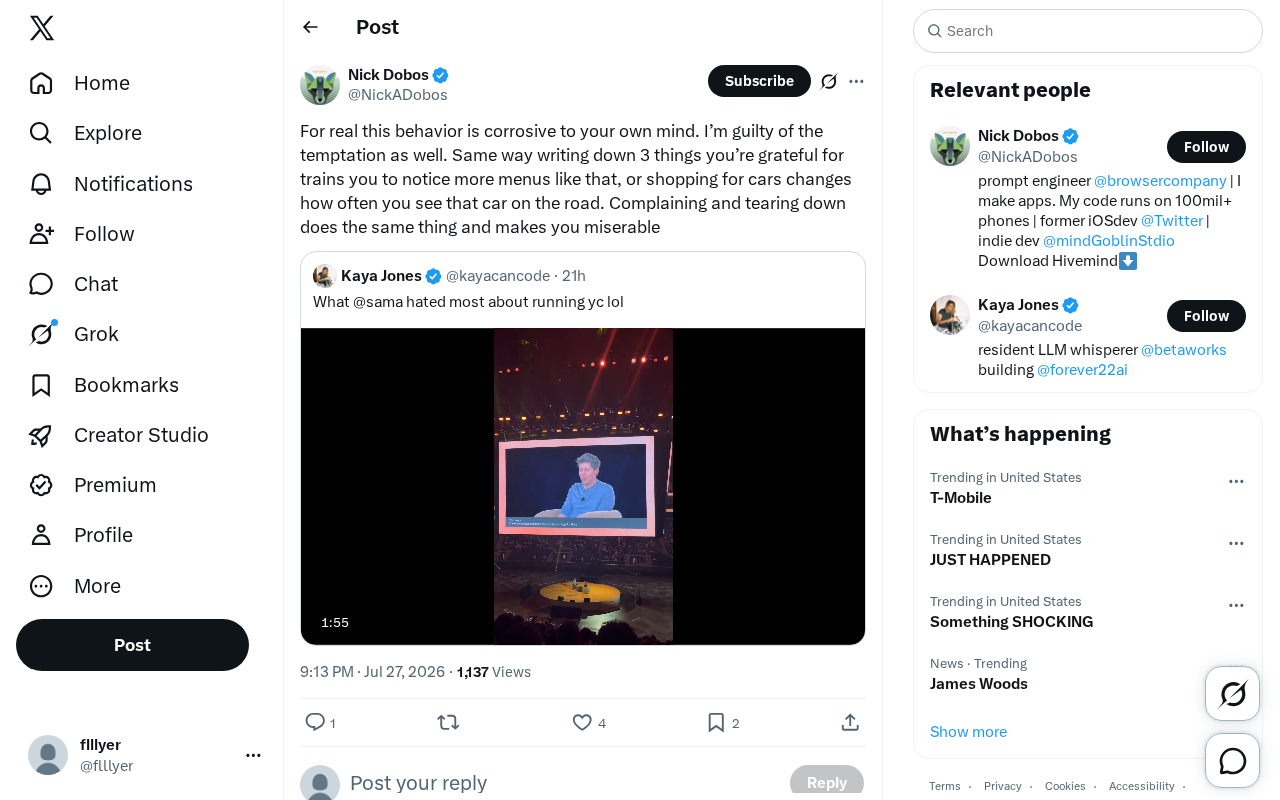
In an age where social media overflows with criticism, venting, and emotional outbursts, one brief tweet articulated a psychological mechanism that many people overlook. This Twitter post pointed out that habitual complaining and tearing others down is actually corroding our own minds.
"For real this behavior is corrosive to your own mind. I'm guilty of the temptation as well."
The author didn't preach from a moral high ground or point fingers at others — instead, they candidly admitted to falling into the same trap. This self-reflective honesty actually made the observation more persuasive.
The Self-Reinforcing Nature of Attention: You See More of What You Focus On
The most valuable insight from this tweet is that it reveals a fundamental principle of how the brain operates — attention is self-reinforcing.
The author used two vivid analogies:
The Positive Feedback Loop of Gratitude Practice
"Writing down three things you're grateful for today trains you to notice more good things like them." This isn't feel-good self-help fluff — it's a phenomenon repeatedly validated by psychological research. When you deliberately seek out things to be grateful for, your brain's Reticular Activating System (RAS) recalibrates, making it easier for you to pick up on positive signals in daily life.
The Reticular Activating System (RAS) is a network of neurons located in the brainstem that acts as the brain's information gatekeeper, determining which sensory inputs deserve conscious processing. Humans receive millions of bits of sensory information per second, yet consciousness can only process a few dozen bits. The RAS's core function is to filter this massive information stream and surface what's most relevant to current goals, focal points, and survival needs. When you repeatedly focus on a certain type of information, the RAS elevates its priority, making it more likely to break through the threshold of conscious awareness. This explains why people with clearly defined goals tend to spot more opportunities — it's not that opportunities have increased, but that their RAS has been reprogrammed to recognize them.
The effectiveness of gratitude practice is also supported by rigorous empirical research. Professor Robert Emmons of UC Davis and Professor Michael McCullough of the University of Miami published a landmark study in 2003 showing that participants who recorded five things they were grateful for each day over 10 weeks demonstrated significantly higher life satisfaction, more positive emotional states, and even fewer physical complaints compared to control groups. Subsequent neuroimaging studies further revealed that gratitude practice activates the medial prefrontal cortex and anterior cingulate cortex — regions closely associated with emotional regulation, social cognition, and reward processing. These findings provide a solid scientific foundation for the idea that "attention can be trained."
The Car-Buying Effect and Frequency Illusion
The other example is even more intuitive: "When you're shopping for a particular car, you suddenly notice that car everywhere on the road." This is the well-known Baader-Meinhof Phenomenon (Frequency Illusion). The number of cars hasn't changed — what changed is your attentional filter.
The Baader-Meinhof Phenomenon was formally named the "Frequency Illusion" by linguist Arnold Zwicky in 2006. It involves the synergistic effect of two cognitive biases: the first is Selective Attention — once a concept is activated, the brain becomes highly sensitive to related information; the second is Confirmation Bias — each time you notice the information, it reinforces the subjective judgment that "this thing is everywhere," while ignoring the countless times you didn't notice it. Neuroscience research indicates this is closely related to working memory functions of the prefrontal cortex and the pattern-matching capabilities of the hippocampus. The brain is essentially a pattern-recognition machine — once a pattern is flagged as important, it keeps "popping out" from the subsequent stream of information.
Both examples point to the same conclusion: the brain preferentially surfaces whatever you repeatedly focus on.
How Complaining Creates a Vicious Cycle
Here's the critical turning point — this attentional training mechanism is neutral. It works just as effectively for negative content.
"Complaining and tearing down does the same thing and makes you miserable."
When you frequently complain, criticize, and look for flaws, you are effectively training your brain to discover more things worth complaining about. Over time, this creates a vicious cycle:
- The more you focus on problems, the easier it becomes to find them
- The more problems you find, the stronger the urge to complain
- The more you complain, the lower your mood drops
- The lower your mood, the more negative your lens for viewing the world becomes
This vicious cycle has a solid neuroscientific foundation. There's a classic expression in neuroscience: "neurons that fire together wire together" — this is Hebb's Rule. Research from Stanford University has shown that repeated complaining continuously strengthens the neural pathways responsible for negative thinking, making pessimistic and critical thought patterns increasingly "automatic." Even more alarming, chronic complaining leads to elevated cortisol (stress hormone) levels, and sustained high cortisol damages the hippocampus — the brain region critical for learning and memory. This means habitual complaining doesn't just affect mood; it may also impair cognitive ability at a physiological level. Neuroplasticity is a double-edged sword: it means the brain can be reshaped by negative habits, but it also means deliberate practice can reverse the process.
Ultimately, this behavior doesn't harm the people you're criticizing — it erodes your own mental state. This is the core meaning of the original phrase "corrosive to your own mind."
How to Actively Manage Your Attention
In a digital era that celebrates "critical thinking" and glorifies "sharp takedowns," this perspective offers a much-needed wake-up call.
Distinguishing Criticism from Complaining
To be clear, the "complaining" discussed here is not the same as rational criticism or constructive feedback. Healthy critical thinking aims to solve problems, while habitual complaining tends to stay trapped in emotional venting and self-reinforcing negative loops. The former is action-oriented; the latter is emotion-driven.
Three Practical Methods for Managing Your Attention
Since attention can be trained, it can also be actively managed. The takeaway from this tweet is that we have far more control over our mental state than we might think.
- Reduce meaningless complaining: Before voicing criticism, ask yourself whether you're solving a problem or just venting emotion
- Deliberately practice positive focus: Whether through gratitude exercises or recording small moments of joy, you can recalibrate your brain's attentional filter
- Be wary of algorithmic amplification: Social media recommendation engines naturally amplify conflict and negative content, creating a dangerous resonance with our brain's self-reinforcing attention mechanisms
That last point deserves further elaboration. Social media recommendation algorithms operate on a simple yet powerful logic: maximize user dwell time and engagement. Extensive research shows that content triggering negative emotions like anger, fear, and disgust naturally generates higher engagement rates — a 2021 study published in Science found that each additional word expressing moral outrage in a tweet increased its retweet rate by approximately 20%. This means algorithms systematically amplify the exposure of negative content. When this external algorithmic amplification resonates with the internal self-reinforcing attention mechanism in our brains, users rapidly descend into an accelerating information spiral: negative content → negative emotions → more engagement → algorithm serves more negative content. Former Google design ethicist Tristan Harris has called this phenomenon "the race to the bottom of the attention economy." Recognizing this mechanism and proactively controlling the quality and quantity of information intake is a critical skill for mental self-preservation in the digital age.
Conclusion: Your Mind Requires Active Maintenance
This seemingly casual tweet touches on a profound self-management truth. We can't control what happens in the outside world, but we can choose where to direct our attention. And that choice is quietly reshaping how we perceive the world.
As the original author candidly admitted — "I'm guilty of the temptation as well." Acknowledging the existence of this temptation is the first step toward breaking free from the negative cycle. True maturity may not lie in never complaining, but in recognizing the cost that complaining exacts on your own mind — and actively choosing a different way to engage with the world.
Key Takeaways
Related articles

Go Microservices in Practice: Detailed Architecture for E-Commerce, AI Agent, and IM System Integration
Deep dive into integrating e-commerce, AI Agent, and IM systems under Go microservices architecture, covering unified auth, gRPC, componentized Agent engines, and group chat bots.

X Platform's Recommendation Algorithm Caught Filtering Brazilian Election Content, Reigniting Algorithm Transparency Debate
X (formerly Twitter) was found filtering Brazilian election content in its For You feed, sparking debate over algorithm transparency and free speech.

Poison-Resistant Concept Anchoring: A New Approach to Defending Against AI Data Poisoning
Deep dive into Poison-Resistant Concept Anchoring, defending against data poisoning via signed anchors and bounded updates. Experiments show 62% poison isolation with 0% false rejection rate.