How Constrained Learning Makes Scientific Modeling More Reliable: A Preview of the CL4SM Workshop

NeurIPS 2026 pre-conference CL4SM workshop calls for papers on physics-compliant constrained learning for scientific modeling.
ML models in scientific domains can fit data while violating physics — outputting negative concentrations, breaking energy conservation, or diverging over time. The CL4SM workshop at NeurIPS 2026 Paris addresses this with a call for papers covering three approaches: soft constraints via penalty terms, hard constraints via structure-preserving architectures, and differentiable optimization layers that project outputs into valid solution spaces. The workshop emphasizes unavoidable trade-offs between guarantees, accuracy, and cost, and spans applications in climate, fluids, and energy. Submissions due October 30, 2026; non-archival.
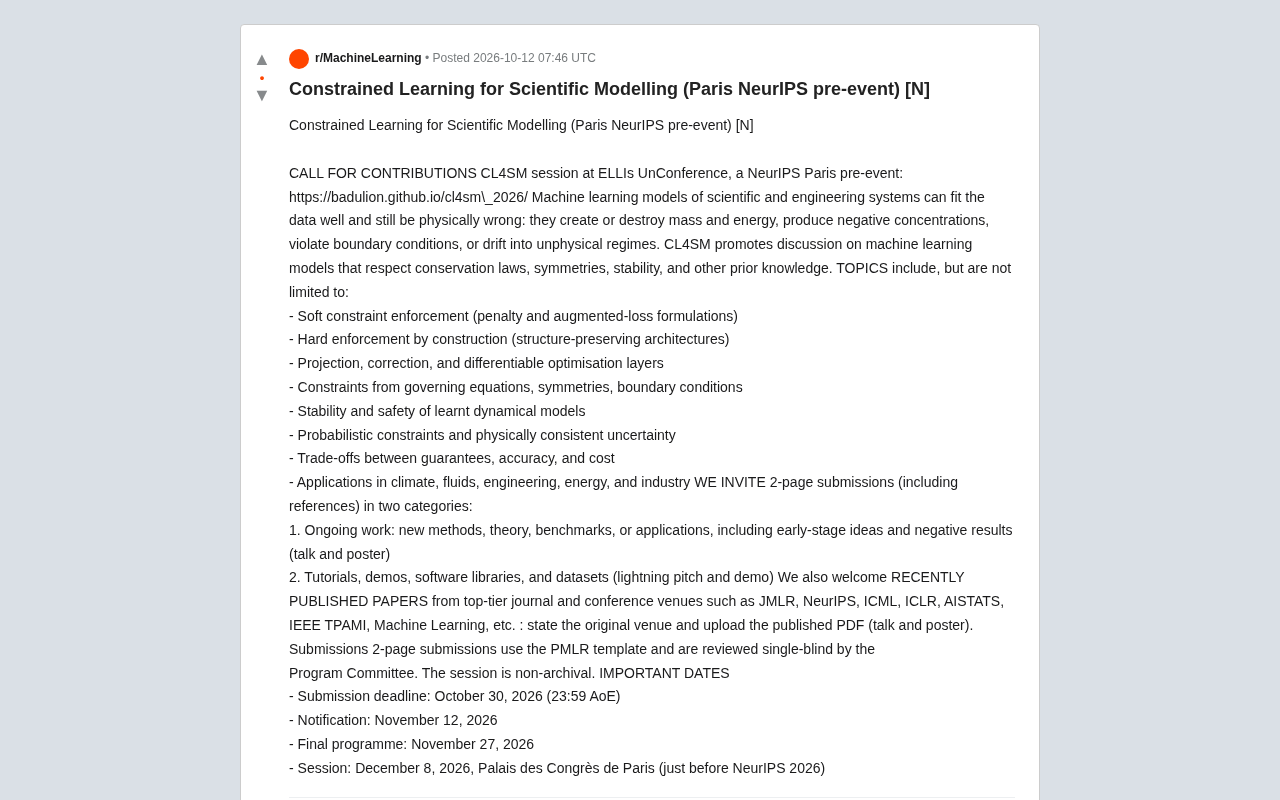
Machine learning has demonstrated remarkable fitting capability in scientific and engineering modeling, but a long-overlooked problem is surfacing: models can fit data extremely well while being completely wrong from a physics standpoint. They may spontaneously create or destroy mass and energy, output negative concentration values, violate boundary conditions, or drift into states that defy physical laws. To address this pain point, the "Constrained Learning for Scientific Modelling" (CL4SM) workshop at the NeurIPS 2026 pre-conference in Paris has issued a call for papers.
Why Scientific Modeling Needs "Constraints"
Traditional deep learning models are fundamentally data-driven black boxes that optimize for minimizing error on training and test sets. But in fields like physics, climate science, fluid dynamics, and energy, a model's "correctness" depends not only on predictive accuracy but also on whether it respects fundamental scientific laws.
A neural network that performs well numerically but predicts negative material concentrations, or allows a system's total energy to grow from nothing during simulation, is untrustworthy in real-world applications — no matter how low its fitting error. What's more dangerous is that models violating physical constraints tend to "diverge" in long-horizon evolution or extrapolation scenarios, producing catastrophic errors.
The core proposition of CL4SM is to push machine learning models to respect conservation laws, symmetries, stability conditions, and other prior knowledge. This represents an important directional shift in the Scientific ML field: moving away from purely chasing fitting accuracy, toward striking a balance between accuracy and physical consistency.
Physics-Informed Neural Networks (PINNs), systematically introduced by Raissi et al. in 2019 in the Journal of Computational Physics, are among the most representative frameworks for incorporating physical constraints into machine learning. The key idea is to add PDE residuals as an extra loss term to the training objective, so the network satisfies equation constraints while fitting observational data. The rise of PINNs greatly elevated the scientific ML community's attention to the "constraints" problem, but also exposed inherent limitations of soft constraints: when PDE residual weights are poorly tuned, gradient conflicts between physical constraints and data fitting can cause training instability or leave constraints insufficiently satisfied. This is precisely the starting point for the more systematic constraint methodology discussed at CL4SM.
Three Technical Approaches to Enforcing Constraints
The workshop's call for papers covers the major technical approaches in constrained learning today, which can roughly be grouped into three categories.
Soft Constraints: Guiding Through the Loss Function
Soft constraint enforcement is the most straightforward approach: physical constraints are incorporated into the training objective as penalty terms or augmented-loss terms. This approach is easy to implement and highly flexible, but it can only "encourage" the model to comply with constraints — it cannot provide strict guarantees. The model may still exhibit minor violations after training.
Hard Constraints: Guarantees Through Architecture Design
Hard enforcement by construction is more thorough. By designing structure-preserving architectures, the model becomes mathematically incapable of violating constraints. Examples include network architectures specifically designed to satisfy conservation laws or symmetries. These methods offer strict guarantees but often limit model expressivity and are more difficult to design.
Representative examples of structure-preserving architectures include: Hamiltonian Neural Networks and Lagrangian Neural Networks, which learn a system's energy function to guarantee energy conservation; symplectic integrators, which embed symplectic geometric structure into time-stepping to ensure phase-space volume is preserved; and equivariant networks, which use group-theoretic constraints to make models naturally satisfy symmetries such as rotations and translations. The core philosophy of these methods is: rather than "penalizing" violations during training, make violations mathematically impossible. The tradeoff is that the model's function class is restricted to a narrower subspace, which can reduce expressivity for real physical systems that don't conform to the assumed symmetries.
Projection and Differentiable Optimization Layers
Between the two extremes lie projection, correction, and differentiable optimization layers. These methods add a correction step at the model's output, "projecting" constraint-violating predictions back into a valid solution space. The emergence of differentiable optimization layers allows this correction to participate in end-to-end training, making it a hot research topic in recent years.
Representative frameworks for differentiable optimization layers include OptNet and cvxpylayers, which embed a convex optimization problem as a layer of the neural network. The inputs are intermediate network features; the outputs are optimal solutions satisfying the constraints; and gradients can be back-propagated via the implicit function theorem or KKT conditions. This means the correction step of "projecting predictions into a valid solution space" is no longer a standalone post-processing stage — it is jointly trained end-to-end with the entire model, allowing constraint satisfaction and predictive accuracy to be optimized simultaneously. Hard boundary condition handling in PINNs follows a similar philosophy: re-parameterizing outputs using basis functions that satisfy boundary conditions, making boundary violations structurally impossible.
More Than Methods — It's About Trade-offs
Notably, the CL4SM call for papers explicitly lists "Trade-offs between guarantees, accuracy, and cost" as a topic. This reflects a mature judgment from researchers in the field: no constraint method is a free lunch.
Hard constraints offer strict guarantees but may sacrifice accuracy and increase design complexity; soft constraints are flexible but lack reliability; projection methods introduce additional computational overhead. The workshop also covers probabilistic constraints and physics-consistent uncertainty quantification, as well as stability and safety in learned dynamical models — topics that point to the reliability challenges that constrained learning must confront when deployed in real industrial settings.
On the application side, the call for papers explicitly covers climate, fluids, engineering, energy, and industrial domains — precisely the scenarios where physical consistency requirements are most stringent, yet data-driven methods hold the most promise.
Submission Details and Key Dates
CL4SM is a workshop within the ELLIS UnConference, serving as a pre-conference event for NeurIPS 2026 in Paris. The workshop accepts two types of two-page submissions (including references):
- Work in progress: new methods, theory, benchmarks, or applications, including early-stage ideas and negative results, presented as talks and posters;
- Tutorials, demos, software libraries, and datasets: presented as lightning pitches and demonstrations.
The workshop also welcomes papers already published at top venues such as JMLR, NeurIPS, ICML, ICLR, AISTATS, and IEEE TPAMI — simply note the original publication venue and upload the published PDF.
Submissions use the PMLR template and undergo single-blind review by the program committee. Importantly, the workshop is non-archival, meaning submission does not affect a paper's future publication at formal venues.
Key dates are as follows:
- Submission deadline: October 30, 2026 (AoE, 23:59)
- Notification of decisions: November 12, 2026
- Final schedule: November 27, 2026
- Workshop date: December 8, 2026, at the Palais des Congrès de Paris — just before NeurIPS 2026 officially opens
For researchers working in scientific machine learning, Physics-Informed Neural Networks (PINNs), and engineering simulation, this is a high-quality platform for showcasing early results and exchanging ideas on constrained learning methodologies. For more details, visit the workshop website at badulion.github.io/cl4sm_2026.
Related articles

Should U.S. College Fraternities Be Banned? A Researcher's Incisive Observations
Why not just ban U.S. college fraternities? A researcher finds the key resistance comes from decision-makers' own fraternity identities and schools' "willful ignorance."

Microsoft Discovery: Accelerating Scientific Discovery with AI Agents
Microsoft's Discovery platform runs specialized AI agents to help researchers screen and prioritize the most promising compounds and experimental paths, reducing experiments and accelerating scientific discovery.

Cambridge Heavy Industries Secretly Develops Desktop-Scale Nuclear Fusion Device
Cambridge Heavy Industries is secretly developing a desktop-scale laser-driven nuclear fusion device, targeting the equipment supply market for fusion power plants. This article analyzes its miniaturization technology path, commercialization logic, and unique positioning in the fusion startup wave.