How Content Creators Can Legitimately Get Early Access to AI Tools

Breaking down the operations logic behind "DM for early access" tweets and offering creators response strategies and boundaries.
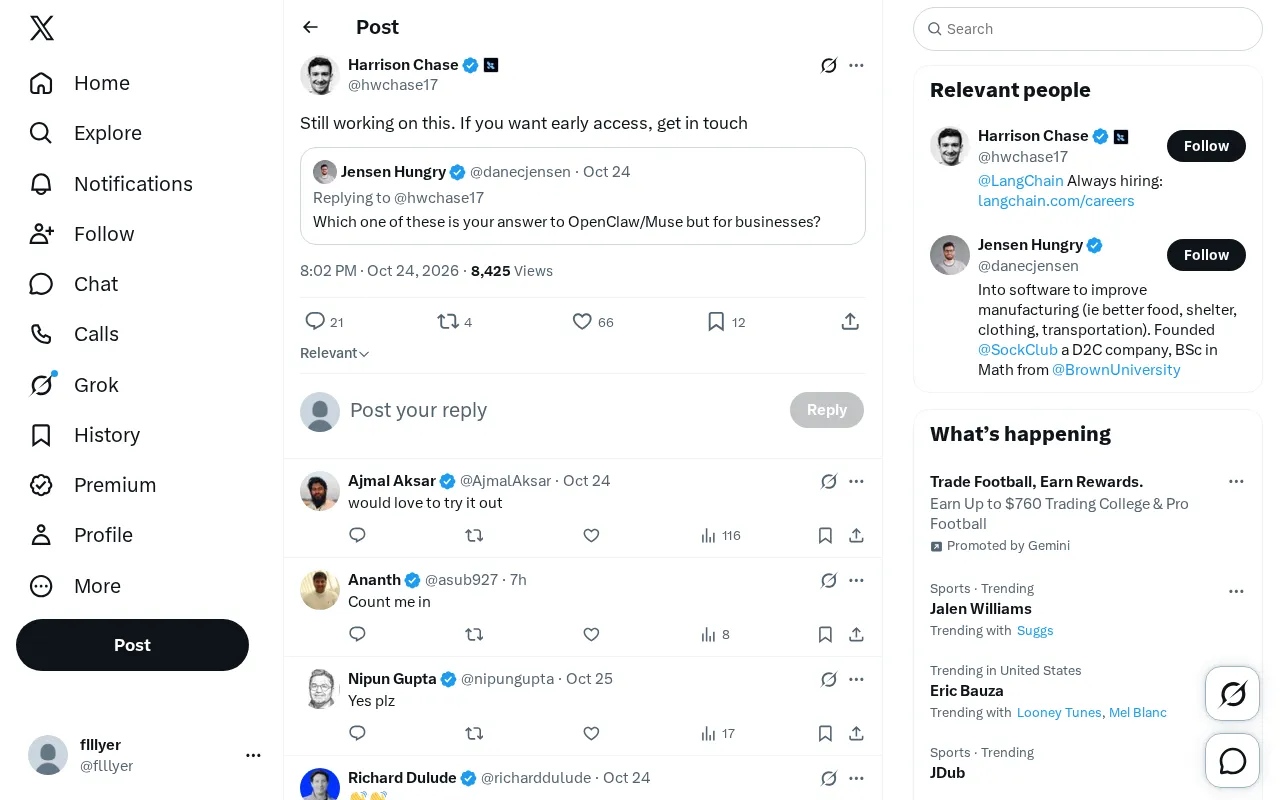
Starting from a minimalist tweet—"Still working on this. If you want early access, get in touch"—the article analyzes why small teams choose this vague launch approach: managing user expectations, reducing public promotion costs, and screening for genuinely interested users through proactive outreach. Early access participants effectively take on roles in user research and in-depth interviews, and for AI tools especially, feedback from real workflows is crucial. For creators, responses should explain their use case and the form of feedback they can provide, replacing "I want to try it" with "here's what I do and what I can give feedback on." The core return of early access lies in process-oriented observation and direct communication rather than being first to publish; before participating, confirm confidentiality agreements to avoid disrupting subsequent content plans.
The Product Operations Logic Behind a Single Tweet
Recently I saw a short tweet on Twitter: "Still working on this. If you want early access, get in touch." The attached image contained only a similar line—no product screenshots, no feature descriptions, no links. This minimalist, almost "information vacuum" style of expression actually sends a signal in the tech world: the product is still being refined, but the team is willing to let some people take an early look.
For content creators and technical writers, this is actually an engagement window worth taking seriously. Early access isn't just a "sneak peek" perk—it often means you can establish a direct communication channel with the team before the product is finalized, and even influence the direction of features. This article breaks down the common intentions behind such invitations, how you should respond, and the real value creators can gain from them.
Why Teams Choose This Kind of "Vague Launch"
Managing Expectations Matters More Than Generating Buzz
When a product isn't finished, publicly promoting feature details carries two risks: first, user expectations get raised and become hard to satisfy; second, competitors can learn the product direction in advance. The line "still working on this" in the tweet is actually expectation management—we're still building, and we're not committing to specific features.
According to discussions by multiple indie developers on social platforms, this "DM for early access" approach is especially common among small teams. It minimizes the cost of public promotion while retaining a filtering mechanism: people willing to reach out proactively usually have a genuine interest in the product direction.
Early Access Is an Extension of User Research
From the product side, early access participants often play the role of "in-depth interview subjects." Teams observe how they use the tool, where they get stuck, and which features are repeatedly requested. For AI tools, this feedback is especially critical, because model output quality is highly correlated with usage scenarios—testing detached from real workflows makes it hard to find problems.
Early Access is a pre-launch stage strategy commonly used in software and content products, referring to a team opening a usable version to a small group of external users before features are fully finalized. Unlike a beta, early access is usually smaller in scale and more targeted in invitations, with participants often needing to apply proactively or being screened by the team. Its core value isn't "early exposure" but rather enabling the team to obtain usage data from real workflows at low cost. For AI tools, early access participants can also help the team calibrate model output quality in specific scenarios, because model performance highly depends on input distribution and task types. Early access is also often combined with the "design partner" model: participants not only try the product but may also join requirements discussions, feature prioritization, and even receive rewards such as lifetime discounts or co-credits.
How You Should Respond as a Creator
Your First Message Should Explain Your Use Case
If you decide to reach out, don't just write "I want to try it." A more effective opener briefly explains your workflow, what problem you hope to solve with this tool, and what type of feedback you can provide. For example: you usually create AI programming content and test the boundaries of code generation tools; or you run a tutorial channel and need to evaluate a tool's usability.
This information lets the other party judge whether you're a target user and increases your chances of being accepted.
Clarify the Form of Feedback You Can Provide
Early access is essentially an exchange. You can proactively offer: willingness to provide structured feedback within one to two weeks, willingness to participate in an online interview, or willingness to publicly share your experience within what the product allows. For small teams, a tester willing to write serious feedback is far more valuable than a hundred people who just claim an activation code.
Structured feedback refers to usage observations organized according to a certain framework, rather than scattered impressions. Common forms include: recording success and failure cases by task type, marking the specific steps where blockers occur, comparing expected versus actual output differences, and providing reproducible input examples. For AI tools, structured feedback should also include records of dimensions such as model output stability, latency, and hallucination frequency. Teams usually value actionable, reproducible feedback more, because this type of information can be directly translated into fixes or product decisions. By contrast, vague evaluations like "works well" or "a bit slow" are of limited help for iteration. Proactively offering structured feedback can both increase your chances of acceptance and make the early access relationship more sustainable.
The Real Returns and Boundaries Creators Can Gain
Influence Comes from Sustained Observation, Not a One-Off Exposure
The value of content material from early access isn't "I got it earlier than others" but rather that you can document the product's process from rough to usable. This kind of process-oriented content is especially scarce in the AI field, because most coverage focuses only on the moment of launch and ignores the debugging and iteration stages.
According to feedback from some YouTube channels focused on tool reviews, tracking a tool's evolution across several versions makes it easier to build long-term reader trust than a single launch review.
Pay Attention to Confidentiality Agreements and Content Boundaries
Not all early access allows public discussion. Some teams require signing a simple confidentiality agreement, or restrict you to describing only your user experience without disclosing specific features. Before agreeing to any conditions, first confirm whether you can accept these restrictions to avoid disrupting your subsequent content plans.
A Habit Worth Developing
This tweet itself provides no product information, but it demonstrates a typical early-stage engagement opportunity. For content creators, developing the habit of staying attuned to such signals pays off: you don't need to follow up on every one, but when the direction overlaps with your content niche, the cost of reaching out is low and the potential information gap is very real.
Replacing "I want to try it" with "here's what I do and what I can give feedback on" is the key step to making this kind of engagement truly valuable.
Related articles

Will GitHub Die? Open Source Maintainer Burnout and the Collaboration Crisis in the AI Era
Lex Fridman podcast discussion on open source maintainer burnout and GitHub's predicament: massive pull requests overwhelm core maintainers, and AI worsens code bloat. Using math journal peer review and Poincaré conjecture verification as analogies, the article analyzes why verification in knowledge production must be deliberately slow, and how open source communities can avoid the failure mode of maintainers exiting.

Stop Building Cookie-Cutter AI Websites: 3 Tools That Transform Your Coding Agent
Three tools that boost AI coding agents: FFmpeg skill for local video editing in Claude Code and Cursor, Hallmark's 50 design themes to fix cookie-cutter AI sites, and Jailbreaks' 25+ model prompts.

How America's Gerontocracy Squeezes the Younger Generation
Americans over 55 hold nearly three-quarters of national wealth, alongside an 80-year-old president and elderly congressional leaders. The Atlantic's Idrees Kahloon explains how gerontocracy drives up housing costs, squeezes opportunities for the young, and explores zoning reform and child poverty reduction as practical fixes.