How Could a Single Router Failure Cripple US Air Traffic Control?
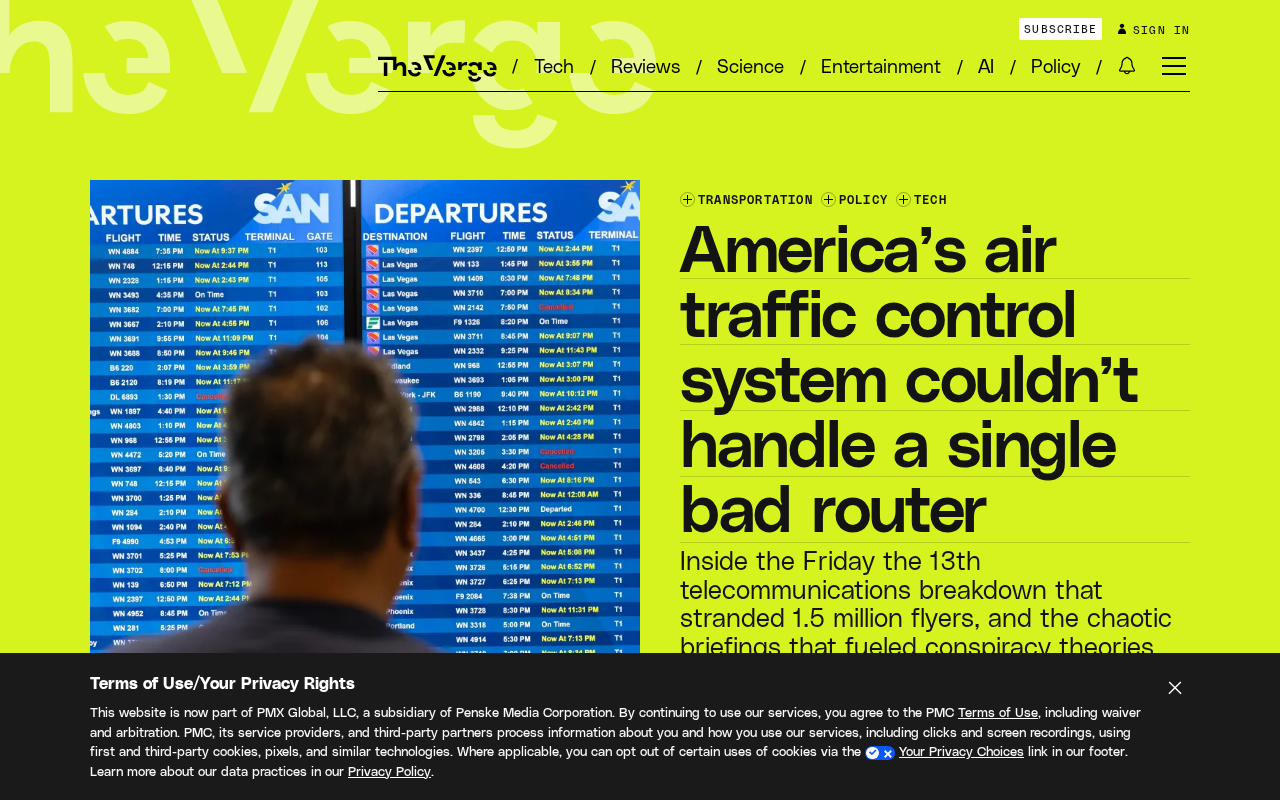
A single FAA router failure caused a nationwide air traffic control communications outage, exposing deep flaws in redundancy design and system resilience.
A report by The Verge shows that a single router failure in the FAA's communications system cascaded into a nationwide air traffic control outage, forcing pilots to give passengers vague in-flight warnings and directly affecting gates and connections. The article notes that air traffic control systems should have device redundancy, link backups, and fault isolation, but this incident shows that redundancy may exist only on paper and that failover paths are highly concentrated. US air traffic control infrastructure has long been aging, and the patchwork of old and new architectures further amplifies the risk of failure propagation. The article distills the true meaning of system resilience: resilience comes from fault isolation, path diversity, and degraded-mode operation, not simply the number of backups; regular single-point-of-failure drills are more meaningful than after-the-fact explanations.
When a Flight Gets the News Over Atlanta
Thirty minutes out from Atlanta, the pilot came on the PA to tell passengers something was wrong. A communications failure with the Federal Aviation Administration (FAA) was spreading nationwide. The pilot offered few details, saying only that it could affect gate availability and connections. For passenger Amanda Khera, the timing could not have been worse.
This is the opening of a report by The Verge. What it describes is not extreme weather or a terrorist attack, but a nationwide air traffic control communications outage triggered by a single failed router. A system that was supposed to be built with redundancy was brought down by one piece of network equipment, exposing unsettling fragility in US aviation infrastructure.

The Failure Chain: From One Device to Nationwide Flights
The core facts in the report are not complicated: the FAA's communications system failed because a router malfunctioned, and the failure quickly "cascaded" nationwide. The pilot's announcement, disrupted passenger itineraries, and affected gates and connections are all downstream symptoms of this failure chain.
What really deserves scrutiny is the middle of the chain. Air traffic control communications are not an ordinary corporate network; they carry instructions between aircraft and the ground. Such systems should, by any reasonable standard, have device redundancy, link backups, and fault isolation so that a single point of failure does not spread. But this incident shows that, at least at some point in the chain, redundancy did not work as expected—or that the redundant failover itself depended on the same path that failed.
The report does not disclose the specific equipment model, the duration of the outage, or the number of flights affected, but the contrast between "a single router" and "nationwide impact" already says enough.
Routers and Cascading Failures
A router is a core forwarding device in a network, responsible for directing packets from one network segment to another based on an address table. In wide-area or backbone networks, core routers often aggregate multiple links and enforce routing policies. A "cascading failure" occurs when the failure of one component is amplified layer by layer through dependencies: when a core router goes down, all links beneath it become unreachable, neighboring routers must recalculate their routing tables, and the flood of routing updates during recalculation drives up CPU and bandwidth load, causing secondary congestion and even more devices to drop off. "Route flapping," common in enterprise networks, is a typical manifestation of this mechanism—a single link oscillating repeatedly keeps the entire autonomous system's routing table refreshing, ultimately dragging down otherwise healthy nodes. Whether a single point of failure escalates into a systemic outage therefore depends on the convergence speed of the routing protocol, the degree of topology redundancy, and whether sensible fault-domain boundaries are in place.
Aging Infrastructure and Fragile Redundancy
The aging of the US air traffic control system is not a new topic. The FAA has long faced pressure from slow equipment upgrades and tight budgets and staffing, and many core systems still run on architectures from years ago. When such systems are connected to modern network environments, they often end up in a patchwork state of "new equipment wrapped around old architecture," where redundancy exists on paper but the actual failover paths are highly concentrated.
This incident provides a concrete example: the failure did not come from an external attack or a complex software logic flaw, but from the failure of one router. The more basic the network component, the easier it is to overlook its single-point risk. Truly mature system design should assume that every component will fail and ensure that the one that fails does not drag down the whole.
Redundancy Design and Fault Isolation
The core assumption of redundancy design is that "components will eventually fail," so service is maintained through backup devices, backup links, or backup sites. But whether redundancy works depends on whether the failover mechanism is independent of the failure itself. Common forms of redundancy include device-level redundancy (hot standby router failover), link-level redundancy (multiple physical paths), and site-level redundancy (geographic disaster recovery). The problem is that if the primary and backup devices share the same configuration files, the same management plane, or the same upstream link, a failure will hit both at once, and the redundancy is effectively useless. Fault isolation is another layer of protection: by dividing fault domains, the failure of one component is confined to a local area and prevented from spreading across the entire network. This usually relies on network segmentation, routing policy control, and rate limiting. The industry commonly uses "single point of failure drills" (such as fault injection in Chaos Engineering) to verify that redundancy can actually take over, rather than merely existing in design documents.
What It Means for Aviation and Passengers
For passengers, the immediate consequence of such a failure is opaque information and uncertain itineraries. Pilots can offer only vague warnings, passengers cannot gauge the scope of the impact, and connections and gate assignments may change at any moment. For airlines, an air traffic control communications outage means reduced scheduling flexibility, and cascading delays on subsequent flights are hard to avoid.
The broader impact is on trust. The air traffic control system is the cornerstone of aviation safety, and public expectations of its reliability are close to "it should not fail." When a single router failure can trigger a nationwide communications problem, regulators and operators need to answer not only "which device failed" but "why was one device enough."
What System Resilience Really Means
The value of this incident is not in assigning blame to a particular device, but in making an abstract concept concrete: system resilience is not achieved by piling up backups, but by fault isolation, path diversity, and the ability to operate in degraded mode. If redundant failover depends on the same link, the same configuration, and the same management plane, then redundancy is only psychological comfort.
For any organization operating critical infrastructure, this air traffic control communications outage is a reminder: regularly conducting single-point-of-failure drills to verify that redundancy can actually take over is more meaningful than explaining the cause after a failure occurs. The failure of one router should not be a reason for nationwide flight chaos—unless the system itself allows it to be.
Degraded Operations and Resilience Engineering
Graceful degradation means that when some components fail, a system actively gives up non-core functions and preserves critical capabilities to continue serving, rather than collapsing entirely. For air traffic control communications, an ideal degraded mode might include switching to backup voice channels, clearing flights at longer intervals, and temporarily restricting airspace traffic. The "path diversity" emphasized by resilience engineering requires that critical communications not depend on a single medium or a single carrier—for example, simultaneously maintaining ground leased lines, satellite links, and VHF voice as complementary means. The opposite is "concentrated fragility"—putting all your eggs in one basket, then covering one basket with another. To judge whether a system is truly resilient, three indicators are usually examined: the scope within which a failure is contained, the time required to restore service to an acceptable level, and whether a minimum level of safe operation can be maintained in a degraded state.
One-line Summary
A single router failure at the FAA triggered a nationwide air traffic control communications outage, exposing deep flaws in redundancy design and system resilience.
Paragraph Summary
An incident reported by The Verge shows that the FAA's communications system cascaded from a single router failure into a nationwide air traffic control communications outage, leaving pilots to give passengers vague in-flight warnings while gate availability and connections were directly affected. The article notes that air traffic control systems should have device redundancy, link backups, and fault isolation, but this incident shows that redundancy may exist only on paper and that failover paths are highly concentrated. US air traffic control infrastructure has long been aging, and the patchwork of old and new architectures further amplifies the risk of failure propagation. The article distills the true meaning of system resilience: resilience comes from fault isolation, path diversity, and degraded-mode operation, not simply the number of backups; regular single-point-of-failure drills are more meaningful than after-the-fact explanations.
Related articles
OpenAI Doubles Down on Healthcare: Cha…
OpenAI Doubles Down on Healthcare: ChatGPT Healthcare Adds Computer-Use Agents and Clinical Plugins
OpenAI updates ChatGPT for Healthcare with computer-use agents, improved clinical answers, and cross-software plugins—moving AI from answering questions to completing real clinical workflows.

Google Maps New Feature: Real-Time Itinerary Generation Turns Navigation into a Travel Assistant
Google Maps launches Ask Maps, which auto-generates multi-day itineraries from natural-language descriptions with real-time info for each stop. This article analyzes the shift from navigation to itinerary planning and its impact on travel planning products.

Apple TV to Launch Free Video Podcasts, Ushering in a New Era for the Podcast Ecosystem
Apple TV will add a free video podcast section, first tested in the developer build; iOS 27.3 beta users will receive the update soon. This article reviews the feature's progress and its potential impact on the podcast ecosystem.