How Delphi Runs Its 'Digital Mind' Platform on Vercel: A No-Ops Practice for a 10-Person Team

Delphi runs a complex AI platform on Vercel with 10 engineers, no dedicated ops, and 100+ deploys per day.
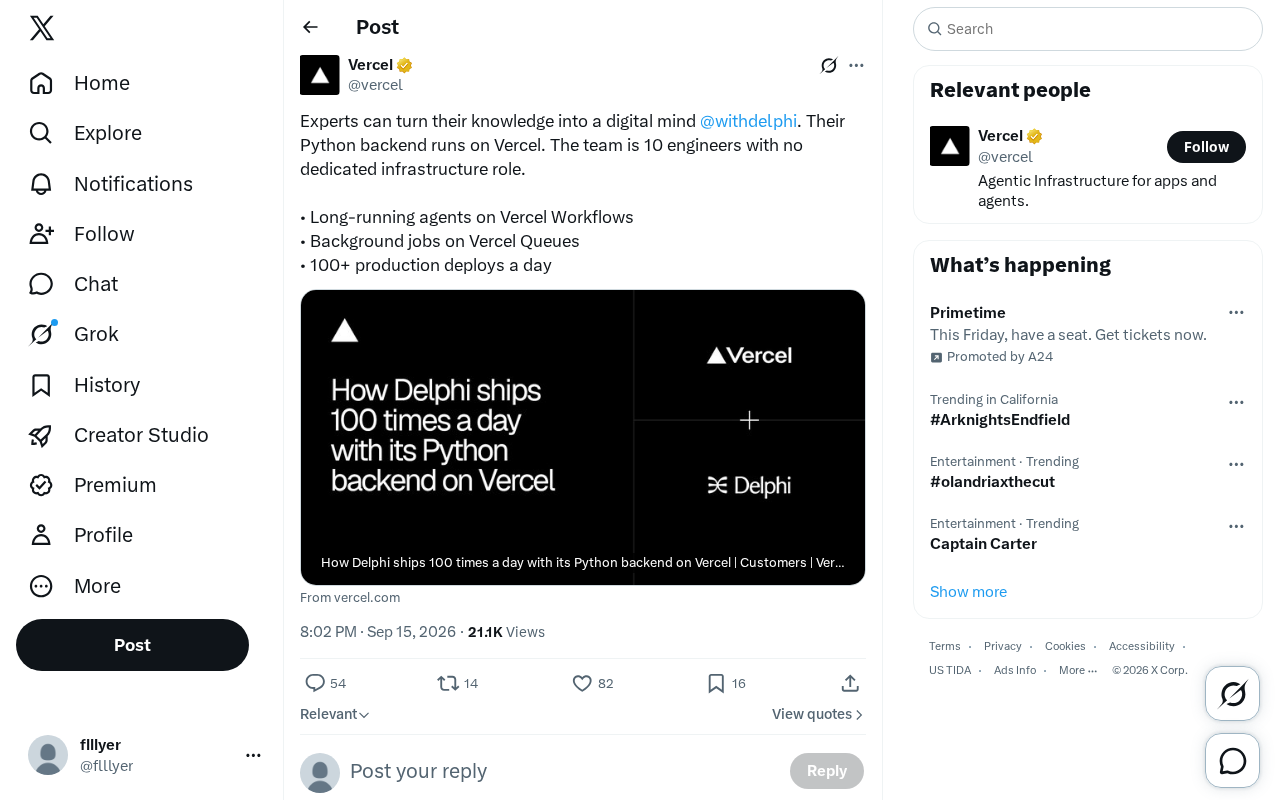
Delphi lets domain experts turn their knowledge into interactive AI "digital minds." Its engineering approach is notable: a Python backend running entirely on Vercel, using Vercel Workflows for long-running agent inference and Vercel Queues for async background jobs — all maintained by a 10-person team with no dedicated infrastructure roles, shipping over 100 production deployments per day. The case illustrates how managed platforms can offload operational complexity, letting small teams focus engineering resources on product differentiation.
Turning Expert Knowledge into a 'Digital Mind'
Delphi (@withdelphi) is building something genuinely imaginative: a platform that lets domain experts transform their knowledge, experience, and thinking style into an interactive "digital mind." Users can query this AI version of the expert at any time and receive responses that closely reflect the expert's own style.
The technical challenges behind this kind of product are significant — it requires handling long-running inference tasks, background batch jobs, and high-frequency iterative deployments. According to a technical deep-dive shared publicly on Twitter, Delphi has built the entire system on a remarkably lean architecture.
An Engineering Team Without Dedicated Ops
The most striking detail is the team size: Delphi's engineering team consists of just 10 engineers, with no dedicated infrastructure roles.
Conventional wisdom holds that supporting an AI product with long-running tasks, background queues, and high-frequency deployments requires dedicated DevOps or SRE teams to maintain Kubernetes clusters, message queues, and CI/CD pipelines. Delphi's approach instead offloads as much operational burden as possible to the platform, freeing every engineer to focus on product logic itself.
This reflects a clear and growing trend: as serverless and managed platforms become more capable, small teams are increasingly able to independently sustain complex systems that once required large backend organizations.
Going Full-Stack on Vercel
According to the shared content, Delphi's Python backend runs entirely on Vercel, leveraging several newer capabilities within the Vercel ecosystem:
Long-Running Tasks: Vercel Workflows
AI agent inference is rarely a simple request-response cycle — it involves multi-step processes that can last tens of seconds or longer. Traditional serverless functions have execution time limits that make them ill-suited for these "long-haul" tasks. Delphi runs long-running agents on Vercel Workflows, using workflow orchestration to handle execution duration and state management.
Vercel Workflows is Vercel's managed workflow orchestration service, allowing developers to chain multiple function calls into stateful execution pipelines. A single workflow can run far beyond the typical few-second ceiling of ordinary serverless functions — in some scenarios up to several hours. It includes built-in step retries, error handling, and persistent execution state, eliminating the need to maintain a custom task scheduler or state database. For AI agent use cases, this is especially critical: a single inference run may involve multiple LLM calls, external tool invocations (such as search or code execution), and intermediate result storage — all dependencies that stateless serverless functions handle poorly.
Background Jobs: Vercel Queues
For async tasks that don't require an immediate response, the team uses Vercel Queues for background jobs. This lets time-consuming processing logic be decoupled from the main request path, ensuring fast response times for users without requiring the team to build and maintain a separate message queue infrastructure.
Message queues are a classic component in distributed systems for decoupling producers and consumers: a producer writes a task to the queue and returns immediately, while a consumer processes it asynchronously. Traditional approaches require teams to self-host and operate services like RabbitMQ, Kafka, or AWS SQS, along with handling message backlog, dead-letter queues, and consumer autoscaling. Vercel Queues wraps this entire infrastructure as a native platform capability — developers simply define consumer functions and trigger logic, while persistence, retry policies, and concurrency control are all platform-managed, eliminating the cost of dedicated middleware operations staff.
High-Frequency Deployments: 100+ Releases Per Day
The number that best illustrates this architecture's efficiency: Delphi maintains over 100 production deployments per day. Sustaining this deployment cadence typically demands a mature CI/CD system and reliable rollback mechanisms. With Vercel's deployment workflow, a 10-person team is able to maintain this pace — giving them a tremendous advantage in rapid experimentation and feature launches.
Deploying 100+ times per day is typically associated with Continuous Deployment (CD) — every code merge that passes tests is automatically pushed to production, rather than accumulated into periodic large releases. Vercel's deployment model naturally fits this rhythm: each git push triggers a build, a preview link or live deployment is ready within minutes, and every historical version is snapshotted for one-click instant rollback. For AI products in particular, where prompt tuning, model switching, and feature logic changes happen constantly, high-frequency deployment capability directly determines how quickly a team can validate hypotheses and respond to user feedback.
What This Practice Tells Us
Delphi's story offers several takeaways for similar AI startup teams.
First, platformization is reshaping the cost structure of infrastructure. When capabilities like Workflows and Queues are natively integrated into managed platforms, long-running tasks and async jobs no longer require a dedicated team to build from scratch — engineering resources can be concentrated on product differentiation.
Second, Python backends can now live comfortably in the Vercel ecosystem, which was historically known as a JavaScript/frontend platform. This signals that Vercel is expanding into full-stack and AI backend use cases.
Third, high-frequency deployment and small teams are not mutually exclusive. The 100+ daily releases are underpinned by a philosophy of delegating operational complexity to the platform and letting engineers focus on business logic. For early-stage teams prioritizing speed, this kind of "leverage" strategy is worth emulating.
It's worth noting that this information comes from a single Twitter post — a promotional piece from a single source. The specific architectural details, cost, and reliability characteristics still need more public documentation to fully verify. Even so, it clearly outlines a viable path for a "small team + managed platform" approach to supporting a complex AI product.
Summary
Delphi runs a Python backend entirely on Vercel — using Workflows to orchestrate long-running agents and Queues to handle background jobs — enabling a 10-person team with no dedicated ops roles to sustain hundreds of production deployments per day. It's both a concrete engineering case study and a reflection of how serverless and managed platforms are lowering the infrastructure barrier for AI applications.
Related articles

Gemini 4 Argon Hands-On: AI Builds Board Games, Constructs Temples, and Trains Robots Autonomously
Gemini 4 Argon hands-on roundup: AI autonomously builds a desk racetrack and temple in Blender, writes a ray tracing engine, trains a humanoid robot to sink 7 shots, plus API pricing and developer access.

The Magic Octagonal Coin: Why Only 9% of People Can Predict Its Flip?
Only 9% of people can correctly predict the Magic Octagon coin flip. This article explains its spatial rotation mechanism, common cognitive pitfalls, and a new hypothesis based on Relevance Theory, exploring the limits of human spatial reasoning.

Sam Altman: AI Is Entering the Era of Scientific Discovery — Math Breakthroughs Will Replicate in Biology and Energy
Sam Altman says AI is entering the era of scientific discovery — math breakthroughs will replicate in biology, materials science, and energy to help develop new drugs and energy sources.