How Does Mechanistic Interpretability Open the Black Box of End-to-End Autonomous Driving?

Researchers use sparse autoencoders to dissect an end-to-end driving model, finding interpretable features and improving planning performance.
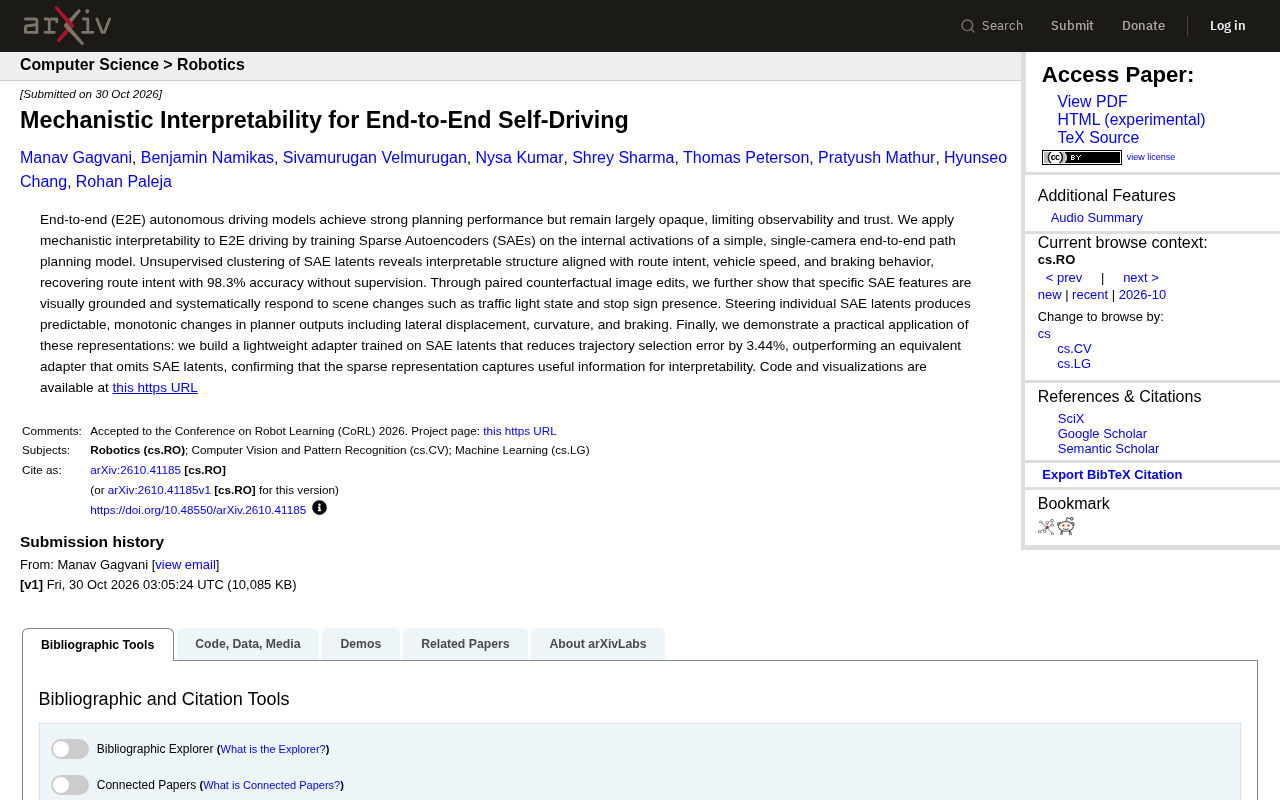
This study introduces mechanistic interpretability to end-to-end autonomous driving path planning models, training sparse autoencoders (SAEs) on the internal activations of a single-camera planner to unsupervisedly decompose feature clusters aligned with route intent, vehicle speed, and braking behavior, with route intent recovery accuracy reaching 98.3%. Through paired counterfactual image editing, researchers verified that these features have a visual basis and respond systematically to changes such as traffic lights and stop signs; manipulating individual SAE features produces predictable, monotonic effects on lateral displacement, curvature, and braking. Finally, a lightweight adapter based on SAE features reduced trajectory selection error by 3.44%, proving that interpretable features can not only "understand" the model but also feed back into planning performance.
End-to-end autonomous driving models excel at path planning, yet remain opaque and hard to trust, like a black box. A recent study introduces Mechanistic Interpretability to this field. By dissecting the model's internal activations with Sparse Autoencoders (SAEs), it not only uncovers interpretable structures aligned with route intent, vehicle speed, and braking behavior, but also demonstrates that these features can be used to actually improve planning performance.
Why End-to-End Driving Needs to Be "Opened Up"
End-to-end models generate driving trajectories directly from sensor inputs, avoiding the information bottlenecks of traditional modular stacks. But this holistic nature comes at a cost: developers cannot know exactly why the model chooses a particular trajectory, making it even harder to intervene and debug in anomalous situations. This lack of observability directly limits trustworthy deployment in safety-critical scenarios.
Mechanistic interpretability offers a bottom-up path: rather than settling for input-output correlation explanations, it dives into neuron activations to find semantically meaningful feature units. Previously, such methods were mainly validated on language models; whether they are feasible for a multimodal, strongly temporal task like autonomous driving remains an open question.
Mechanistic Interpretability is a direction that has emerged in deep learning interpretability research in recent years. Its goal is not to stop at input-output correlation analysis, but to attempt to reverse-engineer the computational mechanisms inside neural networks. It typically uses neurons, attention heads, or directions in activation space as units of analysis, seeking semantically meaningful "circuits" or "features." In language models, researchers have used such methods to identify internal structures corresponding to syntax, factuality, sentiment, and more. Unlike post-hoc attribution methods (such as saliency maps), mechanistic interpretability emphasizes a causal understanding of internal representations, and is therefore considered more likely to support debugging and intervention in safety-critical systems.
Using SAEs to Find Structure in a Single-Camera Planning Model
The researchers chose a simple end-to-end path planning model as their experimental subject—single-camera input, directly outputting a planned path. They trained sparse autoencoders on the model's internal activations, decomposing high-dimensional, dense activations into sparse, interpretable latent features.
After unsupervised clustering of the SAE latent features, structures clearly aligned with driving semantics emerged: route intent, vehicle speed, and braking behavior each corresponded to distinct feature clusters. Particularly interesting is that route intent recovery accuracy reached 98.3%, all without manual annotation. This means the model does contain a linearly separable "intent representation" internally, rather than having it fully diffused across activation space.
This result supports, from an interpretability perspective, the view that the internal computation of end-to-end planners is not inscrutable—at least some decision variables are encoded in a relatively explicit manner.
Sparse Autoencoder (SAE) is a tool for decomposing dense neural network activations. A standard autoencoder compresses and reconstructs input through a bottleneck layer, whereas an SAE adds a sparsity penalty (such as L1 regularization) to the loss function, forcing only a small number of neurons in the hidden layer to be active simultaneously. When an SAE is applied to the activation vector of a given model layer, its hidden layer can be viewed as a set of "latent features," each corresponding to a direction in activation space. Due to the sparsity constraint, these directions are often closer to monosemantic than raw neurons, making them easier for humans to interpret. SAEs were initially used in language models to extract interpretable features, and in recent years have gradually expanded to vision and multimodal models.
Do the Features Actually "See" the Scene?
Finding interpretable features is only the first step; more critical is verifying whether these features are causally linked to visual input. The researchers used paired counterfactual image editing: making targeted modifications to the same scene, such as changing traffic light states or removing stop signs, and observing whether SAE features respond systematically.
The results show that specific SAE features do have a visual basis, changing regularly with scene variations. This rules out the possibility that the features are merely label leakage or training artifacts, indicating that they capture how the model responds to key visual cues.
Furthermore, the researchers directly manipulated individual SAE latent features and observed changes in the planner's output. They found that such manipulation produces predictable, monotonic changes across planning dimensions including lateral displacement, curvature, and braking. Monotonicity is especially important—it means there is a stable directional relationship between features and behavior, rather than chaotic entanglement.
Paired counterfactual image editing is an experimental method for testing whether a model's internal representations have a causal relationship with specific visual factors. Its core idea is: generate paired images of the same scene, changing only one target factor (such as traffic light color or the presence of a stop sign) while keeping everything else unchanged, then compare differences in the model's internal features between the paired samples. If a feature changes systematically with that factor, it can be inferred that the feature encodes the corresponding information. This method is superior to pure correlation analysis because it excludes confounding variables through controlled intervention, approaching the "intervention" concept in causal inference. In interpretability research, counterfactual editing is often used to verify whether features have a genuine visual basis rather than spurious correlations in the training data.
From Explanation to Utility: SAE Features Improve Trajectory Selection
Interpretability research is often criticized as "nice to look at but impractical." The final part of this work provides a counterargument: the researchers built a lightweight adapter that takes SAE latent features as input for trajectory selection. Compared with an equivalent adapter without SAE features, this adapter reduced trajectory selection error by 3.44%.
Although a 3.44% improvement is not dramatic, its significance lies in verifying that sparse representations do carry information useful for downstream tasks. In other words, SAEs not only help us "understand" the model but also provide a compact intermediate representation that can feed back into planning performance. This builds a bridge between interpretability research and practical system optimization.
Implications for Autonomous Driving Development
This study conveys several noteworthy signals. First, mechanistic interpretability is not exclusive to language models—it can also reveal meaningful structures in end-to-end driving models. Second, unsupervised methods alone can recover intent information with high accuracy, reducing interpretability tools' dependence on manual annotation. Third, interpretable features can be translated into performance gains; although the current magnitude is limited, the direction is worth further exploration.
Of course, the experiments are based on a simplified single-camera model, and transfer to multi-sensor, complex urban scenarios still needs verification. The training cost and stability of SAEs, as well as the generalization ability of features across different driving distributions, are also questions that need answering before deployment. But at the very least, this path of "opening the black box" has been proven feasible.
One-line Summary
Researchers use sparse autoencoders to dissect an end-to-end driving model, finding interpretable features and improving planning performance.
Paragraph Summary
This study introduces mechanistic interpretability to end-to-end autonomous driving path planning models. It trains sparse autoencoders (SAEs) on the internal activations of a single-camera planner, unsupervisedly decomposing feature clusters aligned with route intent, vehicle speed, and braking behavior, with route intent recovery accuracy reaching 98.3%. Through paired counterfactual image editing, researchers verified that these features have a visual basis and respond systematically to changes such as traffic lights and stop signs; manipulating individual SAE features produces predictable, monotonic effects on lateral displacement, curvature, and braking. Finally, a lightweight adapter based on SAE features reduced trajectory selection error by 3.44%, proving that interpretable features can not only "understand" the model but also feed back into planning performance.
Related articles

On-Device LLM + ESP32: Build a DIY Calorie Reminder
A Bilibili creator open-sourced a calorie intake reminder: a phone app uses the open-source miniCPM model to locally recognize food photos and estimate calories, while an ESP32 mini screen syncs data and shows intake status with green/yellow/red rings — magnetically attachable to the fridge door for constant reminders.

Running 125B MoE on a 12GB GPU? Inside Strata's Three-Tier Cooperative Engine
Open-source C++ engine Strata runs 125B MoE models locally on 12-16GB consumer GPUs at 40-95 tokens/s. Here's how its VRAM/memory/SSD three-tier pipeline works.

Running Audio and Vision Locally with a 2B Model: LFM3 Hands-On Revealed
A blogger tests Liquid AI's LFM3 Audio 2B and Omni 2B on a MacBook Air: 2B parameters run speech and vision offline, tool calling exceeds expectations, but noise transcription and hallucination issues are evident.