How Does Memory Compression Mislead LLM Group Decisions? A New Benchmark Reveals Two Major Failure Modes

In memory compression for LLM group discussions, rarity and relevance heuristics both systematically fail, and social proof bias further harms decisions.
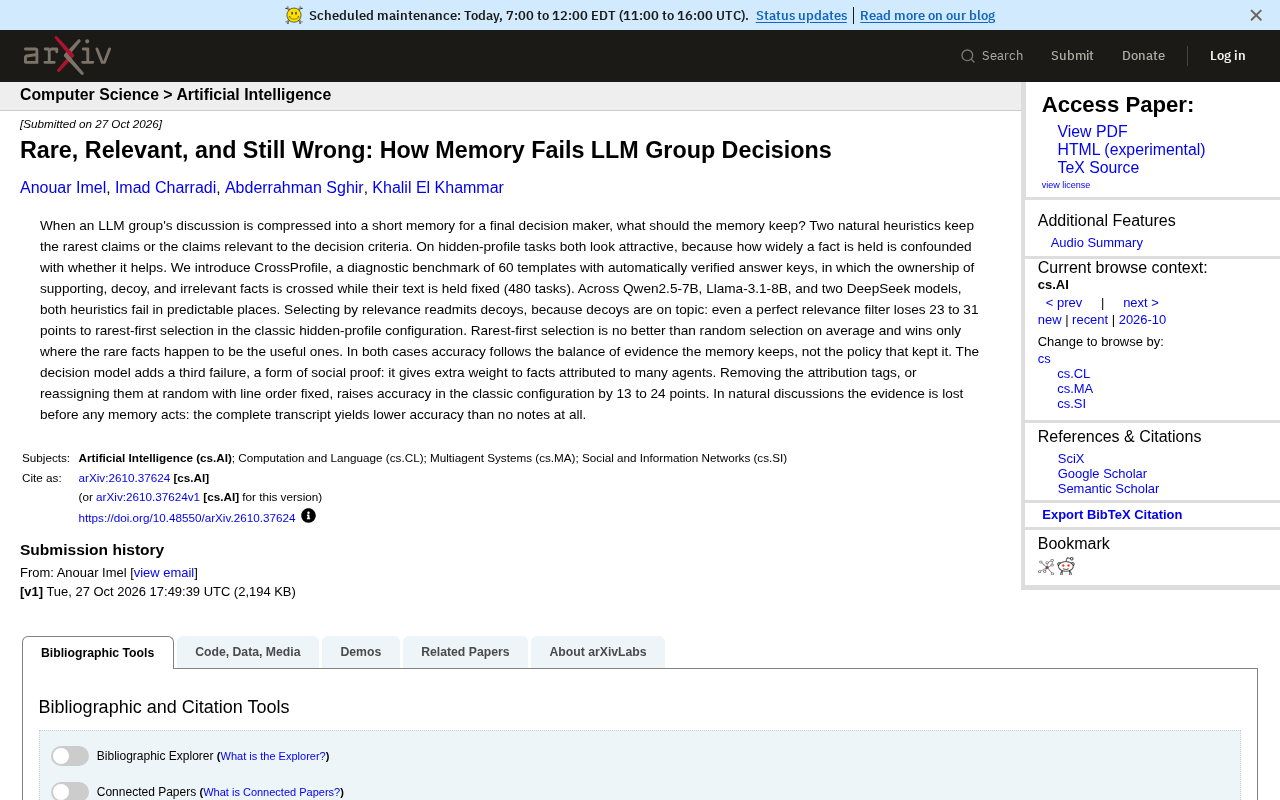
The study builds the CrossProfile benchmark with 60 templates and 480 tasks to test memory strategies of LLM groups in hidden profile tasks. Across models: relevance-based memory selection reintroduces decoy facts, scoring 23-31 points lower than rarest-first; rarest-first is on average no better than random, winning only when rare facts are useful. Even with correct facts retained, decision models show social proof bias; removing or randomly reassigning attribution labels boosts accuracy by 13-24 points. Worse, in natural discussions, full transcripts score lower than no notes, meaning evidence is lost before memory. Conclusion: simply compressing discussion records is unreliable; memory mechanisms need refined design to decouple rarity from relevance and suppress social proof bias.
When multiple large language models (LLMs) form a group to discuss and compress the discussion into a short memory for a final decision-maker to use, what information should the memory retain? Intuitively, we might choose the rarest claims or the claims most relevant to the decision criteria. However, a new study shows that both of these heuristic strategies systematically fail in hidden profile tasks.
Hidden Profile Tasks: The Confusion Between Rarity and Relevance
Hidden profile tasks are commonly used to study group decision-making: each member holds some unique information, and only through sufficient exchange can a correct judgment be made. In such tasks, how many members hold a fact (rarity) is often entangled with whether it is helpful (relevance). The researchers constructed the CrossProfile benchmark, containing 60 templates with automatically verified answer keys, and generated 480 tasks by assigning cross-supportiveness, decoys, and irrelevant facts while keeping the text fixed.
Hidden Profile is a classic paradigm in group decision-making research, first proposed by Stasser and Titus in 1985. Its core setting is: each team member holds a different set of information before discussion; some information favoring the optimal solution is "hidden" and distributed among a minority of members, while information shared by all members often points to a suboptimal solution. Therefore, for a group to make a correct decision, members holding unique information must proactively disclose it and discuss it fully; otherwise, the discussion will repeatedly reinforce shared information, making the group more likely to make wrong judgments than individuals. This phenomenon reveals the widespread existence of "information sampling bias" in group discussions. In LLM multi-agent scenarios, hidden profile tasks are used to test whether model groups can integrate dispersed evidence and whether memory compression mechanisms amplify shared information and suppress unique information.
Failure Modes of Two Heuristic Strategies
Testing on Qwen2.5-7B, Llama-3.1-8B, and two DeepSeekAd models found that selecting by relevance reintroduces decoys—because decoys are inherently on-topic. Even a perfect relevance filter scores 23 to 31 points lower than rarest-first selection in classic hidden profile configurations. Meanwhile, rarest-first selection is on average no better than random selection, and only wins when rare facts happen to be useful.
Decoy facts refer to information that is highly relevant to the decision criteria on the surface of the text but actually misleads judgment. In hidden profile tasks, decoys are usually designed to be on-topic yet point to the wrong answer, so relevance-based memory filtering prioritizes retaining them. Cross-supportiveness describes the degree to which a fact is mentioned and corroborated by multiple members; it is unrelated to the truth of the fact itself and only reflects the distribution structure within the group. The CrossProfile benchmark statistically decouples rarity and relevance by controlling the assignment of cross-supportiveness, decoys, and irrelevant facts, thereby allowing separate testing of the failure sources of each heuristic strategy.
The Third Failure Path of Decision Models: Social Proof
Even when memory retains the correct facts, the decision model introduces a third failure: it is sensitive to social proof and gives extra weight to facts attributed to multiple agents. Removing attribution labels, or randomly reassigning labels while keeping row order unchanged, can improve accuracy by 13 to 24 points in classic configurations.
Social proof refers to the tendency of individuals to believe signals conveyed by the majority or others' behavior under uncertain situations. In LLM group decision-making, when memory entries carry attribution labels indicating "which agent proposed it," the decision model treats facts repeatedly mentioned by multiple agents as more credible, even if such repetition is merely an illusion caused by information distribution. Attribution labels thus become a false consensus cue, making the model sensitive to social proof. Removing labels or randomly reassigning them improves accuracy precisely because it cuts the false association between fact content and proposer identity, forcing the decision model to judge based on the facts themselves rather than "how many people said it."
In Natural Discussions, Evidence Is Lost Before Memory
More concerning, in natural discussions, evidence is lost before memory comes into play: the accuracy of full transcripts is even lower than having no notes at all. This means the group discussion itself may fail to effectively integrate information.
Full transcripts refer to round-by-round records preserving the entire discussion process, rather than compressed summary memory. Ideally, a full transcript should contain all unique information disclosed by members and should be superior to compressed notes. But experiments found its accuracy is even lower than no notes, indicating the problem is not in the memory compression stage but in the discussion generation stage itself: in natural dialogue, models may fail to effectively elicit, restate, or retain key evidence held by minorities, causing this information to disappear from the dialogue flow before entering memory. This result shifts the attribution of failure from "memory strategy" forward to "discussion protocol," suggesting the need to design dialogue mechanisms that better stimulate information disclosure.
Implications for the Design of LLM Group Decision Systems
These findings have direct implications for building multi-agent decision systems. Simply compressing discussion records is unreliable; memory strategies require more refined design to avoid confusion between rarity and relevance while reducing social proof bias. The CrossProfile benchmark provides a tool for diagnosing these issues, and future work needs to explore more robust memory mechanisms.
According to the original data, the failure modes of the two heuristic strategies are consistent across different models, indicating this is a universal problem rather than a model-specific defect.
One-line Summary
In memory compression for LLM group discussions, both rarity and relevance heuristics systematically fail, and social proof bias further harms decision-making.
Paragraph Summary
The study constructs the CrossProfile benchmark, containing 60 templates and 480 tasks, to test memory strategies of LLM groups in hidden profile tasks. Testing on multiple models found: selecting memory by relevance reintroduces decoy facts, scoring 23 to 31 points lower than rarest-first selection; rarest-first selection is on average no better than random selection, winning only when rare facts happen to be useful. Even when memory retains correct facts, decision models remain affected by social proof bias, and removing or randomly reassigning attribution labels can improve accuracy by 13 to 24 points. More seriously, in natural discussions, the accuracy of full transcripts is even lower than no notes, indicating evidence is lost before memory comes into play. The study concludes that simply compressing discussion records is unreliable, and memory mechanisms need refined design to decouple rarity from relevance and suppress social proof bias.
Related articles

Tencent WorkBuddy Hands-On: How AI Agents Crush Traditional Chat Assistants
WorkBuddy vs Doubao tested: how AI Agents directly operate computers to convert PPT to PDF, archive files and more. Analysis of WorkBuddy's low barrier, domestic ecosystem, pricing and plugin marketplace, plus AI Agent selection advice.

Azure Cross-Tenant Attack Chain: Root Cause Analysis of Five Paths
Binary Security analyzes five full cross-tenant compromise paths in Azure, trending 271 points on HN. This article interprets their shared root cause perspective and offers defense recommendations for cloud tenant isolation and reflections on responsibility boundaries.

Recreating a Real Bubble Tea Station in Isaac Sim: Script-Driven Unitree G1 Brews Tea
Developers recreated a real self-service tea station in NVIDIA Isaac Sim, using scripts to drive a Unitree G1 through a five-step tea-brewing process, exploring whether physics simulation can be a source of synthetic robot demonstration data and discussing contact stability and imitation learning.