How Jev Turns Questions into Decisions: A Deep Dive into Its Decision Model Architecture

Jev uses four layers of contracts—state, typed output, probability, and policy—to converge AI outputs from vague answers into executable decisions.
Jev is an engineering framework for AI decision systems that uses four layers of contracts—state, typed output, probability, and application policy—to progressively converge model outputs from free text into executable structured decisions. The state contract models system-perceivable variables with types; the typed-output contract requires conformity to a predefined schema so downstream systems can consume outputs directly; the probability contract quantifies uncertainty and supports confidence-based layered handling; and the application-policy contract manages decision activation conditions, priorities, and rollback mechanisms, decoupling models from business rules. The article also discusses key trade-offs such as expressiveness versus controllability, end-to-end versus modularity, and probability calibration, and notes that the architecture offers broadly useful guidance for building reliable AI decision systems.
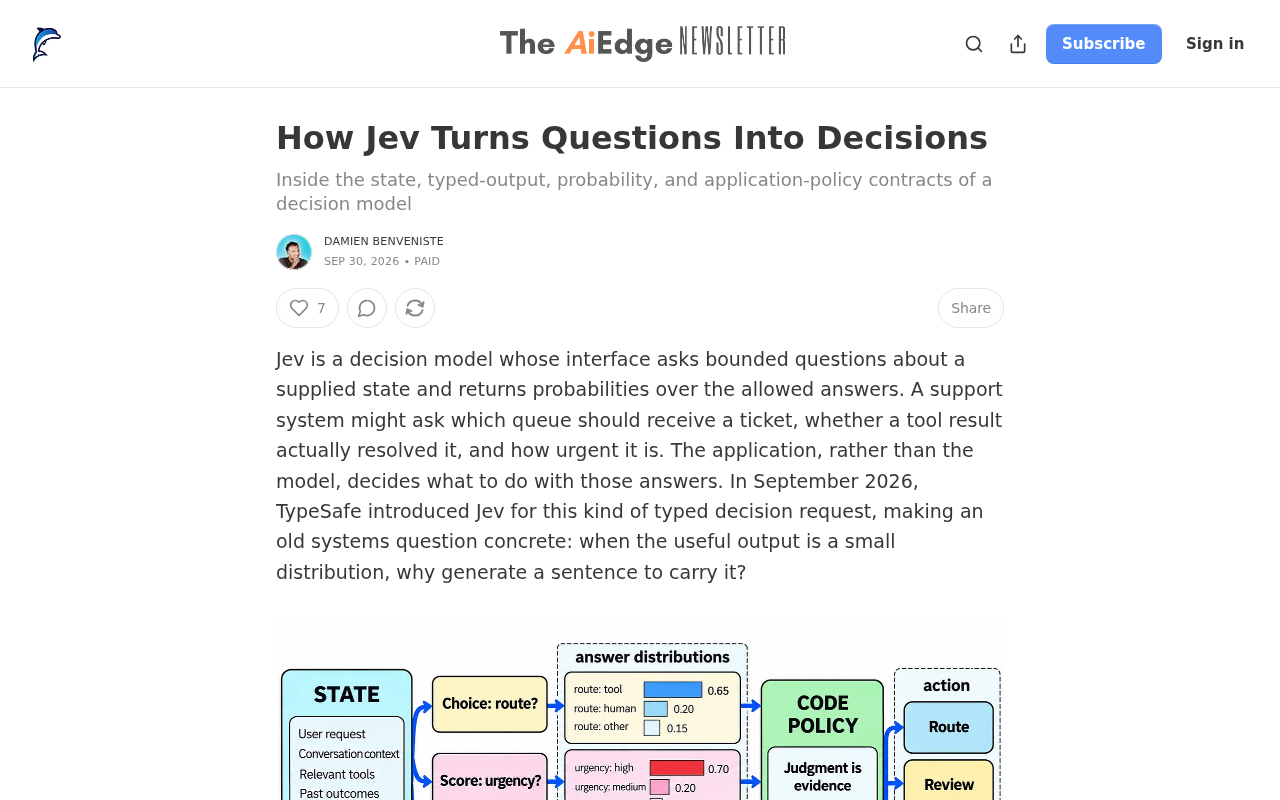
In today's increasingly complex AI decision systems, how to move model outputs from "vague answers" to "executable decisions" is a core challenge facing many teams. As a decision model framework, Jev offers a valuable engineering paradigm for this problem through four layers of contracts: state, typed output, probability, and policy.
The Core Challenge of Decision Models
Traditional AI applications often stop at the "Q&A" level: the user inputs a question, and the model returns a piece of natural language. This approach works well in information retrieval scenarios, but once it comes to decisions that need to be automatically executed by a system—such as risk control approvals, resource scheduling, or automated trading—pure text output falls short.
Jev's design starting point is precisely to address this gap. According to its technical documentation, the model progressively converges a "question" into a "decision" through four layers of contracts, each with explicit type constraints and validation mechanisms.
The Four-Layer Contract Architecture
State Contract
The state contract defines all variables that the system can perceive during the decision process. This is not just a simple list of input parameters, but a complete modeling of the "current world state"—including user context, historical behavior, external environmental signals, and more.
The key point is that the state is typed. Each state variable has an explicit data type and value range, which provides a structured input foundation for subsequent probabilistic reasoning. Compared with unconstrained natural language prompts, typed state significantly reduces the risk of model misunderstanding.
Typed-Output Contract
The output is no longer a piece of free text, but structured data conforming to a predefined schema. For example, the output of a risk control decision might take the form {action: "approve" | "reject" | "review", confidence: 0.0-1.0, reasons: string[]}.
The value of this design is that downstream systems can directly consume the output without an additional parsing layer. At the same time, type constraints also force the model to maintain logical consistency during reasoning—it cannot output ambiguous answers and must make an explicit choice.
At the engineering implementation level, typed output is usually realized with tools such as JSON Schema or Pydantic. JSON Schema declaratively defines field names, data types, enum values, required fields, and nested structures, and can be directly consumed by validation libraries in multiple languages; Pydantic, in the Python ecosystem, automatically generates validation logic through type annotations and supports serialization and deserialization. Another technical route is Constrained Decoding: when the model generates each token, it dynamically masks candidates that do not conform to the target grammar or schema, ensuring the validity of the output structure at the decoding level rather than correcting it through post-hoc parsing. Compared with the strategy of "generate, then validate, and retry on failure," constrained decoding can significantly reduce the invalid generation rate, but it requires the model inference framework to provide logits-level intervention interfaces. In real systems, the two are often used together: constrained decoding ensures syntactic correctness, while schema validation ensures semantic completeness.
Probability Contract
The probability contract requires the model not only to give a decision, but also to quantify uncertainty. This addresses a fundamental flaw of traditional rule engines: rule systems can only express "yes/no," while real-world decisions often require "how certain."
By outputting probability distributions, Jev allows downstream systems to adopt different strategies based on confidence thresholds. For example, high-confidence decisions are executed automatically, medium-confidence ones are escalated to human review, and low-confidence ones trigger an additional information collection process. This layered handling mechanism greatly improves the system's safety margin in practical applications.
Probability calibration refers to the consistency between the confidence scores output by the model and the actual accuracy rate. A well-calibrated model, when it claims 80% certainty, should in fact be correct about 80% of the time across a large number of similar predictions. Common calibration methods include Platt Scaling (fitting a logistic regression on the model output) and Isotonic Regression (non-parametric monotonic regression); both require an independent validation set to estimate calibration parameters. A common metric for evaluating calibration quality is Expected Calibration Error (ECE), which bins confidence scores and computes the weighted average of the differences between confidence and accuracy within each bin. Notably, modern deep learning models generally exhibit overconfidence—this stems both from the fact that the training objective (minimizing cross-entropy) does not directly optimize calibration, and from excessive model capacity that leads to memorizing the training distribution. In decision systems, if probabilities are not calibrated, threshold-based layered strategies (such as high-confidence automatic execution) may frequently misjudge, and the actual risk can far exceed expectations.
Application-Policy Contract
The final layer of contract defines how decisions are applied. This includes the conditions for a decision to take effect, priority rules, conflict resolution mechanisms, and rollback strategies.
The existence of this layer means that Jev is not just a model that "outputs decisions," but a complete framework for managing the decision lifecycle. The policy contract decouples model outputs from business rules, allowing the same decision model to adapt to different business scenarios.
Design by Contract was first proposed by Bertrand Meyer in the Eiffel language. Its core idea is that interactions between software components should be constrained by explicit preconditions, postconditions, and invariants, and that any violation of the contract by either party is considered a defect. Jev migrates this idea from the traditional function interface level into the AI decision pipeline: the state contract approximates preconditions, the typed-output and probability contracts define the form and semantic constraints of postconditions, and the application-policy contract serves as a system-level invariant. The significance of this migration is that it turns expectations originally implicit in prompts or documentation into executable, testable explicit constraints, shifting the behavioral boundary of AI systems from "best effort" to "verifiable."
Key Trade-offs in Engineering Practice
Jev's architectural design reflects several trade-offs worth noting.
The balance between expressiveness and controllability. Typed output limits the model's room for "free expression," but in exchange it brings predictability and auditability. In regulated industries (finance, healthcare), this trade-off is almost inevitable.
The choice between end-to-end and modularity. Jev favors a modular design—state modeling, reasoning, output formatting, and policy application each have their own role. This increases system complexity, but makes each stage independently testable and iterable.
The challenge of probability calibration. The probability contract is appealing, but whether the probabilities output by the model are well calibrated remains an open question. Models that are overconfident or overly conservative both weaken the value of this mechanism.
Implications for AI Decision System Development
Jev's four-layer contract architecture provides a referable blueprint for building reliable AI decision systems. Its core insight is that a decision is not a single model call, but a complete pipeline from state perception to policy execution.
For teams currently building AI decision-making capabilities, Jev's practice suggests several directions: prioritize defining clear output schemas rather than relying on prompt engineering; treat uncertainty quantification as a first-class citizen; and establish clear policy boundaries between the model layer and the business layer. These principles do not depend on a specific model or framework and have strong general applicability.
Related articles

Should U.S. College Fraternities Be Banned? A Researcher's Incisive Observations
Why not just ban U.S. college fraternities? A researcher finds the key resistance comes from decision-makers' own fraternity identities and schools' "willful ignorance."

Microsoft Discovery: Accelerating Scientific Discovery with AI Agents
Microsoft's Discovery platform runs specialized AI agents to help researchers screen and prioritize the most promising compounds and experimental paths, reducing experiments and accelerating scientific discovery.

Cambridge Heavy Industries Secretly Develops Desktop-Scale Nuclear Fusion Device
Cambridge Heavy Industries is secretly developing a desktop-scale laser-driven nuclear fusion device, targeting the equipment supply market for fusion power plants. This article analyzes its miniaturization technology path, commercialization logic, and unique positioning in the fusion startup wave.