How Kubernetes Becomes Day-One Ready for NVIDIA Vera Rubin

NVIDIA uses a compute-domain abstraction to make Kubernetes AI-Ready for new GPUs on day one.
The article outlines the compatibility challenges NVIDIA Vera Rubin poses to Kubernetes: drivers, kernels, runtimes, and networking must all align with the new hardware, and the traditional approach of node labeling and manually maintained driver version matrices is costly and error-prone. NVIDIA's solution is a "compute domain" abstraction that converges hardware differences into the resource abstraction layer so cluster configuration logic need not be rewritten for each GPU generation. The article stresses that the value of the "Day One" goal is shortening the adaptation window after new hardware arrives and reducing idle expensive compute, and notes that platform teams should focus on resource abstraction capability rather than single-generation hardware specs—the key to keeping Kubernetes in step with the hardware roadmap.
NVIDIA Vera Rubin, as a new generation of GPU hardware, imposes stricter compatibility requirements on Kubernetes across drivers, kernels, runtimes, and the network stack. NVIDIA's official technical blog revealed the engineering approach to making clusters AI-Ready on the very first day the hardware launches. The core is not stacking more configuration items, but rather reorganizing resource abstraction around "compute domains."
Root Cause: Hardware Iterates Faster Than Cluster Configuration
The original article states plainly that configuring and optimizing Kubernetes for new GPU hardware is "complex and error-prone," involving multiple layers including drivers, kernels, runtimes, and networking. This complexity is further amplified on new architectures like Vera Rubin: each layer must align with the new hardware's characteristics, and any lagging layer will prevent the entire GPU from being properly recognized and allocated by the scheduler.
The traditional approach is to label nodes, declare resources by device model, and then rely on operations teams to manually maintain driver version matrices. The faster hardware generations turn over, the higher the maintenance cost of this manual process and the greater the probability of errors.
Vera Rubin is the name of NVIDIA's next-generation GPU platform announced after Blackwell, continuing the tradition of naming after scientists. New architectures typically come with higher memory bandwidth, updated interconnect solutions (such as NVLink generation upgrades), and new system-level features, which means driver versions, CUDA toolchains, container base images, and network drivers all need to be upgraded in sync to versions that support the architecture. There is strong version coupling between drivers and kernel modules, and Kubernetes nodes are often built from different batches and different images. This "version matrix" is precisely why manual maintenance costs remain high, and it is the real-world context behind the article's emphasis on front-loading adaptation into the abstraction layer.
Compute Domains: Converging Hardware Differences into the Abstraction Layer
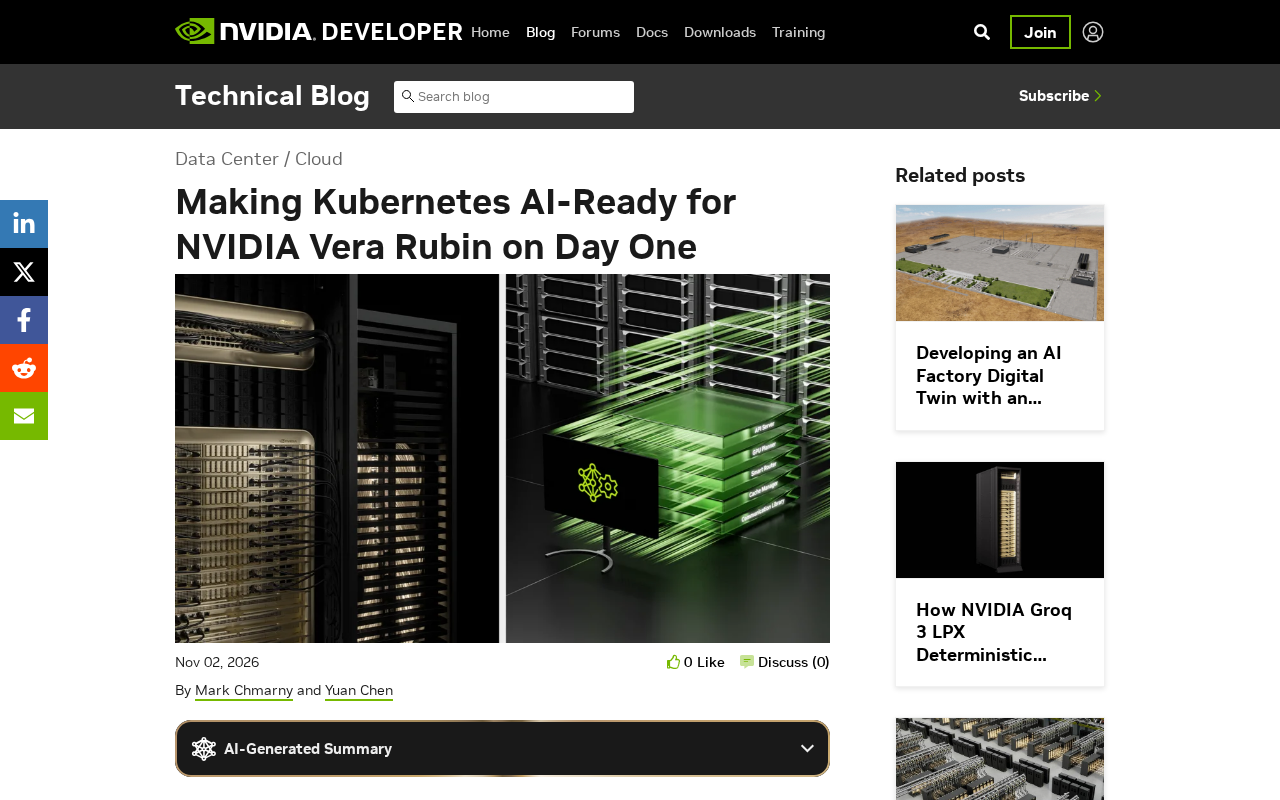
NVIDIA's solution is to introduce the concept of "compute domains." As seen in the diagram, this abstraction is not a simple node grouping; rather, it shifts the organization of compute resources from "by machine" to "by domain," so that the scheduling layer's perception of hardware differences is converged at the domain level.
The significance of this design lies in decoupling: cluster-side configuration logic does not need to be rewritten for each new GPU generation, and hardware-related adaptation is confined to the definition and configuration of domains. For AI platform teams that need to quickly onboard new hardware, this directly reduces the configuration surface that must be changed and validated on day one.
The original article does not elaborate on the specific API-level fields of compute domains, but based on its positioning, it is more like a resource boundary prepared for scenarios where multiple GPU generations coexist, rather than a labeling system solely for single-card recognition.
Understanding compute domains requires first understanding Kubernetes' existing GPU resource abstraction: GPUs are exposed as extended resources (such as nvidia.com/gpu) through the Device Plugin mechanism. The scheduler only performs count-based allocation and is nearly unaware of model-generation differences, so node labels and nodeSelector have become common means of distinguishing hardware. The compute domain approach adds another level of logical boundary on top of this layer, aggregating similar or same-generation compute resources into units that can be described and scheduled as a whole, so that upper-layer policies are written for "domains" rather than "machines." This is similar in direction to ClusterClass, NodePool, and other approaches in the cluster API for "managing heterogeneous nodes as groups," with the difference being that it also incorporates GPU generation characteristics into the definition of the domain.
What Day-One Readiness Means
"Day One" is the core demand in the original title. After new hardware arrives, teams often have to go through a series of steps—driver installation, container runtime validation, network configuration tuning—before training jobs can actually run. The longer this window, the higher the idle cost of expensive compute.
Front-loading adaptation work into compute domains and accompanying runtime configurations essentially turns "tune after launch" into "match at launch." The four layers mentioned in the original article—drivers, kernel, runtime, and networking—correspond exactly to the links that must be connected simultaneously to achieve this goal; the absence of any one link will cause day-one readiness to fail.
In real engineering, "day-one readiness" for AI clusters usually corresponds to a verifiable acceptance checklist: GPU drivers and kernel modules (such as NVIDIA's nvidia.ko) can load correctly with the node image and pass nvidia-smi self-checks; the container runtime must inject GPU devices and driver libraries into containers through the NVIDIA Container Toolkit; on the Kubernetes side, the NVIDIA Device Plugin is relied upon to register GPUs as schedulable resources, and the scheduler and topology manager must correctly recognize NUMA and GPU affinity; the network layer involves the device plugins and CNI configuration required for RDMA/RoCE or GPUDirect. If any link is missing, a Pod may fail to request a GPU or fail to saturate bandwidth. Therefore, "Day One" is not a single configuration item but an end-to-end validation chain from kernel to scheduler.
Practical Implications for Platform Teams
From this technical blog, it is clear that NVIDIA's investment focus in the Kubernetes ecosystem is shifting from "supporting a certain GPU" to "enabling clusters to continuously accept new GPUs." For teams building their own AI clusters, what deserves attention is not the specific parameters of a particular hardware generation, but whether the resource abstraction layer can isolate hardware generation differences within a controllable scope.
As the pace of hardware iteration continues to accelerate, manually maintaining compatibility matrices will become increasingly unsustainable. Converging adaptation logic into abstractions such as compute domains is the key to keeping Kubernetes in step with NVIDIA's hardware roadmap.
Related articles

VERS: Editing Activation Explanations to Halve Reasoning Model Tokens
VERS guides reasoning models by editing activation explanations, cutting 45.8% of tokens on GSM8K with only a 0.82 pp accuracy drop and transferring to larger models, but losing accuracy on competition problems.

Finding Errors Is Not Enough: Selective Model Escalation for Entity-Targeted Sentiment Analysis
This study explores selective model escalation for entity-targeted sentiment analysis, comparing data collection ordering, uncertainty-driven re-examination, and model routing—finding that minority-class priority only helps at very small data volumes, the oracle upper bound far exceeds actual gains, and escalation must be tailored to each dataset.

WAS-PO: Using Whitened Advantages to Solve the Correlation Trap in Multi-Reward Reinforcement Learning
WAS-PO paper proposes whitening advantages to correct correlation bias in multi-reward RL: when rewards are correlated, naive weighted summation effectively applies Σ^{1/2}w instead of w. Experiments show training reward improves steadily, but held-out accuracy does not improve in sync, and under two rewards it actually falls behind.