How Many Tokens Does AI Evaluation Consume? The Overlooked Compute Cost Black Hole

Model evaluation is a hidden but massive driver of global AI token consumption.
A surprising share of global AI token spend — estimated at 10% to 30% — may go toward model evaluation rather than serving end users. From LLM-as-a-Judge workflows to prompt iteration and regression testing, evals consume tokens at scale, especially during development. This article explores why evaluation costs are underestimated and how teams can adopt smarter strategies to manage them.
A Problem Hiding in Plain Sight
Recently, a question posted on Twitter sparked discussion among AI practitioners: "What percentage of global AI token spend do you think goes toward running evals?"
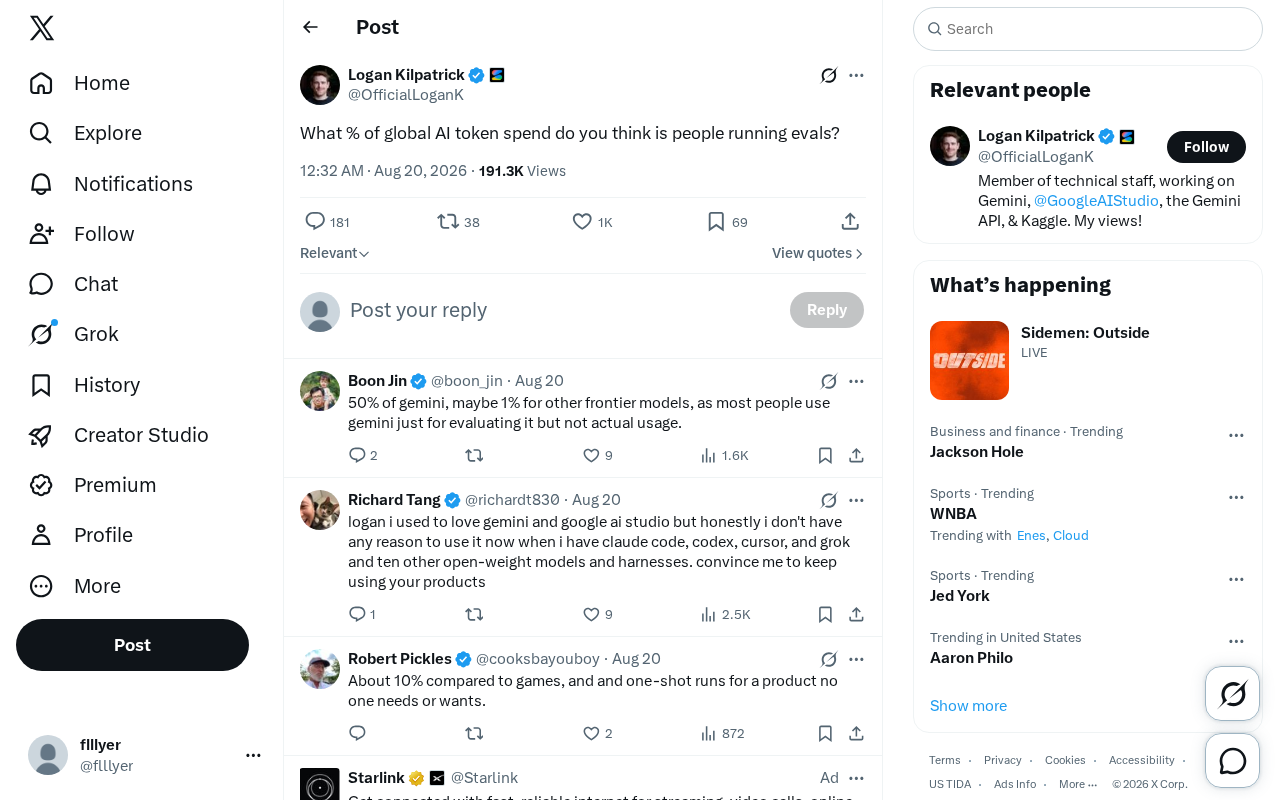
This seemingly simple question touches on a rarely quantified yet omnipresent cost black hole in LLM application development — model evaluation (commonly known as evals). While everyone focuses on the compute costs of model training and inference, few have seriously calculated just how many tokens we're burning to verify whether a model or AI application is "good enough."
What Are Evals: The Invisible Infrastructure of AI Development
Evaluation Is the Core of LLM Quality Assurance
In traditional software development, we have unit tests and integration tests to ensure code quality. In LLM application development, however, the inherent non-determinism of model outputs makes "testing" extraordinarily complex. You can't use a simple assert statement to judge whether a piece of generated text is "correct" — and that's exactly why evals exist.
Typical evaluation scenarios include:
- Model capability benchmarking: Running scores on datasets like MMLU, GSM8K, HumanEval, etc.
- Prompt iteration validation: Re-running the test suite every time a prompt is revised
- Regression testing: Ensuring existing functionality hasn't degraded after model or pipeline updates
- LLM-as-a-Judge: Using one large model to evaluate the output quality of another
Why Evaluation Token Costs Are Severely Underestimated
The key issue is that many evaluation workflows are massive token consumers. Take the increasingly popular "LLM-as-a-Judge" approach — you not only consume tokens to generate the answers being evaluated, but also spend additional tokens having another model score them. A single evaluation run often means double or even multiple times the token overhead.
More importantly, evaluation isn't a one-time event. A serious AI team might run hundreds or thousands of evaluations per day: every commit in the CI/CD pipeline triggers a run, A/B tests compare multiple versions, and prompt engineers iterate dozens of times a day. These costs accumulate over time to staggering proportions.
Evals May Account for a Surprisingly Large Share of Global AI Token Spend
Token Distribution Differences Between Development and Production
If we break down the lifecycle of an AI application, an interesting pattern emerges. Before an app reaches large-scale deployment, nearly all token consumption during the development and debugging phase comes from evaluation and experimentation, not real user requests.
For the many AI startups still in their exploration phase — those that haven't yet found PMF (Product-Market Fit) — evaluation, testing, and tuning likely make up a substantial portion of their token bills. This explains why some practitioners speculate that evals account for a far larger share of global AI token spend than intuition would suggest — with estimates ranging from 10% to 30%, or even higher.
Synthetic Data Generation Further Amplifies Evaluation Costs
You may not have noticed, but evaluation overlaps significantly with synthetic data generation, model distillation, and similar workflows. When teams use LLMs to batch-generate test cases or construct evaluation datasets, these costs may not be labeled "eval" in name, but they are essentially "non-end-user" token expenditures. If you include all of this broader "internal consumption," the percentage only goes higher.
The Far-Reaching Impact of Evaluation Costs on the AI Industry
Evaluation Efficiency Is Becoming a New Competitive Advantage
If evals truly consume such a large share of compute resources, then reducing evaluation costs is a business opportunity in itself. This explains the wave of evaluation tools and platforms that have emerged in recent years — LangSmith, Braintrust, Promptfoo, and others — whose core value proposition includes helping teams run evals more efficiently and affordably.
Going forward, smart teams will adopt tiered evaluation strategies: using smaller models or rule-based methods for initial screening, reserving expensive LLM judges for critical checkpoints; leveraging caching to avoid redundant evaluations; and using more refined evaluation sets to cut unnecessary token consumption.
Implications for AI Compute Demand Forecasting
For cloud providers and chip companies, this question has practical significance. Current market forecasts for AI compute demand are largely based on the assumption of "inference serving real users." But if a significant portion of token consumption actually comes from developers running evaluations and experiments, then the structure of compute demand looks quite different from what people imagine — it depends more on the vibrancy of the developer ecosystem than on end-application user scale.
Conclusion: It's Time to Include Evals in Cost Accounting
The value of this Twitter question isn't in providing a precise answer — it's in reminding the entire industry that our understanding of AI costs has blind spots.
Evaluation is an indispensable part of ensuring AI application quality, but its costs have long been buried under the vague category of "R&D expenses," rarely tracked separately. As AI applications mature, teams that can manage evaluation costs with precision — finding the optimal balance between quality and expenditure — will gain a very real competitive edge.
Next time you look at an AI company's compute bill, it's worth asking: how much of this was spent on "verifying" rather than "serving"?
Related articles

Workbuddy for Absolute Beginners: How a Desktop AI Agent Fits Into Real Workflows
A beginner's guide to the Workbuddy desktop AI agent: installation, claiming credits, file management, and building automated workflows—compared with CodeX for fit and cost, helping professionals shift from AI question-askers to AI managers.

OpenAI's New Agent Stack: Computer Use, Decisions API, and Ultra-Fast Workflows
OpenAI Dev Day unveiled a new agent stack: Computer Use outperforms humans, Decisions API delivers ultra-low-latency classification via Luna, Agents API opens the same Computer Use capabilities, and GPT-6.1 Sol costs only one-seventh of Astra. Core updates, benchmark data, and developer insights.

Liang Wenfeng Open-Sources DeepInfo Inference Framework, Takes On U.S. Ban
DeepSeek open-sources its DeepInfo inference framework after its models, featuring GPU/CPU cross-pipelining, small-model prediction with large-model verification, and full Huawei Ascend and NVIDIA chip support—facing the U.S. federal ban head-on. This article analyzes its significance for AI deployment and open-source strategy.