How Model Fine-Tuning Can Cut Costs by 90%: Owning the Intelligence at the Core of Your Product

Specialized model training can cut core task inference costs by up to 90% — waiting for general model upgrades won't.
The article examines a key fork in AI development: relying on general-purpose model API upgrades versus training specialized models for core product tasks. General-purpose models are built to cover broad use cases, making them inherently costly for high-frequency, predictable tasks. Through smaller model size, fewer token consumption, and more controllable deployment, specialized training can achieve up to 90% cost reduction. More fundamentally, owning your core intelligence is a strategic moat question — if competitors can replicate your key capabilities with the same API, your differentiation is fragile. The article also cautions that the 90% figure lacks public benchmarks, and specialized training only makes sense when tasks are frequent, stable, and cost-sensitive.
Why the Next Foundation Model Won't Save Your Product
A perspective circulating in the tech community has recently sparked discussion: for the core tasks that customers truly rely on, model training can reduce costs by up to 90%. The sharper claim that follows is this — no matter how powerful the next foundation model turns out to be, simply waiting for the next update won't get you there.
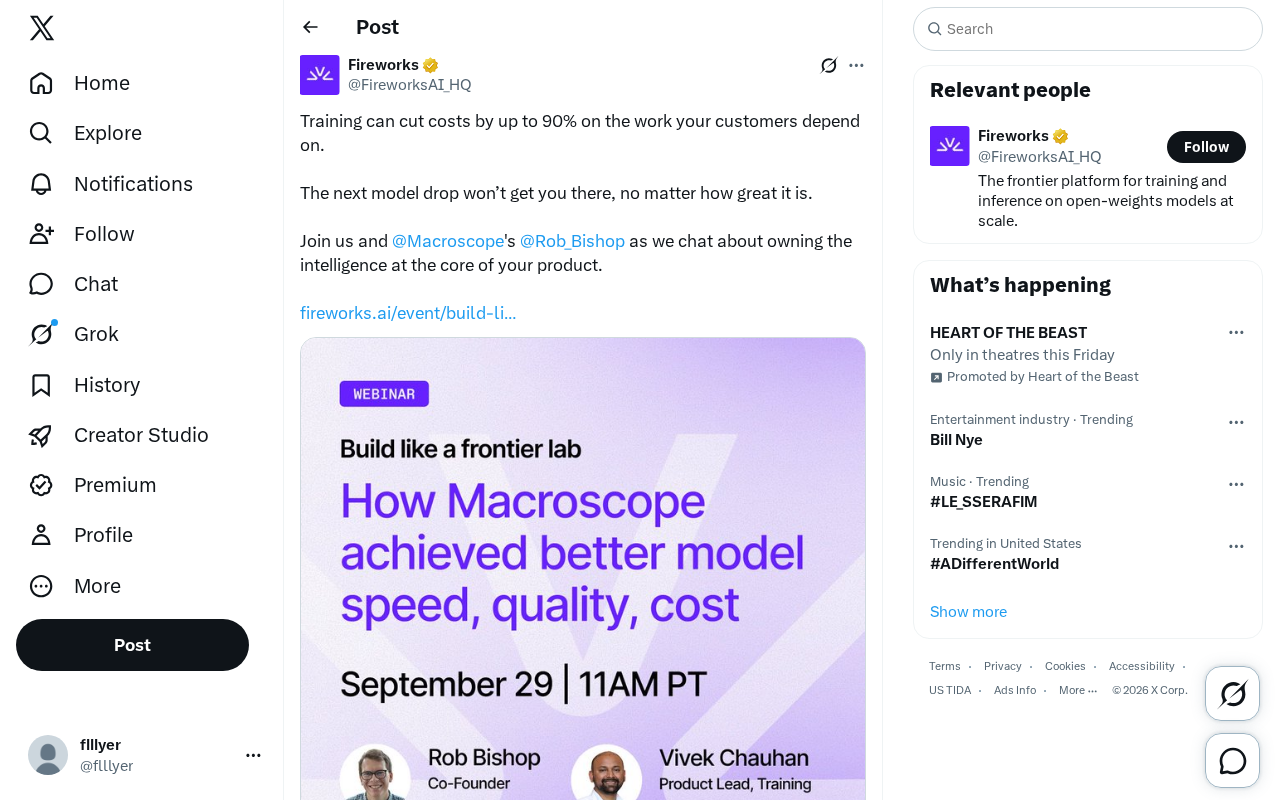
This touches on a fundamental fork in AI application development: should you continue depending on general-purpose large models and wait for their capabilities to improve, or take control of your product's core intelligence layer through targeted training? The original post comes from a teaser for a conversation with Rob Bishop of Macroscope, centered on the theme of "owning the intelligence at the core of your product."
The Fork in the Road: General Model Upgrades vs. Specialized Training
Many teams default to this strategy: plug into the latest and most capable general-purpose model API, then wait for the next model iteration to fix current performance and cost issues. It's a simple, straightforward approach — but it has structural limitations.
General-purpose large models are designed to cover the widest possible range of tasks, which means they carry unavoidably heavy parameter counts and inference costs. When your product only needs to repeatedly handle a narrow set of core tasks, using a massive general-purpose model essentially means paying for a large amount of capability you'll never use.
The core logic the original post emphasizes is this: what actually determines the customer experience is usually the work that customers depend on — high-frequency, predictable tasks with clear accuracy requirements. Training or fine-tuning a model specifically for these tasks allows a smaller, more specialized model to match or even exceed the performance of a general-purpose model, while dramatically reducing per-inference costs.
Where the 90% Cost Reduction Comes From
The "up to 90% reduction" figure is an attention-grabbing number. While specific measurement conditions aren't detailed in what is promotional content, the source of these savings is technically well-grounded:
Smaller Model Size
Through training on task-specific data, specialized models can often achieve target accuracy with far fewer parameters than general-purpose large models. Fewer parameters directly translates to lower compute and memory requirements for inference.
Fewer Token Consumed
Specialized models typically don't require extensive prompt engineering or large numbers of few-shot examples to guide their behavior, because the target behavior has already been internalized into the model weights. This means significantly fewer input tokens per call.
Prompt engineering refers to the technique of carefully crafting input text to guide a general-purpose model toward a desired output. Because general-purpose models need to "understand" task intent at runtime, developers often need to include detailed instructions, role descriptions, and several demonstration examples (few-shot examples) to tell the model "here's what you should do." All of this is billed as input tokens on every API call, and it adds up quickly. By contrast, a fine-tuned specialized model has already had these behavioral patterns "written into" its weights during training, so inference only requires the minimal task input — system prompts can be dramatically shortened or omitted entirely, directly reducing token usage per call. In high-concurrency production environments, this difference has a significant impact on the overall API bill.
More Controllable Deployment
Owning your own model means you can choose more cost-effective deployment options instead of indefinitely absorbing per-call pricing from a third-party API provider — a gap that becomes especially pronounced at high concurrency.
The Strategic Implications of "Owning the Core Intelligence"
The real point of this discussion isn't just cost — it's control. When the most critical intelligent capabilities of your product are entirely dependent on an external model provider, your product differentiation, cost structure, and even availability are all tied to someone else's roadmap.
The phrase "owning the intelligence at the core of your product" is worth sitting with. It elevates training from a purely technical choice to a product strategy question: is your core capability something you rent, or something you own?
For product companies whose core value proposition is AI, if the most critical capabilities can be replicated by any competitor using the same API, the moat is extremely fragile. By training specialized models on proprietary data, teams can not only cut costs but also accumulate capability assets that are difficult to replicate.
Model fine-tuning and pre-training from scratch are the two main paths to building a "specialized model," with very different costs and barriers to entry. Pre-training from scratch requires massive datasets and enormous compute — typically only feasible for large labs. The more common approach is to perform Supervised Fine-Tuning (SFT) or preference alignment training (RLHF/DPO) on top of an existing foundation model (such as the open-source Llama or Mistral series), requiring only a few hundred to a few thousand high-quality task samples, completable with limited GPU resources. This puts specialized model ownership within realistic reach for small and mid-sized product teams that have accumulated sufficient business data. Choosing an open-source foundation model also reduces dependency on any single vendor while preserving the flexibility to deploy on private infrastructure — fundamentally severing the per-call billing cost structure.
A Measured Take on This Perspective
It's worth noting that this is content with a clear promotional intent. The "90%" figure lacks publicly available measurement details, and actual results are highly dependent on the specific task type, data quality, and the team's engineering capabilities.
Specialized training also comes with its own costs: it requires data accumulation, training and operations expertise, and ongoing model performance evaluation. For early-stage products with shifting tasks and unstable requirements, using a general-purpose model API directly may actually be more flexible and faster to iterate.
A reasonable decision framework might be: when a particular task is frequent enough, stable enough, and cost-sensitive enough, migrating it from a general-purpose model to a specialized trained model may deliver meaningful cost savings. Otherwise, the added complexity of training may not be worth it.
Summary
This community discussion raises a question worth every AI product team's consideration: are you planning to wait indefinitely for the next more powerful model, or are you going to start taking ownership of the intelligence at the core of your product? Under the dual pressure of cost and control, specialized training for core tasks is becoming an increasingly well-regarded path forward.
Related articles

Should U.S. College Fraternities Be Banned? A Researcher's Incisive Observations
Why not just ban U.S. college fraternities? A researcher finds the key resistance comes from decision-makers' own fraternity identities and schools' "willful ignorance."

Microsoft Discovery: Accelerating Scientific Discovery with AI Agents
Microsoft's Discovery platform runs specialized AI agents to help researchers screen and prioritize the most promising compounds and experimental paths, reducing experiments and accelerating scientific discovery.

Cambridge Heavy Industries Secretly Develops Desktop-Scale Nuclear Fusion Device
Cambridge Heavy Industries is secretly developing a desktop-scale laser-driven nuclear fusion device, targeting the equipment supply market for fusion power plants. This article analyzes its miniaturization technology path, commercialization logic, and unique positioning in the fusion startup wave.