How Much Code Do You Actually Need to Rewrite When Switching Agent Frameworks? Real-World Insights

Switching Agent frameworks is costly due to hidden coupling — build migration-friendly architecture from day one.
This article tackles an overlooked engineering challenge in AI Agent development: the true cost of framework migration. Triggered by a Reddit post from a voice agent evals developer, it examines how state management, tracing, and tool definitions tend to become tightly coupled to a specific runtime, making migration far more painful than expected. Rather than running a full migration drill, the article recommends keeping your architecture migration-friendly from the start — wrapping framework calls behind stable interfaces, decoupling business logic from the runtime, and designing your eval system as a framework-agnostic quality anchor. In a rapidly evolving framework ecosystem, this mindset is key to staying adaptable.
An Underestimated Engineering Challenge
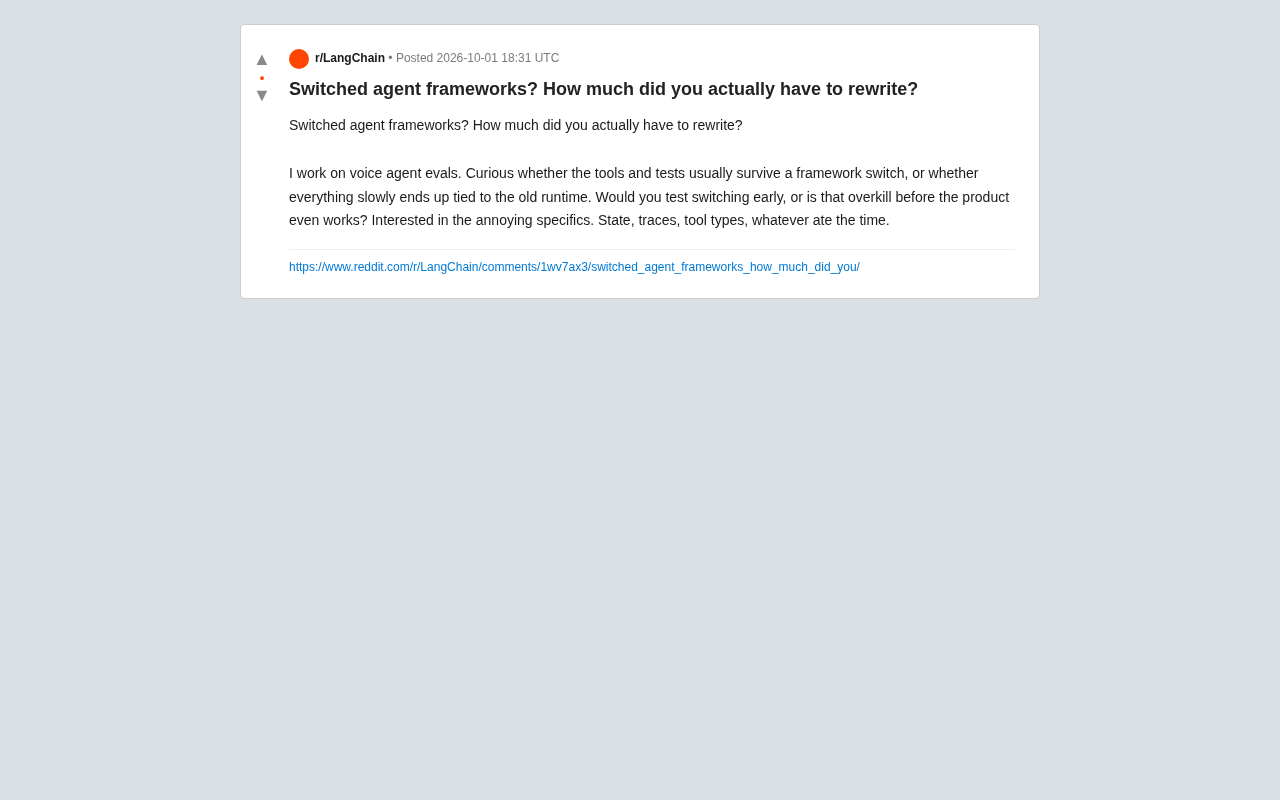
In the AI Agent development space, there's a question that often gets overlooked yet carries serious consequences: when you decide to migrate from one Agent framework to another, how much code actually needs to be rewritten? A developer focused on voice agent evals raised this topic on Reddit, sparking an in-depth discussion about the maintainability of Agent engineering.
The core question is refreshingly practical: can your tools and tests survive a framework switch, or does everything slowly end up tied to the old runtime? Going further — should you proactively test framework portability before your product is even mature, or is that overkill?
Why Framework Lock-In Is a Trap
Agent framework migrations are painful primarily because of hidden coupling. Most teams, eager to validate their product quickly, lean heavily on the convenient abstractions a framework provides — state management, tool-calling conventions, tracing mechanisms, and so on. These conveniences accelerate development in the short term, but they also embed a lot of runtime-specific logic deep into the codebase.
As the project evolves, this coupling spreads like ivy. By the time you realize the current framework can't meet your needs — whether due to performance bottlenecks, missing features, or an abandoned community — the migration cost has become staggering. The original poster's concern hits the nail on the head: "everything slowly ends up tied to the old runtime."
The Parts That Will Eat Your Time
Based on the "annoying specifics" mentioned in the discussion, the most time-consuming areas during migration typically include:
- State management: Different frameworks handle session state, memory, and context storage and propagation in vastly different ways — almost nothing is directly reusable.
- Tracing and observability: Log formats, trace structures, and debugging tools are often deeply coupled to a specific framework. After switching, your entire monitoring stack may need to be rebuilt from scratch.
- Tool types: The way tools (tool/function calling) are defined, their schema formats, and return protocols vary across frameworks with no real standard — this is ground zero for rewrites.
Today's mainstream AI Agent frameworks — including LangChain/LangGraph, AutoGen, CrewAI, LlamaIndex Workflows, and OpenAI Swarm — each have their own independent design philosophy when it comes to tool-calling protocols, state persistence, and multi-agent orchestration. For example, LangGraph uses a graph structure to describe an agent's state machine, while CrewAI organizes agent collaboration through a declarative "role-task" style. These two paradigms share almost no common vocabulary at the abstraction layer. As a result, even migrating a mid-sized Agent application from one framework to another often isn't "adapting code" — it's "re-modeling from scratch," and the effort is consistently underestimated.
Can Your Evals and Tests Survive?
The original poster's background is in voice agent evals, and this perspective offers a key insight: an evaluation system should ideally be framework-agnostic. Ideally, your test cases care about "what goes in and what's expected to come out" — not "how the framework implements it internally."
If your eval suite is written with sufficient abstraction — driving the agent through stable interfaces rather than internal framework APIs — its chances of surviving a framework switch are much higher. Conversely, if your test code directly calls internal framework methods or depends on specific trace formats, then the tests themselves become part of the migration burden.
This reveals an important engineering principle: the evaluation layer should be designed as a "migration anchor," not as something that gets rewritten alongside the framework. A robust, framework-agnostic eval suite lets you quickly verify whether the new framework has achieved the same quality bar as the old one.
Voice agent evals represent a specialized subdomain with unique requirements around latency, interruption handling, and conversation turn management — far more demanding than typical text-based agent evals. Common evaluation dimensions include Time to First Byte (TTFB), speech-to-text accuracy, the agent's ability to recover state after an interruption, and intent consistency across multi-turn conversations. Because voice-specific metrics are naturally tied to the audio pipeline rather than framework logic, developers in this space tend to be especially sensitive to "how to decouple the eval layer from the framework" — which is precisely why the original poster was able to frame the question so precisely.
Should You Test Framework Portability Early?
This is the most contentious question in the discussion: when your product hasn't even proven itself yet, is spending energy validating framework portability forward-thinking or wasteful?
The case for early testing argues that even a small-scale "migration drill" can expose the most fragile coupling points in your codebase, nudging you toward establishing sound abstraction boundaries early. The cost of such a drill is low, but the potential payoff is high.
The opposing view holds that obsessing over framework portability before product viability is confirmed is classic premature optimization. If the product might not survive anyway, investing engineering resources into a migration that may never happen simply isn't worth it.
A Pragmatic Middle Ground
The more practical approach may be: don't run a full migration drill, but keep your architecture migration-friendly from the start. In practice, this means:
- Wrapping framework calls behind your own defined interfaces, rather than calling framework APIs directly throughout the codebase;
- Decoupling business logic, prompts, and tool definitions from the framework runtime;
- Keeping the evaluation system independent, as a cross-framework quality benchmark;
- Using neutral storage formats for state and trace data.
Even without actively rehearsing a switch, if you ever do need to migrate, the pain will be significantly reduced.
The concept of premature optimization comes from computer scientist Donald Knuth's famous quote: "premature optimization is the root of all evil." It was originally a warning against investing heavily in performance tuning before bottlenecks are clearly identified. In the context of Agent engineering, the term has been extended to describe pouring effort into infrastructure before the product direction is settled. It's worth noting that Knuth's full statement actually reads: "We should forget about small efficiencies, say about 97% of the time — premature optimization is the root of all evil; yet we should not pass up our opportunities in that critical 3%." This means that for architectural decisions that genuinely affect a system's entire lifecycle, thinking ahead is still reasonable — it shouldn't be dismissed wholesale under the banner of "premature optimization."
Key Takeaways for Agent Developers
The Agent framework ecosystem is still evolving rapidly. Today's hottest framework could be superseded by something better tomorrow. In the face of this uncertainty, treating frameworks as replaceable components rather than the foundation of your project is a healthier engineering mindset.
The core recommendations can be summarized as: keep your eval system independent, abstract your tool definitions, keep state management neutral, and wrap your framework calls. These investments may seem unnecessary early in a product's life, but they buy you flexibility and low cost when migration eventually becomes necessary — and that flexibility is precisely the key capability for navigating the fast-moving AI toolchain landscape.
Related articles

Huberman's Rational Supplement Guide: A Five-Layer Health Framework and Scientific Decision-Making
Stanford neurobiology professor Huberman proposes a rational supplement framework: behavior and nutrition are the foundation, basic combination supplements serve as insurance, and sleep/hormonal/cognitive directions should stick to single-ingredient experiments. Omega-3 is the top single-ingredient choice, and melatonin is not recommended.

The Unsung Painter Behind Gilded Age Manhattan Interior Design
HN discussion highlights the painter behind Gilded Age Manhattan interiors: he created murals and decorative paintings but was long overlooked as his work was seen as architectural appendage.

Can AI Agents Be Socially Engineered? Understanding Prompt Injection and Tool Permission Risks
Through Invariant Lab's GitHub Issue injection and Brave's AI browser attack, this article analyzes how Prompt Injection induces AI Agents to perform unauthorized actions, and offers protection advice across three layers: least privilege, tool validation, and operation auditing.