How NVIDIA's Multi-Agent System Automates Financial Signal Discovery

NVIDIA proposes a multi-agent AI system to automate quantitative financial signal discovery workflows.
NVIDIA has released a technical approach leveraging Multi-Agent Systems (MAS) to automate the quantitative financial signal discovery process. The system features five specialized agents — strategy, data, coding, backtesting, and optimization — collaborating to simulate a complete quant research team, reducing the traditional days-long hypothesis-coding-backtesting-optimization cycle to minutes. The solution combines LLM financial reasoning capabilities with decision explainability, though challenges like overfitting risk and LLM hallucination remain.
Overview: When Quantitative Finance Meets Multi-Agent AI
In quantitative finance, researchers build algorithms to trade assets, derivatives, and other financial instruments. At the core of this work is discovering trading signals — data patterns and features that can predict market movements. Traditionally, this process has been heavily reliant on human experts' experience and intuition, making it both time-consuming and difficult to scale.
A recent technical blog post from NVIDIA proposes an entirely new approach: leveraging Multi-Agent Systems (MAS) to automate and optimize the financial signal discovery process. This solution deeply integrates the reasoning capabilities of Large Language Models (LLMs) with specialized quantitative finance workflows, marking another significant advancement in AI applications for the financial sector.
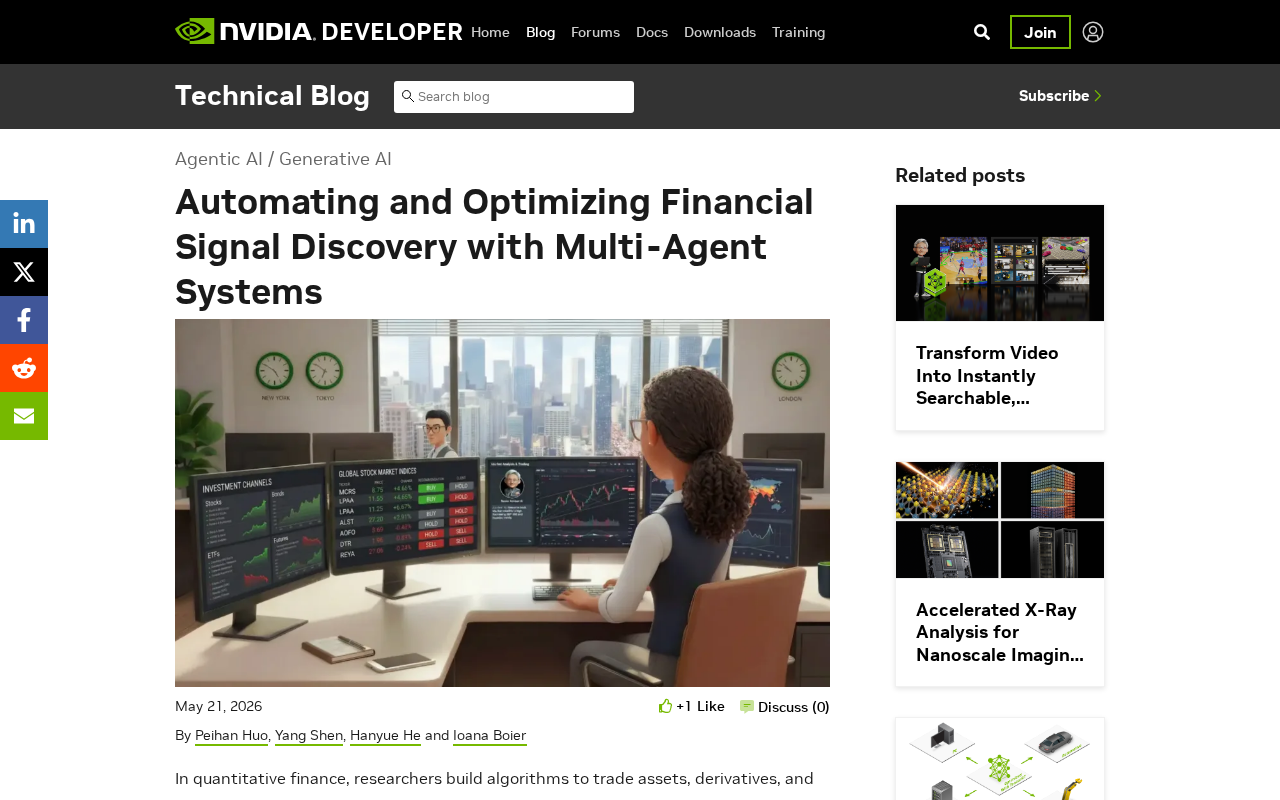
What Is Financial Signal Discovery?
The Nature and Historical Origins of Signals
In quantitative trading, a "signal" refers to a data feature that provides directional predictions about the market. For example, an unusual spike in a stock's trading volume might signal an impending price movement, or changes in macroeconomic indicators might affect an entire sector's trajectory. The daily work of quantitative researchers involves mining these signals from massive datasets and converting them into executable trading strategies.
Quantitative trading itself originated in the 1970s, with pioneers like Edward Thorp and James Simons introducing mathematical models to financial markets. Renaissance Technologies, founded by Simons, achieved astonishing annualized returns exceeding 60% over decades through its Medallion Fund's systematic signal-mining approach. This history not only demonstrates the enormous value of quantitative signals but also laid the foundation for modern quantitative finance — the quality and efficiency of signal discovery directly determines the competitive ceiling of quantitative strategies.
Bottlenecks in the Traditional Signal Discovery Process
The traditional signal discovery workflow typically includes the following steps:
- Hypothesis generation: Researchers propose trading hypotheses based on market understanding
- Data processing: Collecting and cleaning relevant financial data
- Feature engineering: Constructing features that may have predictive power
- Backtesting validation: Testing signal effectiveness on historical data
- Optimization iteration: Adjusting and improving signals based on results
The main pain point of this process is that every step requires highly specialized human intervention. Researchers need to possess both financial intuition and programming skills, and the iteration cycle from hypothesis to validation often takes days or even weeks.
Architecture Design of the Multi-Agent System
Technical Principles of Multi-Agent Systems
Multi-Agent Systems (MAS) represent an important branch of artificial intelligence, with theoretical roots traceable to Distributed Artificial Intelligence (DAI) research. In the era of large language models, frameworks like AutoGPT, MetaGPT, and CrewAI have brought MAS into the mainstream. The core idea behind these frameworks is that a single LLM tends to encounter context window limitations and reasoning drift when handling complex, multi-step tasks. By decomposing tasks across multiple specialized agents, each focused on a specific subtask, the overall system's reliability and output quality can be significantly improved. This architectural advantage is particularly pronounced in scenarios like financial signal discovery that require rigorous logical chains and specialized domain knowledge.
Five Types of Collaborative Agents
The core philosophy of multi-agent systems is to decompose complex tasks into multiple subtasks handled by different specialized agents. In the financial signal discovery scenario, this architecture can simulate a complete quantitative research team:
- Strategy Agent: Responsible for generating trading hypotheses and strategy frameworks, similar to the role of a chief strategist
- Data Agent: Handles data acquisition, cleaning, and preprocessing, ensuring data quality
- Coding Agent: Translates strategy logic into executable code and implements feature engineering
- Backtesting Agent: Runs strategies on historical data and evaluates performance metrics
- Optimization Agent: Analyzes backtest results, proposes improvements, and drives the next iteration cycle
Coordination and Communication Mechanisms Between Agents
The key challenge in multi-agent systems lies in coordination between agents. The system requires an orchestration layer to manage task routing, handle dependencies, and ensure that each agent's output can be correctly consumed by downstream agents. This design enables the entire signal discovery workflow to run multiple iterations automatically with minimal human intervention.
Technical Advantages and Core Innovations
Automated Iteration Dramatically Accelerates Research Cycles
In traditional quantitative research, a signal may take days or even weeks to go from hypothesis to validation. A multi-agent system can complete a full "hypothesis-coding-backtesting-optimization" cycle in just minutes. More critically, the system can explore multiple directions in parallel, vastly expanding the search space.
LLM-Powered Financial Reasoning Capabilities and Their Boundaries
Large language models play a central role in this architecture. They can not only understand specialized financial terminology and concepts but also generate reasonable trading hypotheses based on existing financial knowledge. This capability means the system isn't simply performing brute-force search — it possesses a degree of "financial intuition."
However, LLM financial reasoning capabilities have clear boundaries. General-purpose models like GPT-4 and Claude, trained on vast amounts of financial text, can understand complex financial concepts and market mechanisms. But LLMs also suffer from "hallucination" — models may generate seemingly plausible but actually incorrect financial logic with high confidence. BloombergGPT, trained specifically for the financial domain, along with finance-specific fine-tuned models being explored by various institutions, represent important directions for improving LLM financial reasoning reliability. In multi-agent systems, introducing dedicated "verification agents" to fact-check LLM outputs is a critical design choice for mitigating hallucination risks.
Explainability and Transparency of Decision Processes
Unlike purely black-box machine learning models, every decision step in a multi-agent system has a clear reasoning chain. The strategy agent explains why it proposes a particular hypothesis, and the optimization agent explains why it recommends a specific adjustment. This transparency is crucial for regulatory compliance requirements in the financial sector.
Practical Application Scenarios and Challenges
Four Typical Application Scenarios
This technical approach is applicable across multiple quantitative finance scenarios:
- Alpha signal mining: Automatically discovering factors with excess return predictive capability
- Risk factor analysis: Identifying and quantifying risk exposures in investment portfolios
- Alternative data integration: Converting unstructured data such as news and social media into trading signals
- Rapid strategy prototype validation: Accelerating the process from idea to preliminary verification
Key Challenges in Implementation
Despite the promising outlook, multi-agent financial systems still face several challenges in practical deployment:
- Overfitting risk: Automated systems may generate signals that perform excellently on historical data but lack generalization ability. This problem has long plagued quantitative finance — research by scholars like Campbell Harvey suggests that many published factors in financial academic literature may be products of "backtest overfitting" or "data snooping bias"
Related articles
Deep Dive into AI Agent Skill Design: …
Deep Dive into AI Agent Skill Design: Engineering Practices from Anthropic and Perplexity
A deep dive into Skill design philosophy from Anthropic's Claude Code team and Perplexity's Agent team, covering the Tax Test, Gotchas Flywheel, progressive disclosure, and Eval-First practices for building high-quality AI Agent skill systems.
Deep Dive into OpenAI's Official GPT-5…
Deep Dive into OpenAI's Official GPT-5.6 Prompting Guide: The Shift from Manual to Automatic
A deep dive into OpenAI's official GPT-5.6 Sol prompting guide: conciseness-first, outcome-oriented design, autonomy boundaries, tool routing, and reasoning intensity tuning.
 Deep Dives
Deep Dive into How OpenClaw (Open-Source Crayfish) AI Agent Works
Deep analysis of OpenClaw AI Agent internals: System Prompt, tool calling, SubAgents, Skill system, memory, and Context Engineering explained.