How Open Source Communities Combat AI Project Flooding: The Megathread Mechanism Explained

Reddit's selfhosted community tackles AI project flooding with weekly Megathreads and transparency rules.
As AI tools enable rapid creation of software projects, Reddit's selfhosted community has introduced a Megathread mechanism to combat information overload. The system centralizes new project announcements into weekly threads with standardized templates requiring deployment details and AI involvement disclosure, establishing a sustainable governance model for the AI era.
Introduction: When AI Projects Start Flooding Open Source Communities
With the proliferation of generative AI tools, anyone can produce a "seemingly functional" software project in hours or even minutes. While this brings a flourishing of innovation, it also poses unprecedented challenges for content management in open source communities. The "New Project Megathread" mechanism recently introduced by a selfhosted community on Reddit is a prime example of how communities are responding to this trend.
The selfhosted community refers to a group of tech enthusiasts who prefer running services on their own hardware or private servers rather than relying on third-party cloud platforms. The projects they follow span cloud storage alternatives (like Nextcloud), media servers (like Jellyfin), password managers (like Vaultwarden), and more. Core values of this community include data sovereignty, privacy protection, and complete control over technology. Reddit's r/selfhosted is one of the most active communities in this space, with hundreds of thousands of subscribers, and has long served as an important channel for new projects to gather early user feedback.
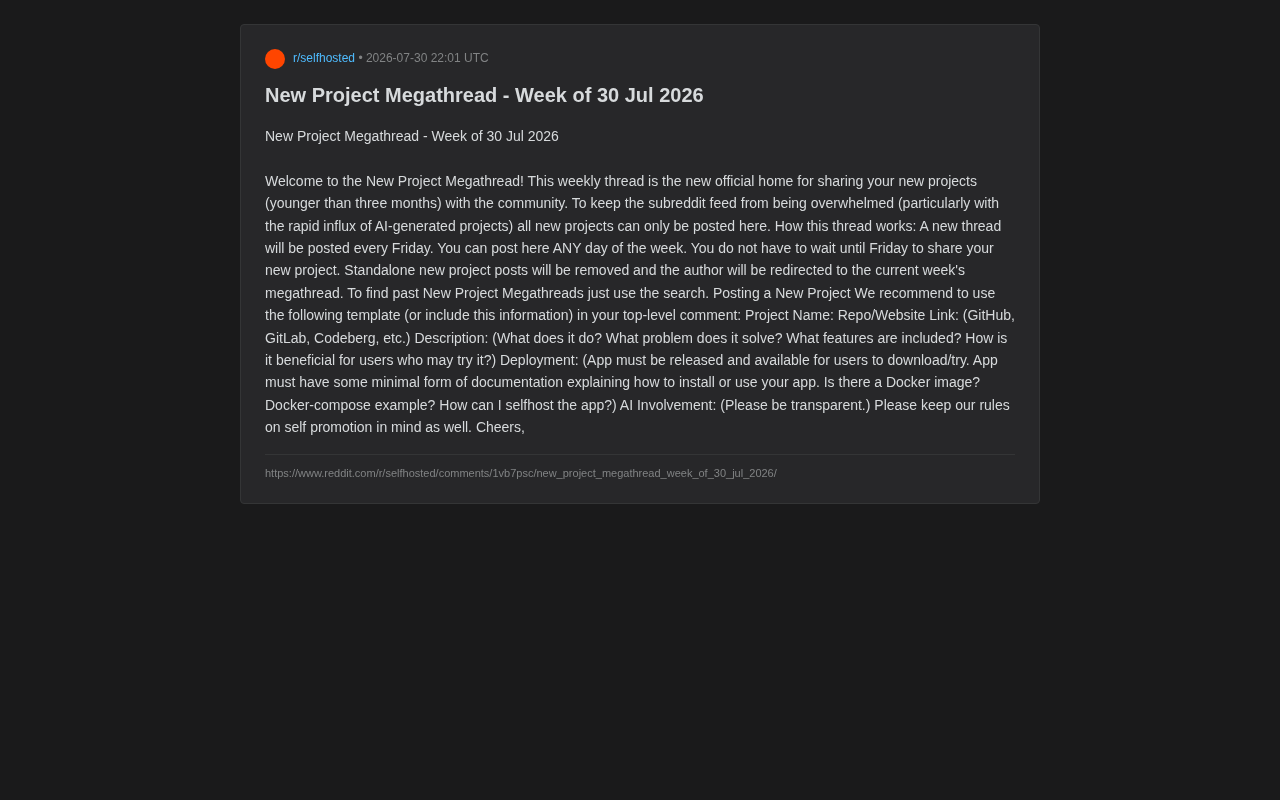
This weekly pinned post explicitly states its purpose: to provide the community with an "official space for sharing new projects," while directly addressing the driving force behind it: the rapid influx of AI-generated projects is flooding the community feed. What appears to be merely a forum management rule actually reflects the deeper changes facing the entire open source ecosystem in the AI era.
Megathread Mechanism Design: Establishing Order for Project Sharing
Centralized Posting Rules
The core of this community's approach lies in "funneling." All new projects less than three months old can only be posted in the weekly Megathread. Any standalone new project posts are removed, with authors directed back to the current Megathread.
Specific rules include:
- New thread posted every Friday: Creating a regular cadence that facilitates management and retrieval.
- Post anytime: Users don't have to wait until Friday—they can share in the current thread as a comment any day.
- Searchable history: Past Megathreads can be found via search, forming a chronological project archive.
The elegance of this design lies in the fact that it neither completely prohibits new project sharing (which would stifle community vitality) nor allows a free-for-all (which would lead to information overload). Through a "buffer pool," it concentrates scattered noise into a controllable space.
In the history of open source communities, the signal-to-noise ratio problem isn't unique to the AI era—spam flooding mailing lists in the early days, the proliferation of low-quality npm packages in the 2010s, and the massive number of forked-but-never-maintained repositories on GitHub are all precedents. But AI has pushed this problem to a new magnitude: one person can generate dozens of seemingly complete project repositories in a single day, each with a README, CI configuration, and even unit tests, yet none may have undergone genuine thought and validation. The Megathread mechanism is a modern application of a classic tool in the community governance toolkit.
Standardized Project Submission Template
Even more noteworthy is the standard template the community has established for project submissions, requiring posters to provide the following information:
- Project Name
- Repository/Website Link (GitHub, GitLab, Codeberg, etc.)
- Feature Description: What problem it solves, what features it includes, what value it offers users
- Deployment Method: The application must be published and available for download/trial, must have minimal installation or usage documentation, whether it provides Docker images, docker-compose examples, and how to self-host
- AI Involvement: Posters are required to be transparent
Among these, Codeberg's specific mention as a code hosting platform is worth noting. Codeberg is a nonprofit code hosting platform built on Forgejo (a community fork of Gitea), headquartered in Berlin, Germany, operated by a registered nonprofit organization. It doesn't rely on venture capital funding and doesn't monetize user data. For open source developers who value data sovereignty and oppose platform monopolies, Codeberg represents a third path beyond GitHub and GitLab. Its mention within the selfhosted community reflects the community's alignment with values of decentralization and data autonomy.
This template effectively serves as a lightweight "project quality threshold." It makes "usability" a hard requirement—applications must be genuinely deployable with documentation, not just empty shell repositories with nothing but a README.
AI Transparency Disclosure: A New Ethical Norm for Open Source Communities
Among all the rules, the most era-defining provision is the transparency requirement regarding AI involvement. The community explicitly asks posters to "Please be transparent" and proactively disclose the degree of AI participation in their project.
This clause didn't appear by accident. It reflects an emerging ethical consensus within the open source community: AI assistance itself isn't the problem—concealing AI involvement is. As "vibe coding" (programming by feel with AI) becomes commonplace, the community cares more about a project's actual quality and maintainability than whether AI was used.
Vibe coding is a development approach that emerged during 2024-2025 as large language models' programming capabilities improved. Developers describe requirements to AI in natural language, and AI generates most or even all of the code—the developer themselves may not fully understand every line of logic in the generated code. The term was first coined by Andrej Karpathy in early 2025. Vibe coding has dramatically lowered the barrier to software development, enabling non-professional programmers to create fully functional applications, but has also sparked widespread concerns about code quality, security vulnerabilities, and long-term maintainability.
Requiring transparent disclosure is essentially building a trust mechanism. It allows other users, when evaluating a project, to have reasonable expectations about code quality, long-term maintenance likelihood, and potential "AI hallucination" risks. This is far more mature than simply "banning AI projects" and better aligned with the reality of technological evolution.
AI hallucination in code generation scenarios is particularly concerning: calling APIs or library functions that don't actually exist, generating syntactically correct but logically flawed code, fabricating nonexistent configuration parameters, omitting necessary validation steps in security-critical paths, and more. In selfhosted scenarios, these problems are especially dangerous—because selfhosted services are typically directly exposed to the internet, an AI-generated authentication module with security vulnerabilities could directly lead to user data breaches. The community's requirement for AI involvement disclosure is precisely to ensure users have adequate mental preparation and auditing awareness for such risks.
Implications for Open Source Ecosystem Governance
Attention Protection: The Core Challenge Amid Quantity Overload
The essence of the Megathread mechanism is protecting the scarce resource of community members' "attention." After AI dramatically lowers the barrier to creation, the marginal cost of content approaches zero, but users' time and attention remain finite. Any healthy community must find a balance between "openness" and "signal-to-noise ratio."
The Megathread approach offers a replicable paradigm: don't perform content censorship—perform content organization; don't judge whether projects are good or bad—provide a structured presentation framework and return the filtering power to community members themselves.
The Pragmatic Spirit of the Selfhosted Community
You might not have noticed, but the template's emphasis on "deployment methods"—Docker images, docker-compose, selfhosting documentation—embodies the selfhosted community's characteristic pragmatic orientation.
Docker is an OS-level virtualization technology that packages an application and all its dependencies into a standardized container image. docker-compose is an orchestration tool that allows users to define and launch multi-container applications through a single YAML configuration file (such as a web application plus database plus reverse proxy combination). In the selfhosted space, Docker has become the de facto standard deployment method because it solves the "works on my machine" environment consistency problem. Whether a project provides Docker images and compose files often determines whether an average user can successfully deploy it within five minutes—which is why the community template makes it a required field.
Here, whether a project "actually runs" matters more than how many stars it has. This insistence on practicality is precisely the natural barrier against AI-generated "shell projects." A vibe-coded project might pass README-level scrutiny, but when users actually execute docker-compose up, the true quality of the code is laid bare.
Conclusion: The Evolution of Community Rules for Coexisting with AI
This seemingly mundane weekly pinned post is actually a rational adjustment by an open source community facing the AI wave. It doesn't resort to panic-driven bans, nor does it allow information overload to go unchecked. Instead, through the three-pronged approach of centralized management, standardized templates, and transparency disclosure, it builds a sustainable order for the community.
For other technical communities struggling with AI-generated content, this mechanism offers valuable reference: rather than fighting AI, build new rules for coexisting with it. What truly needs to be safeguarded has never been the form of "human originality"—it's the quality, usability, and trust of the content itself.
Related articles

Cloudflare Uses AI to Standardize Engineering Practices: From Standards Drift to Automated Enforcement
Deep dive into how Cloudflare uses LLMs to auto-enforce engineering standards, solving standards drift in large teams. Explores AI code review in CI/CD pipelines, challenges, and implications.

50 Decision Engines: Reshaping Creator Economy Operations with Quantitative Tools
Deep dive into the Sovereign Creator Calculator Suite: 50 Notion-based interactive decision engines covering pricing, churn, ad ROI, and MRR modeling for data-driven creator growth.

GLEE Competition: A Detailed Guide to the NeurIPS 2026 Official Negotiation AI Challenge
NeurIPS 2026 GLEE Competition challenges AI agents to negotiate in real-time via natural language, covering bargaining, persuasion, and game strategies. Full guide on rules, approaches, and prizes.