How Replit Evaluates AI Coding Agents: A Deep Dive into ByteBench Benchmark and Continuous Optimization Framework

Replit launches open-source ByteBench benchmark, building a complete AI Agent evaluation system for Vibe Coding.
Replit addresses the failure of traditional code evaluation methods in Vibe Coding scenarios by building a dual-pillar system combining offline and online evaluation. Offline evaluation guards the release baseline through the newly launched open-source ByteBench benchmark, using PRDs as input in a technology-agnostic approach. Online evaluation continuously discovers issues and drives improvement through A/B testing and the semantic clustering tool Telescope, leveraging massive real-world data to form a daily iteration closed loop.
As an AI-powered coding platform for knowledge workers, Replit's Agent handles millions of real user requests daily. In a recent technical talk, Replit President and CTO Mikaela Katasa provided a detailed overview of how they built a comprehensive system spanning offline benchmarks to online continuous evaluation, and officially launched their new open-source benchmark, ByteBench. This methodology offers tremendous reference value for all AI Agent developers.
The Evaluation Dilemma in Vibe Coding
Vibe Coding is a programming paradigm coined by OpenAI co-founder Andrej Karpathy in early 2025 that quickly gained popularity. It refers to users relying entirely on natural language to describe their intent, with AI taking full responsibility for code generation—users themselves don't need to understand or review the underlying code. The rise of this paradigm marks a fundamental lowering of the programming barrier: the target audience expands from professional developers to all knowledge workers with ideas, and the only evaluation criterion that matters becomes "does the app actually work."
Traditional code evaluation methods are built on one premise: users are software developers who specify frameworks, write tests, and provide codebases. But the scenario Replit faces is entirely different—users provide only a natural language description and expect the Agent to generate a runnable application from scratch. They don't write tests, don't specify tech stacks, and only care whether the final result works.
This means evaluation methods previously designed for software developers must be fundamentally rethought. Benchmarks like SWE-Bench, released by Princeton University in 2023, operate on the core logic of extracting tasks from real GitHub issues, requiring Agents to generate code patches to fix bugs in existing projects, then validating correctness through the project's existing test suite. This design inherently assumes a mature codebase and comprehensive tests—but Vibe Coding users typically start from an empty codebase, where no "patching" scenario exists at all. SWE-Bench's evaluation logic therefore becomes completely inapplicable.
What makes this even trickier is that model iterations happen extremely fast, with system prompts, tool definitions, and product features all changing continuously. Replit pushes updates to millions of users almost daily. In this high-frequency iteration environment, the traditional approach of "run one evaluation, look at a single score, manually judge good or bad" is far from sufficient.
Dual-Pillar Evaluation Framework: Offline + Online Evaluation
Replit built a dual-pillar system centered on the philosophy of "continuous evaluation," tightly coupling pre-release quality gates with post-release data-driven improvement.
Offline Evaluation: The Pre-Release Gatekeeper
Offline evaluation plays the role of a boolean switch—black or white. Before a new version ships, if the benchmark shows serious performance regression, the release must be halted. This is the baseline, ensuring an obviously degraded version never reaches users.
Online Evaluation: The True Engine of Continuous Improvement
The more valuable component comes from extensive A/B testing and production data analysis. The Agent generates millions of trace records daily, and the scale and richness of this real data far exceeds the 20 scenarios in offline evaluation.
Notably, A/B testing faces unique challenges in AI Agent scenarios: Agent optimization objectives are often multi-dimensional (speed, cost, quality, user satisfaction), and different metrics frequently contradict each other. Additionally, the vast variance in Agent task complexity requires larger samples to reach statistical significance, and users' true satisfaction with Agent outputs may only manifest hours after use. These factors collectively make A/B test results for AI Agents often ambiguous, requiring human engineers to make holistic judgments.
Online evaluation only kicks in after version release, forcing the team to respond and iterate as quickly as possible. The two systems form a closed loop: offline tests guard the baseline, online data drives improvement, analysis results lead to code changes, which are then tested again—an endless cycle. Replit goes through this cycle every single day.
ByteBench: An Open-Source End-to-End Benchmark for Vibe Coding
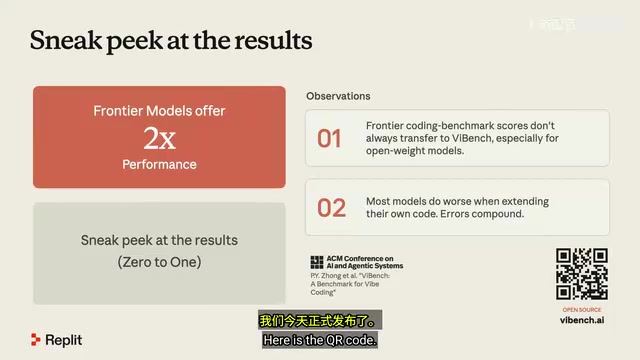
Replit officially launched ByteBench, a brand-new public benchmark specifically designed for Vibe Coding scenarios, filling the evaluation gap in this space.
Design Philosophy: PRD as Input, Technology-Agnostic
ByteBench takes Product Requirements Documents (PRDs) as input—essentially detailed natural language descriptions. Choosing PRDs as benchmark input rather than code or technical specifications carries profound implications: it anchors the evaluation starting point at the user intent level rather than the technical implementation level. This means the evaluation framework is naturally decoupled from specific programming languages or framework choices—whether the Agent builds the app with React or Vue, Python or Node.js, as long as the final functionality matches the PRD description, it passes. This "begin with the end in mind" evaluation philosophy aligns perfectly with Vibe Coding users' core demand of "only caring whether the result works."
The team selected 20 scenarios from real Replit usage records, without using synthetic data. The evaluation engine's workflow is: read the codebase → open a browser to access the Agent-built application → verify functionality step by step according to a natural language test plan → aggregate results to generate scores. Even the test plans themselves are written in natural language, such as "open the admin panel, log in with a specific account, click a certain toggle."
Five Test Scenarios: From Simple to Complex
ByteBench designed five test combinations of increasing complexity, comprehensively covering different stages of real-world development:
- Base Mode: Build an application from scratch based on a PRD in one shot
- Reference Implementation Mode: Start from already-running code and add new features on top
- MVP Extension Mode: Continue development from an MVP the Agent has already built
- Stacking Mode: Directly adopt the Agent's unverified output and continue building on top of it
- Parallel Task Mode: Break the PRD into multiple parallel tasks, execute them separately, then merge
Key Finding: Stacking Scenarios Remain the Biggest Challenge
The gap between leading models and open-source models is nearly twofold. Most models show noticeable degradation when extending from incorrect code, and the "stacking" scenario remains the most difficult to this day. This also confirms an important insight: developing new features without incorporating a testing step is undermining the foundation.
Telescope: An Automated Problem Discovery Tool Based on Semantic Clustering
Replit internally developed a tool called Telescope for automatically discovering and fixing problems from massive production data—a core component of their online evaluation system.

Semantic Clustering Replaces Traditional Rule Matching
The core method involves vectorizing all trace records and then clustering them by semantics. Vectorization (Embedding) is the technique of converting text into high-dimensional numerical vectors, where semantically similar texts are closer together in vector space. Semantic clustering then builds on this by using algorithms like K-Means or HDBSCAN to group similar vectors into the same cluster. Compared to traditional regex or keyword matching, semantic clustering can identify issues that are expressed differently but share similar meaning—for example, "environment not ready" and "runtime initialization failed."
Related articles
Deep Dive into AI Agent Skill Design: …
Deep Dive into AI Agent Skill Design: Engineering Practices from Anthropic and Perplexity
A deep dive into Skill design philosophy from Anthropic's Claude Code team and Perplexity's Agent team, covering the Tax Test, Gotchas Flywheel, progressive disclosure, and Eval-First practices for building high-quality AI Agent skill systems.
Deep Dive into OpenAI's Official GPT-5…
Deep Dive into OpenAI's Official GPT-5.6 Prompting Guide: The Shift from Manual to Automatic
A deep dive into OpenAI's official GPT-5.6 Sol prompting guide: conciseness-first, outcome-oriented design, autonomy boundaries, tool routing, and reasoning intensity tuning.
 Deep Dives
Deep Dive into How OpenClaw (Open-Source Crayfish) AI Agent Works
Deep analysis of OpenClaw AI Agent internals: System Prompt, tool calling, SubAgents, Skill system, memory, and Context Engineering explained.