How the Conquistadors Defeated the Aztecs: The Decisive Edge of Steel and Warhorses

Spain's conquest of the Aztecs succeeded through steel tactics, psychological warfare, sea mobility, and warhorses — not firearms.
Historian Si Sheppard dismantles the popular narrative of "guns conquering the Americas." The Conquistadors' victory rested on a multi-dimensional system of advantages: Toledo steel swords and thrusting tactics countered the slashing pattern of obsidian weapons; Cortés secretly buried fallen soldiers to maintain the myth of invincibility; sailing ships granted strategic freedom to land anywhere along the coast; and most critically, warhorses — extinct in the Americas since prehistory — left indigenous peoples with no cavalry doctrine, no counter-tactics, and no weapons to stop a charge. The Aztecs' only domesticated animals were turkeys and Chihuahuas, leaving them far behind even the Inca's llama logistics, let alone Old World draft-animal traditions. This history is a classic case of asymmetric advantage: the decisive edge came from multiple capabilities working in concert within the right tactical framework, not from any single superweapon.
The Spanish Conquistadors defeated a vast Aztec empire with just a few hundred men — a story often reduced to a simple narrative of "guns conquering the Americas." But historian Si Sheppard offers a far more nuanced analysis: what truly tipped the balance wasn't firearms, but a combination of steel, warhorses, and psychological warfare.
Firearms Were Overrated — Steel Was the Real Game-Changer
Many imagine gunpowder weapons as the core tool that let the Conquistadors steamroll indigenous peoples. The reality was quite different. Firearms of the era were agonizingly slow to reload, and once the initial shock wore off, indigenous warriors quickly grasped how limited their battlefield value actually was.
The real gap-opener was steel. Aztec and other indigenous weapons were largely made from wood, stone, and obsidian — a volcanic glass that, when sharpened, produced an extraordinarily keen edge and was devastatingly effective as a slashing weapon. But against the Conquistadors' steel armor, especially their steel helmets, these cutting weapons lost much of their effectiveness.

The Conquistadors inherited a military tradition rooted in the Old World, wielding longswords forged from Toledo steel. The critical factor was tactical: they used their swords as thrusting weapons, specifically targeting indigenous warriors who charged in swinging slashing blows — attackers who exposed their flanks mid-swing and could be neutralized with a single thrust. This technological gap of "thrust beating slash" is something a simple comparison of materials cannot fully capture.
The signature indigenous weapon was the Aztec macuahuitl — a flat wooden club with obsidian blades embedded along both edges. Modern experiments have shown that obsidian blades can be sharper than surgical steel at the microscopic level, with exceptional ability to cut soft tissue. Yet their fatal flaw is brittleness: they shatter on contact with hard surfaces and are suited only for lateral slashing, not thrusting. Toledo steel swords combined the hardness of high-carbon steel with the toughness of low-carbon steel, able to withstand repeated impacts without breaking, while the thrusting motion neatly sidestepped the zone where obsidian weapons had their advantage. This double mismatch — in material and in tactics — meant that even with numerical superiority, indigenous warriors faced a deeply unfavorable exchange ratio in close combat.
Psychological Warfare: Burying the Dead Under the Floorboards
The Conquistadors were not invincible. Sheppard specifically notes that Hernán Cortés was a master of the psychological game. During fighting against the Tlaxcalans, the Conquistadors did suffer casualties.

To prevent enemies from confirming they had inflicted losses on the Conquistadors in melee combat, Cortés deliberately had his fallen soldiers buried under the floors of the buildings where they were quartered. This way, the enemy could never confirm whether the Conquistadors bled or died. This was a physical war, but also a psychological one — a contest over myth and fear. Maintaining the illusion of invincibility was itself a weapon.
The Tlaxcalans were longtime enemies of the Aztec Empire, long kept under siege and blockade. When Cortés arrived, the Tlaxcalans initially fought the Spanish but, after several defeats, switched sides and became the largest ground force in the conquest. In the final siege of Tenochtitlan, Spanish soldiers numbered only in the hundreds, while Tlaxcalan and other allied indigenous warriors numbered in the tens of thousands. Cortés's psychological warfare therefore served not only to intimidate the Aztecs but also to sustain his allies' belief in the Conquistadors' supernatural power — once those allies realized the Conquistadors were mortal, the coalition could collapse at any moment. Secretly burying the dead was, in essence, information control used to stabilize a fragile political and military alliance.
Sea Power and Mobility: The Ability to Land Anywhere
The Conquistadors also held an external advantage — maritime power through sailing ships. With wind-driven vessels, they could choose landing points almost anywhere along a vast coastline, seizing the strategic initiative.
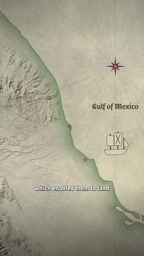
This mobility made it extremely difficult for indigenous peoples to anticipate the direction of attack or organize effective defenses around fixed positions. Once the Conquistadors moved deep into the interior, however, it was another force entirely that proved most decisive.
Warhorses: The Ultimate Weapon With No Counter on the American Battlefield
Sheppard repeatedly emphasizes that once the Conquistadors pushed inland, the importance of horses cannot be overstated.
An often-overlooked fact: horses originally evolved in North America, but subsequently went extinct there. When the Conquistadors arrived with warhorses, indigenous peoples had not only never seen horses — they broadly lacked any draft or pack animals. Beasts of burden had never been integrated into their economies, ways of life, or military systems.

The Inca were something of an exception — they had llamas. On campaign, Inca armies were followed by llama baggage trains stretching for miles. But the Aztecs didn't even have that. Their only domesticated animals were turkeys and Chihuahuas.
On the subject of dogs: the Conquistadors also brought large armored war mastiffs, trained to knock men down. One can imagine the terror these war dogs inflicted on indigenous peoples.
But warhorses remained the most critical asset. In attack, a cavalry charge could directly shatter any indigenous formation — the enemy had neither weapons designed to counter cavalry nor the training and discipline needed to stand against an impact charge. And if the tide turned, the Conquistadors could retreat far faster than any pursuing enemy. The triple combination of mobility, shock, and psychological terror made the warhorse the truly decisive weapon of this conquest.
Equus went extinct in North America roughly ten thousand years ago, at the end of the last Ice Age, as part of a broader wave of megafaunal extinctions whose causes — human hunting and climate change — remain debated. The consequences were profound: the entire Americas spent the following millennia without large domesticable draft animals (Andean camelids being the sole exception), sending indigenous American civilizations down a fundamentally different developmental path from the Old World in terms of agricultural transport, long-distance logistics, and military mobility. When the Spanish returned horses to the Americas in the 16th century, indigenous peoples had not only never witnessed a cavalry charge — their entire social infrastructure and military training had never had the opportunity to evolve any countermeasure whatsoever, a stark contrast to the anti-cavalry tactics accumulated over millennia of Old World conflicts.
A Comprehensive Advantage Beyond the Technological Gap
Reducing the conquest of the Aztecs to "superior weapons" is a misreading of history. Sheppard's analysis reveals a far more three-dimensional picture: the advantage did not come from any single superweapon, but from a combined system of steel armor and thrusting tactics, psychological warfare, maritime mobility, and warhorses paired with war dogs.
For us today, this history also stands as a classic case study in "asymmetric advantage" — what truly changes the game is rarely the most visible technology, but rather the combination of multiple capabilities operating within the right tactical framework.
Related articles

A Single Prompt Triggers a Global PHP Security Storm: Is AI a Savior or a Hidden Risk?
A single AI prompt triggered a global PHP security crisis affecting Wikipedia and the Internet Archive. This article reviews the incident, analyzes the OpenAI-Amazon controversy, and explores the security paradox of lowered vulnerability discovery barriers in the AI era and developer response strategies.

When AI Is Taken Away: How Reliance on Shortcuts Undermines Your Problem-Solving Resilience
A study of 1,222 people found that after using AI to answer questions, once AI was removed, people gave up on more problems than a control group that never used AI. The article analyzes the impact of AI reliance on learning resilience and metacognition, and explores design implications for AI learning tools.

Carta and NewView Partner to Let Startup Employees Cash Out Equity Early
Carta and NewView Capital partner to simplify startup tender offers, helping employees sell equity early. Analysis of the mechanism, liquidity pain points, and impact.