How Theoretical Physicists Can Efficiently Get Started with Machine Learning: Optimal Paths and Resource Guide

A strategic guide for theoretical physicists to efficiently transition into machine learning.
This article provides a systematic roadmap for theoretical physicists entering machine learning, highlighting the natural mathematical advantages (linear algebra, probability, optimization), recommending a three-stage learning path from Bishop's PRML through deep learning practice to cross-disciplinary research, and identifying key intersection areas like PINNs, diffusion models, and RG-inspired deep learning theory.
From Physics to Machine Learning: An Underrated Career Transition
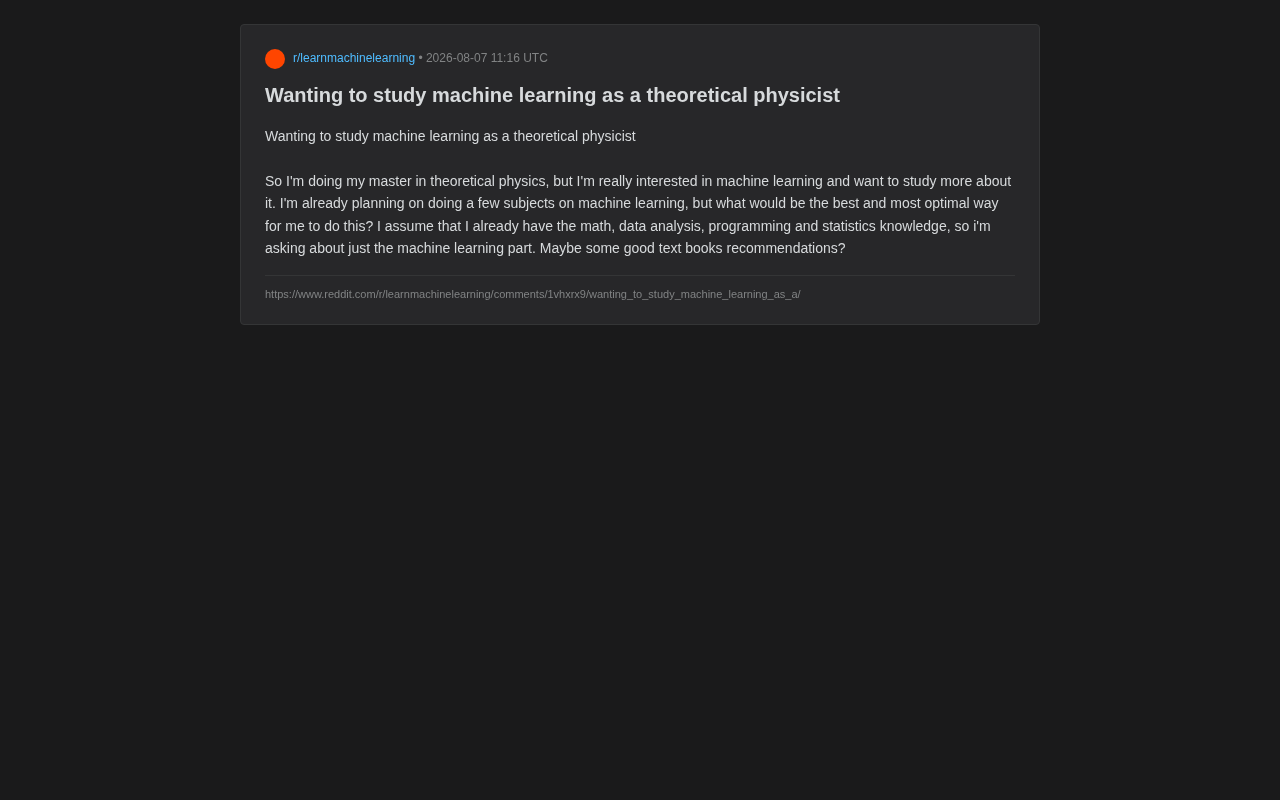
In Reddit's machine learning community, a student pursuing a master's degree in theoretical physics posed a highly representative question: as a physics researcher already equipped with solid foundations in mathematics, statistics, programming, and data analysis, what's the optimal path to systematically learn machine learning? He admitted that he had already planned to take several related courses but was looking for targeted advice and textbook recommendations specifically for the "pure machine learning" components.
Behind this question lies a larger trend: physicists are becoming some of the most sought-after talent in machine learning. From DeepMind to OpenAI, from quantitative hedge funds to autonomous driving companies, researchers with theoretical physics backgrounds are active at every frontier of AI. Understanding this phenomenon offers tremendous reference value for anyone looking to make the cross-disciplinary leap.
The Natural Advantages of Physicists Transitioning to Machine Learning
Why do people with theoretical physics backgrounds often find machine learning twice as easy to learn? The answer lies in the deep overlap between the two disciplines in mathematical tools and modes of thinking.
High Reusability of Mathematical Tools
The core mathematical foundations of machine learning—linear algebra, probability theory, multivariate calculus, and optimization theory—are precisely the tools that theoretical physics researchers work with daily. Backpropagation in neural networks is essentially an application of the chain rule; variational inference shares remarkable similarities with free energy minimization in statistical mechanics; and the mathematical framework of diffusion models directly borrows from Langevin dynamics in non-equilibrium statistical physics.
Variational Inference is a core technique in Bayesian machine learning, used to approximate the true posterior by optimizing an approximate distribution when the exact posterior is intractable. Its optimization objective is to minimize the negative Evidence Lower Bound (ELBO), which is equivalent to minimizing the KL divergence between the approximate distribution and the true posterior. This mirrors the principle of free energy minimization in statistical mechanics: in statistical physics, a system's equilibrium state at a given temperature corresponds to the minimum of the free energy F=E-TS, where the trade-off between energy E and entropy S determines the system's optimal state. The loss function of a Variational Autoencoder (VAE) can be precisely interpreted as a free energy functional—the reconstruction loss corresponds to the energy term, and KL regularization corresponds to the entropy term—which is exactly why physicists can quickly grasp the essence of these methods.
Diffusion Models represent one of the most important breakthroughs in generative AI in recent years, powering image generation systems like Stable Diffusion and DALL-E. The core idea is to first "diffuse" the data distribution into a simple Gaussian distribution by gradually adding noise, then learn the reverse denoising process to generate new samples. This framework has a direct mathematical correspondence with Langevin dynamics in non-equilibrium statistical physics—the Langevin equation describes the motion of particles driven by random thermal fluctuations in a potential field, and the sampling process of diffusion models is essentially Langevin sampling along the learned score function. The foundational papers on diffusion models directly cite statistical physics literature, and many improvements draw on the theoretical framework of stochastic differential equations.
For a physicist who can fluently handle tensors, functionals, and stochastic processes, the mathematical barriers in machine learning papers pose virtually no obstacle. The questioner's assumption that he has already mastered "math, statistics, and programming" is reasonable—what he truly needs to fill in is how these tools are specifically applied within the machine learning paradigm.
Seamless Transfer of Modeling Thinking
The core of theoretical physics training is "describing complex phenomena with concise models," which aligns closely with the machine learning approach of "fitting data distributions with parameterized models." Physicists are accustomed to thinking about model assumptions, symmetries, conservation laws, and scaling behavior—this systematic modeling ability is extremely valuable when designing and analyzing deep learning architectures.
Optimal Learning Path: A Three-Stage Strategy
For physics researchers with strong mathematical foundations, learning machine learning should not start from introductory courses. Instead, adopt a strategy of "skip the basics, target the core."
Stage One: Building the Language System of Machine Learning
The primary task is to familiarize yourself with machine learning terminology, problem categorization (supervised/unsupervised/reinforcement learning), and evaluation paradigms. The recommended starting point is Christopher Bishop's classic Pattern Recognition and Machine Learning, which unfolds from a Bayesian perspective with mathematical rigor—perfectly suited to a physicist's taste.
Bayesian methods view parameter learning in machine learning as a posterior inference process: given a prior distribution and observed data, beliefs about model parameters are updated through Bayes' theorem. Unlike frequentist point estimation methods, Bayesian methods naturally provide uncertainty quantification—critical for scientific applications, where researchers need not only predictions but also confidence in those predictions. Bishop's book unifies regression, classification, clustering, dimensionality reduction, and other machine learning tasks under a Bayesian perspective, expressing them all as probabilistic inference problems. For physicists, the Bayesian framework has a natural correspondence with the partition function formalism in statistical physics: the prior distribution resembles Boltzmann weights defined by an energy function, the normalization constant corresponds to the partition function, and posterior inference corresponds to computing ensemble averages under given constraints.
Another book, Kevin Murphy's Probabilistic Machine Learning, is more modern and comprehensive, covering the complete spectrum from classical methods to deep generative models.
Stage Two: Theory and Practice of Deep Learning
Entering the deep learning stage, Deep Learning by Goodfellow, Bengio, and Courville (the "flower book") is an indispensable authoritative textbook—its second part provides sufficiently solid coverage of modern deep networks. Readers with theoretical physics backgrounds should focus on the mathematical principles behind backpropagation, optimization algorithms (Adam, momentum methods), and regularization techniques.
On the other hand, hands-on practice is crucial. It's recommended to implement a small neural network from scratch using PyTorch, then gradually transition to mainstream architectures like Transformers. The Transformer is a neural network architecture proposed by Google's team in the 2017 paper Attention Is All You Need, and has since become the dominant architecture in natural language processing, computer vision, and even scientific computing. Its core innovation is the self-attention mechanism: for each element in an input sequence, it computes relevance weights with all other elements to aggregate information, thereby capturing dependencies at arbitrary distances. Mathematically, self-attention can be understood as a dynamic, data-dependent linear transformation involving dot-product operations between three sets of matrices: Query, Key, and Value. For physicists, Transformers can be viewed as a many-body interaction model defined over sequence space, where the attention matrix resembles a coupling matrix between particles. Milestone models such as GPT, BERT, and Vision Transformer are all based on this architecture.
Combining theoretical understanding with code implementation greatly deepens one's grasp of how machine learning works.
Stage Three: Finding Cross-Disciplinary Research Directions Between Physics and ML
This is where physicists are most competitive. Several hot cross-disciplinary directions are worth attention:
-
Physics-Informed Neural Networks (PINNs): Embedding partial differential equation constraints into neural network training to solve physical systems. PINNs were systematically proposed by Raissi et al. at Brown University in 2019, representing an important paradigm for the fusion of scientific computing and deep learning. Traditional numerical methods (such as finite element and finite difference methods) for solving PDEs require mesh discretization and face the curse of dimensionality in high-dimensional problems and complex geometries. PINN's core innovation lies in incorporating the PDE residual as part of the loss function: the neural network is trained to satisfy boundary and initial conditions while ensuring its output satisfies the governing equations everywhere in the computational domain. In practice, automatic differentiation is used to directly compute partial derivatives of the network output with respect to input coordinates at various orders, which are then substituted into the PDE to obtain the residual term. This approach is mesh-free, naturally suited to high-dimensional and inverse problems, and has been applied in fluid mechanics, quantum mechanics, materials science, and many other fields.
-
Machine Learning Applications in Statistical Physics: Such as using generative models to study phase transitions and Ising models.
-
Deep Learning Theory: Leveraging the renormalization group and mean-field methods from statistical mechanics to analyze the generalization capabilities of neural networks. The Renormalization Group (RG) is a core tool in theoretical physics for analyzing multi-scale phenomena, originally developed by Kenneth Wilson to explain critical phenomena in phase transitions. The core idea of RG is to systematically "coarse-grain"—integrating out microscopic degrees of freedom layer by layer to extract effective macroscopic descriptions—revealing connections between physical laws at different scales. In recent years, multiple researchers have noted a profound structural analogy between the layer-by-layer feature extraction process of deep neural networks and the coarse-graining operations of RG: each layer of the network performs some form of information compression and feature extraction on the input, similar to how irrelevant degrees of freedom are integrated out in an RG flow. This perspective provides physical intuition for understanding why deep networks can efficiently represent hierarchical structures and has spawned research directions using RG-inspired network architecture design.
-
Scientific Computing and Surrogate Models: Using neural networks to accelerate expensive physical simulations.
Delving into these directions allows you to convert existing physics expertise into unique research competitiveness, rather than competing head-to-head with researchers from pure computer science backgrounds.
Recommended Learning Resources and Textbook List
Beyond the classic textbooks mentioned above, a number of high-quality free resources are particularly well-suited for learners with strong mathematical backgrounds:
- Stanford CS231n (Computer Vision) and CS224n (Natural Language Processing): Combining theoretical depth with engineering practice
- David MacKay's Information Theory, Inference, and Learning Algorithms: Approaching from an information theory angle with a strong physics flavor
- Deep learning theory papers on arXiv: Reading cutting-edge work directly—physicists can often keep up quickly
It's worth emphasizing that machine learning is a "learn by doing" discipline. Reading alone is far from sufficient. Participating in real projects, reproducing papers, and even applying machine learning methods to your own physics research topics constitute the most effective path to deeper understanding.
Conclusion: The Value of Cross-Disciplinary Work Lies in Fusion
For this theoretical physics master's student who posed the question, perhaps the most important advice is: don't view physics and machine learning as two separate fields. The real opportunity lies at their intersection. With solid mathematical foundations, you can cross the technical threshold of machine learning within a few months, while your physical intuition and modeling capabilities are scarce qualities that many pure AI practitioners need years to develop.
Whether you ultimately choose to stay in academia researching AI for Science or enter industry to work in machine learning engineering, your theoretical physics training will serve as your unique competitive moat.
Related articles

llama.cpp GUI Launcher for Linux: Hands-On Review of Two Installation Methods
Hands-on review of the llama.cpp GUI Launcher for Linux, comparing manual compilation vs. Snap installation, covering startup commands, known bugs, and differences from Ollama and LM Studio.

Training-Free Object Localization with DINOv2: One-Shot Open-World Detection and Segmentation
Explore a training-free object localization approach using DINOv2 patch embeddings — no fine-tuning needed. Achieve open-world one-shot detection and segmentation with touching instance separation.

How to Spend $100/Month on AI Subscriptions: Single Pro Plan vs. Combo Approach — A Deep Comparison
Should you spend $100/month on ChatGPT Pro alone or combine ChatGPT Plus, Cursor Pro, and SuperGrok? A deep comparison of single vs. combo AI subscription strategies for developers and knowledge workers.