How to Add Deep Research Skills to AI Agent Frameworks: NVIDIA's Skill-Based Architecture Explained

NVIDIA proposes embeddable deep research skill modules to overcome general AI Agent orchestration limitations.
NVIDIA's developer blog explores how mainstream AI Agent frameworks (Claude Code, Codex, LangChain) fall short on deep research tasks, proposing to encapsulate deep research capabilities as specialized cognitive skill modules. These modules feature four core abilities—goal decomposition, multi-source iterative retrieval, critical evaluation, and knowledge synthesis—using a layered sub-agent architecture that supports plug-and-play integration and self-evolution, representing a paradigm shift from static tool calling to dynamic skill evolution.
With the rapid development of AI Agent frameworks like Claude Code, Codex, and LangChain Deep Agents, AI agents have demonstrated powerful orchestration capabilities in session management, tool chain invocation, and code execution. However, when faced with complex tasks requiring deep research, these general-purpose frameworks often fall short. A recently published technical article on the NVIDIA developer blog explores how to add specialized Deep Research Skills to Agent frameworks, enabling agents to possess genuine deep exploration and analytical capabilities.
The Limitations of General-Purpose AI Agent Frameworks
Current mainstream AI Agent frameworks—including Claude Code, OpenAI Codex, and LangChain Deep Agents—are essentially excellent "orchestrators." These three types of frameworks represent the three dominant paradigms in current AI Agents: Claude Code focuses on the closed loop of code generation and execution, building a complete pipeline from natural language requirements to runnable code; OpenAI Codex specializes in code comprehension and completion, deeply integrating program semantic understanding capabilities; LangChain provides a general-purpose tool chain orchestration framework based on the ReAct (Reasoning + Acting) thought-action loop pattern, allowing developers to flexibly combine various tools and data sources. They excel at managing conversational sessions, chaining various tools, executing code, and generating responses. But when facing tasks that require multiple rounds of in-depth investigation, cross-source information integration, and systematic knowledge building, their performance is often underwhelming.
The root cause of this limitation lies in: a fundamental difference between general orchestration capabilities and specialized research capabilities. Orchestration focuses on process management and tool scheduling, while deep research requires higher-level cognitive abilities such as goal-driven information retrieval, critical evaluation, multi-source cross-validation, and structured knowledge synthesis.
Core Definition and Characteristics of Deep Research Skills
From Tool Calling to Cognitive Skills
Deep Research Skills differ from simple search tools or RAG (Retrieval-Augmented Generation) pipelines. Understanding this distinction requires first grasping the inherent limitations of RAG technology: RAG compensates for LLMs' knowledge cutoff dates by retrieving relevant documents from external knowledge bases before generating answers, and is a widely used knowledge augmentation technique in current AI systems. However, standard RAG pipelines are typically single-turn, single-source static retrieval—the system submits one query, retrieves a batch of documents, and generates one answer. The entire process lacks the ability for iterative deepening, cross-source validation, and critical evaluation. For complex research questions requiring multi-perspective argumentation, this "one question, one answer" approach is far from sufficient.
Deep Research Skills are designed precisely to break through this bottleneck as specialized cognitive modules that can be embedded into existing Agent frameworks, featuring the following core characteristics:
- Goal Decomposition: Automatically breaks down complex research questions into multiple sub-questions, forming a systematic research plan
- Multi-Source Deep Retrieval: Not limited to a single search, but performs multi-round, multi-source iterative information acquisition
- Critical Evaluation: Assesses credibility, checks consistency, and identifies contradictions in retrieved information
- Knowledge Synthesis: Integrates scattered information fragments into structured research reports, complete with supporting arguments and citation tracing
Design Advantages of the Skill-Based Architecture
Encapsulating deep research capabilities as a "Skill" rather than a standalone application is the key design philosophy of this approach. This architecture brings three significant advantages:
- Plug-and-Play: Any Agent framework that supports tool or skill extensions can directly integrate this capability
- On-Demand Activation: The Agent activates this skill only when it determines the task requires deep research, avoiding unnecessary resource consumption
- Complementary to Existing Capabilities: The deep research skill works synergistically with other skills like code execution and data analysis, forming more powerful comprehensive capabilities
Technical Implementation Path and Architecture Design
Self-Evolving Sub-Agent Architecture
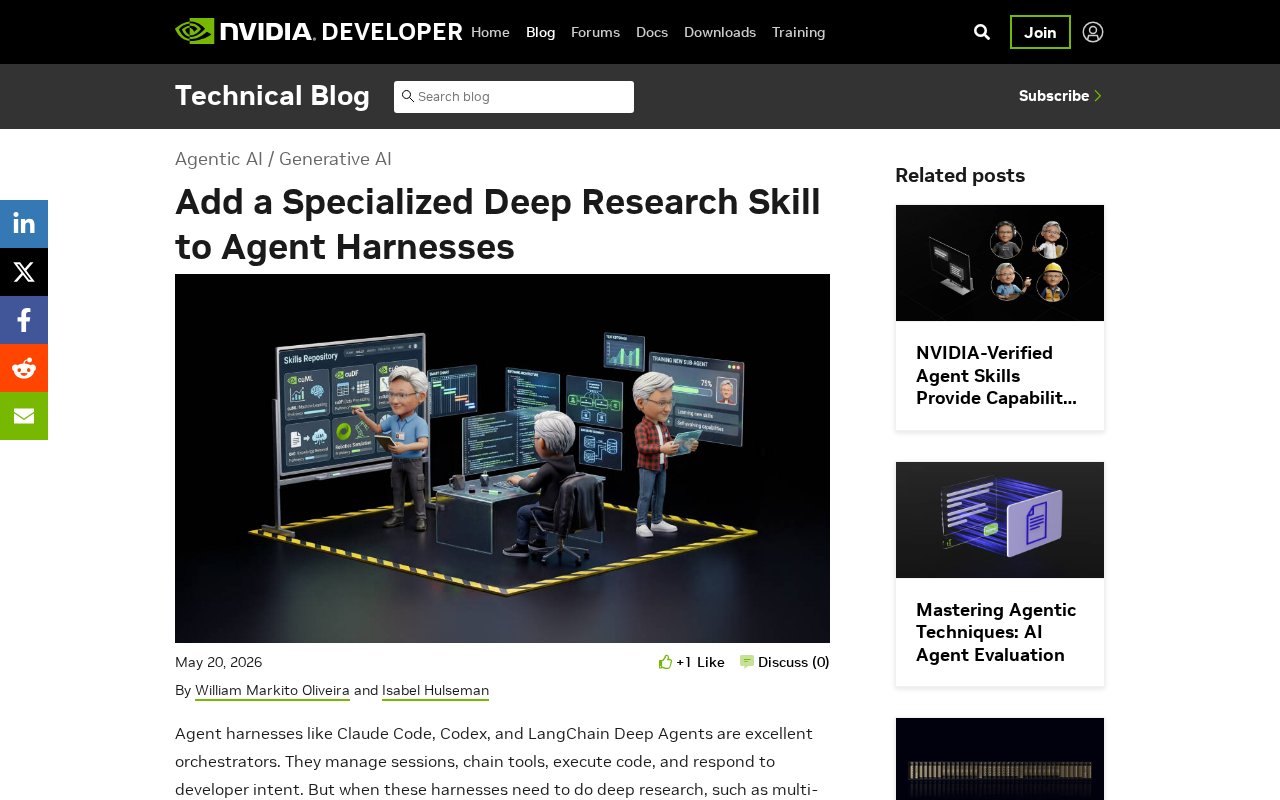
From the conceptual diagram published by NVIDIA, the approach involves several key components: a Skills Repository, software architecture design, Big Data Schema, and the ability to train new sub-agents. This points to a "self-evolving" architectural design philosophy.
This self-evolving architecture draws on core ideas from Meta-Learning and Neural Architecture Search (NAS)—allowing the system to dynamically adjust its own reasoning strategies and tool configurations at runtime, rather than relying on fixed processes hard-coded by developers in advance. This aligns closely with the concept of "Learning to Learn" from cognitive science: the system not only executes tasks but continuously optimizes how it handles similar tasks during execution. Compared to traditional static tool calling, this architecture grants Agents genuine adaptability.
Specifically, the Deep Research Skill employs a layered technical architecture:
- Main Agent Layer: Responsible for task understanding and skill routing, determining when to invoke deep research capabilities
- Research Sub-Agent Layer: Dedicated to executing research tasks, containing components such as a Planner, Retriever, Evaluator, and Synthesizer
- Knowledge Management Layer: Maintains intermediate knowledge accumulated during the research process, supporting cross-session knowledge reuse
Integration Methods with Mainstream Agent Frameworks
For different Agent frameworks, integration approaches vary:
- Claude Code: Deep research can be registered as a callable skill through custom tool definitions. Claude's tool-calling mechanism supports complex input/output schema definitions, making it naturally suited for encapsulating multi-step research workflows
- LangChain Deep Agents: Leveraging its native Agent tool chain mechanism, the research skill is integrated as a composite tool node. LangChain's Chain Composition design makes nesting multiple layers of sub-agents possible
- Codex: Through API extension interfaces, research capabilities are encapsulated as standardized function calls, leveraging its powerful code comprehension abilities to further enhance processing depth for technical research questions
Practical Application Scenarios for Deep Research Skills
The introduction of Deep Research Skills will significantly enhance AI Agent performance in the following scenarios:
Technical Research and Technology Selection: When developers need to evaluate multiple technical solutions, the Agent can automatically conduct comprehensive technical comparison research, covering multi-dimensional analysis including performance benchmarks, community activity, and long-term maintenance risks.
Competitive Analysis: During product development, the Agent can systematically collect and analyze competitor information, generating structured competitive analysis reports.
Academic Literature Reviews: For researchers, the Agent can automatically retrieve, filter, and synthesize the latest research findings in relevant fields, dramatically shortening the literature research timeline. Traditional literature reviews often require researchers weeks or even months, while Agents equipped with deep research skills can complete preliminary cross-database retrieval, deduplication, quality filtering, and topic clustering within hours, allowing researchers to focus their energy on higher-value critical analysis.
Compliance and Risk Assessment: In enterprise applications, the Agent can deeply research relevant regulations, industry standards, and best practices, providing comprehensive compliance analysis for decision-making.
Future Outlook: From Tool Usage to Skill Self-Evolution
The most noteworthy aspect of this approach is its "self-evolving" design philosophy. Traditional Agent tools are static—whatever tools developers define are all the Agent can use. The skill-based architecture allows Agents to continuously optimize research strategies during use, and even train new sub-agents to handle research tasks in specific domains.
From a broader technical evolution perspective, this paradigm shift from "tool usage" to "skill evolution" aligns closely with the overall trend of AI systems moving from "narrow intelligence" toward "general intelligence." When Agents are no longer merely executors calling predefined tools, but can dynamically reconstruct their own capability graph based on task feedback, the system's boundaries are no longer determined by initial configuration but are jointly shaped by task demands and learning history—this is precisely what distinguishes Autonomous Agents from traditional automation scripts.
For developers, now is an excellent time to pay attention to and practice in this direction. Whether building enterprise-level AI assistants or personal research tools, adding deep research skills to Agent frameworks will deliver substantial capability improvements.
Key Takeaways
- Current mainstream Agent frameworks (Claude Code, Codex, LangChain, etc.) have powerful orchestration capabilities but show clear limitations in deep research tasks
- Deep Research Skills are specialized cognitive modules that can be embedded in existing Agent frameworks, featuring goal decomposition, multi-source retrieval, critical evaluation, and knowledge synthesis capabilities
- The skill-based architecture design enables plug-and-play integration, supports on-demand activation, and complements existing Agent capabilities
- It adopts a self-evolving sub-agent architecture with core components including a Skills Repository, Research Sub-Agent Layer, and Knowledge Management Layer
- This approach represents a paradigm shift from static tool usage to dynamic skill evolution, marking an important direction in Agent AI development
Related articles
Deep Dive into AI Agent Skill Design: …
Deep Dive into AI Agent Skill Design: Engineering Practices from Anthropic and Perplexity
A deep dive into Skill design philosophy from Anthropic's Claude Code team and Perplexity's Agent team, covering the Tax Test, Gotchas Flywheel, progressive disclosure, and Eval-First practices for building high-quality AI Agent skill systems.
Deep Dive into OpenAI's Official GPT-5…
Deep Dive into OpenAI's Official GPT-5.6 Prompting Guide: The Shift from Manual to Automatic
A deep dive into OpenAI's official GPT-5.6 Sol prompting guide: conciseness-first, outcome-oriented design, autonomy boundaries, tool routing, and reasoning intensity tuning.
 Deep Dives
Deep Dive into How OpenClaw (Open-Source Crayfish) AI Agent Works
Deep analysis of OpenClaw AI Agent internals: System Prompt, tool calling, SubAgents, Skill system, memory, and Context Engineering explained.