How to Better Delegate Tasks to AI Assistants: Starting with a Weekly Report Practice

Entrust tasks to AI rather than dictating steps—start practicing delegation skills with a weekly report.
The article argues that the real next level in using AI assistants is learning to "delegate": providing goals, context, authority, and checkpoints, and letting the assistant decide how to proceed. Using AI assistant Dorothy to generate a personal "week in wins" report as an example, it demonstrates a complete delegation process. A weekly report is chosen because it's clear, personally beneficial, requires no special skills, yet quickly exposes typical friction. First results are usually imperfect and need feedback iteration. Once stable, one-time delegation can become an ongoing mechanism. The core principle: give direction, not steps.
Why You Need to Learn to Delegate Tasks to AI Assistants
Many people are already using AI assistants, but very few truly know how to "delegate." Delegation is not the same as giving orders—it means entrusting a piece of work to someone, providing sufficient context and authority, and agreeing on when to check progress. This follows the same logic as handing a task to a colleague or subordinate—except the recipient is now an AI.
The original author uses their collaboration experience with AI assistant Dorothy (Dot for short) to demonstrate a complete delegation practice. The key isn't whether you have management experience—it's whether you're willing to practice this skill. Even if you've never managed anyone, you can start with something small.
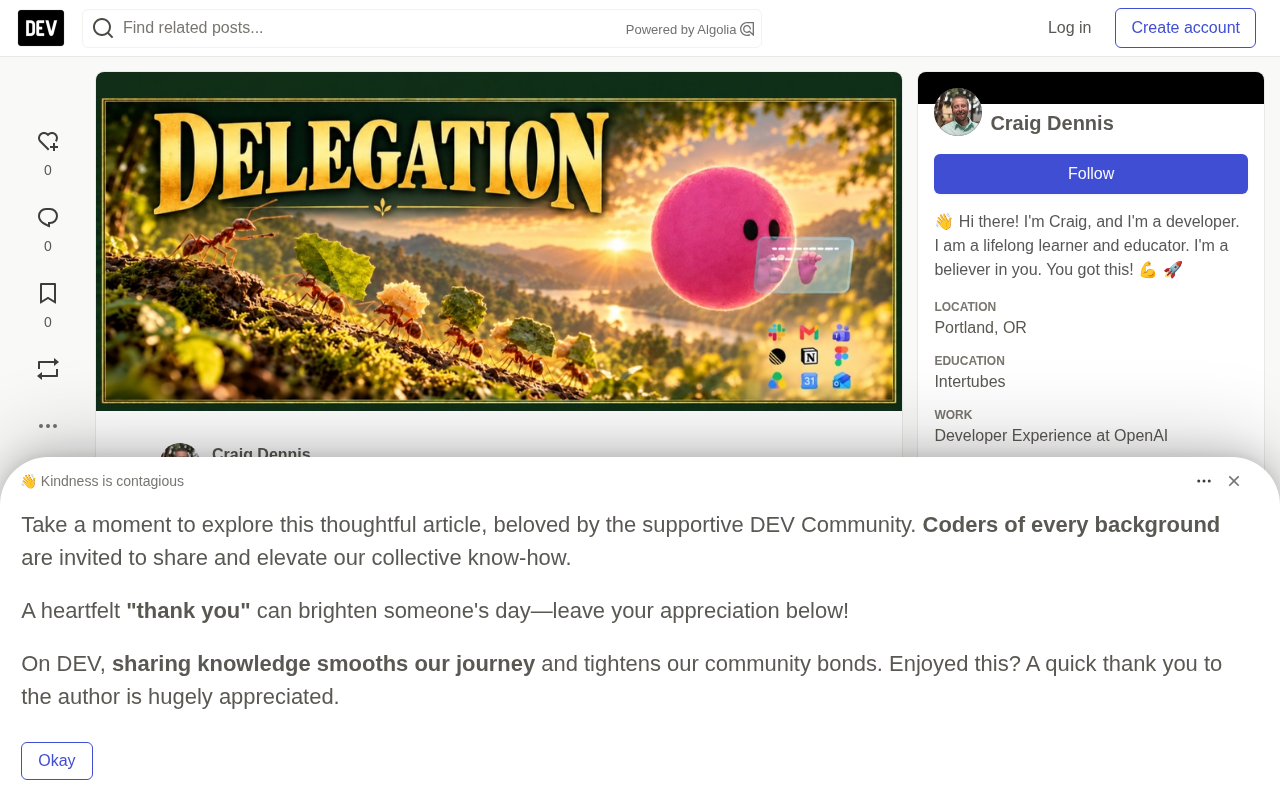
Delegation is a classic concept in management theory, referring to a manager transferring a task along with the corresponding decision-making authority to a subordinate, while retaining ultimate responsibility. The most fundamental difference from "giving orders" is this: giving orders only transmits an action, while delegation transmits goals, context, and boundaries of authority. Classic management theories (such as Hersey and Blanchard's "Situational Leadership" model) point out that delegation maturity depends on two dimensions: the complexity of the task itself, and the ability and willingness of the delegatee. The characteristics of AI assistants happen to fall in the "high ability, low initiative" quadrant—it can execute, but won't proactively probe your deeper intent, so the more thorough the context you provide, the closer the result will be to expectations.
In AI collaboration scenarios, delegation has an additional layer of particularity: you can't observe its "work habits" through daily interaction, so you must make explicit the tacit knowledge that would normally be transmitted through rapport—such as information sources, priority-ranking rules, and confidentiality requirements. This is also why the original article lists "agreeing on when to check progress" as one of the three core elements of delegation—in human teams, checkpoints are often automatically provided by organizational processes, but with AI, you must set them proactively.
Start Your First Delegation with a "Week in Wins"
Why Choose a "Weekly Report" as the Practice Task
The first delegation task the author recommends is: creating your own "week in wins" report, which could also be called a "brag diary."
This task has natural advantages: you know exactly what to do, but you always procrastinate; it's personally valuable but requires no special skills. The process of doing it lets you quickly experience the typical friction in delegation—insufficient context, overly broad tasks, and the need for back-and-forth clarification.
The author admits that many things done and new things learned easily slip from memory if not recorded. A weekly report helps you retain these "wins" while staying motivated.
A Clear Delegation Instruction
The author's initial instruction to Dorothy was:
"Help me prepare my week in wins. Show what I accomplished, including new things I learned or tried, who helped, and why it matters. Use our agreed sources, ask if anything is missing, and keep it private until I want to see it."
This instruction contains the core elements of delegation: goals, sources, authority, and delivery requirements. It doesn't specify exactly how to do it, but leaves room for the assistant to figure things out on its own.
Task sources are an easily overlooked yet extremely critical part of AI delegation. "Agreed sources" refers to the information access scope you've established with the AI in advance—for example, designated note libraries, calendars, chat records, email folders, or certain sensitive areas that are off-limits. This is similar to defining which materials a new employee can access.
Unclear sources lead to two typical problems: first, the assistant repeatedly asks "where do I find this information," slowing progress; second, it "fills in the blanks" on its own, substituting general knowledge from its training data for your actual data, producing content that seems reasonable but has nothing to do with you. Clarifying sources also brings privacy benefits—the original article emphasizes "keep it private until I want to see it," which essentially means controlling the draft's distribution scope firmly through source and visibility settings. A practical tip: create a "source list" for frequently used tasks, marking which are required reading and which are optional references, and confirm whether adjustments are needed with each delegation.
Feedback and Iteration Are Key in Delegation
The First Result Is Usually Imperfect
After receiving the assistant's output, the author gives feedback:
- "You missed this project."
- "This credit should go to my teammate."
- "This seems small, but it matters for a reason."
These conversations are themselves part of the delegation work. You're practicing how to explain priorities, give useful feedback, and judge whether results meet the bar.
Identify Problems and Adjust
You may discover: not enough context was given, the task was too broad, or the assistant needs to ask a question before continuing. These are all signals that your delegation approach needs adjustment. The original article emphasizes: start with small tasks—small enough that you can notice these problems—then retry.
Behind "start with small tasks" is a transferable learning principle: the granularity of the feedback loop. The bigger the task, the longer the gap between issuing the instruction and seeing the result, and the harder it is to determine which link went wrong. Small tasks compress "context—instruction—output—feedback" into a cycle you can fully observe, similar to writing a few lines of a function when learning to code, or practicing a single paragraph when learning to write.
Additionally, small tasks have a hidden advantage: low cost of failure. You can overturn the first version, rewrite the instruction, or try a different phrasing without any psychological burden, and without worrying about delaying real work. What the original article means by "small enough that you can notice these problems" is exactly this observability—you need to be able to distinguish whether the result is due to "not enough context" or "task defined too broadly," and then make targeted corrections. Each retry accumulates your own "delegation instinct," which is more reliable than any template.
Turn One-Time Delegation into an Ongoing Mechanism
Once results consistently meet the bar, you can turn this task into an ongoing responsibility. The author suggests two directions:
- Automatically generate a private draft every Friday
- Prepare a list of accomplishments before review meetings, with triggers and lead times set
Ultimately, the decision is yours: which sources to use, when to ask questions, and what content needs your review before sharing. The core is letting the assistant truly help you, rather than you making all the decisions for it.
The Essence of Delegation: Give Direction, Not Steps
The original article repeatedly emphasizes one point: you delegated the task, but didn't tell it how to do it. You gave enough context and authority for it to get results and deliver when you need them.
The author also mentions: don't manage for the sake of managing. Even if you're not in a management position, you can practice delegation. Pick a task to hand off, see what comes back, and improve together. Don't dictate how it must be done—let it be creative, and let it proactively ask for help when needed.
Final Thoughts
Delegation is a skill you can practice, and AI assistants make the cost of practice much lower. Starting with a weekly report, you may find that your communication style, priority judgment, and feedback quality all improve. As the author says: learning itself is a win.
One-line Summary
Entrust tasks to AI rather than dictating steps—start practicing delegation skills with a weekly report.
Paragraph Summary
The article argues that the real next level in using AI assistants isn't giving orders, but learning to "delegate": providing goals, context, authority, and checkpoints, and letting the assistant decide how to do things. Using AI assistant Dorothy to generate a personal "week in wins" report as an example, the author demonstrates a complete delegation process. A weekly report is chosen as the starting point because it's clear, personally beneficial, requires no special skills, yet quickly exposes typical friction like insufficient context and overly broad tasks. The first version is usually imperfect—missing items, misattributed credit, and priority misjudgments all need to be corrected through feedback iteration. Once output consistently meets the bar, one-time delegation can be upgraded to an ongoing mechanism, such as automatically generating a private draft every Friday. The core principle is to give direction rather than steps, letting the assistant retain creativity and proactively ask for help.
Related articles

Why Does the Tesla Roadster Need to Fly? A Deep Dive into Musk's Wild Demo
Tesla's Roadster launch showed wall-climbing, upside-down driving, and flying stunts—but The Vergecast notes the demo car may lack a battery, the Rocket version is invite-only and not street-legal, and the website terms don't guarantee delivery. After nine years of delays, why does this car still need to exist?

AI Is Not a Replacement: Human-AI Collaboration Through the Lens of Factory Root Cause Analysis
Starting from factory root cause analysis, this article explains how AI accelerates evidence chain construction rather than replacing human experts, exploring the pragmatic implementation logic and business value of 'AI supporting people rather than replacing them.'

AI Agent Decision Auditing: Building an Evidence Chain in Regulated Workflows
Starting from a Reddit discussion, this article analyzes three core issues in AI agent decision auditing within regulated workflows: what fields audit records should contain, how to handle feedback latency for erroneous decisions, and how to continuously calibrate LLM judge consistency with human judgment.