How to Choose a Research Direction for Your AI Master's? A Practical Decision Framework for Employment

A practical framework for AI master's students to choose research directions optimized for industry employment.
This article provides an employment-oriented decision framework for AI master's students choosing research directions. Using skill transferability as the core criterion, it analyzes topics like action recognition, EEG-to-image generation, emotion recognition, and causal inference, evaluating their industrial value and career prospects. The key recommendation: prioritize directions that build mainstream technical skills and demonstrable projects.
A Real Selection Dilemma
For many students planning to pursue an AI master's degree with the goal of entering industry (rather than continuing to a PhD), choosing a research direction is often fraught with indecision. Recently, an incoming AI master's student on Reddit shared his situation: his preferred advisor wasn't accepting new students this semester, forcing him to switch labs and research directions on short notice. The new advisor specializes in affective computing and healthcare AI, and provided a list of available research topics:
- Emotion Recognition
- Empathy Measurement/Generation
- Action Recognition
- EEG/fMRI to Image Generation
- Causality Analysis/Inference/Discovery
Affective Computing is a research field formally proposed by Rosalind Picard at MIT Media Lab in 1997, aimed at enabling computers to recognize, understand, process, and simulate human emotions. The field spans computer science, psychology, and cognitive science, and has gained new momentum in recent years with advances in deep learning and multimodal perception technologies. Healthcare AI applies artificial intelligence to medical scenarios such as disease diagnosis, drug discovery, and patient management. The combination of these two directions demonstrates unique value in clinical scenarios like mental health assessment, early depression screening, and pain management.
This student has an undergraduate background in artificial intelligence, with interests focused on computer vision, 3D vision, and generative AI. He's clear about not pursuing a PhD—his goal is to build solid technical capabilities during his master's and ultimately land an AI/CV role at a major tech company.
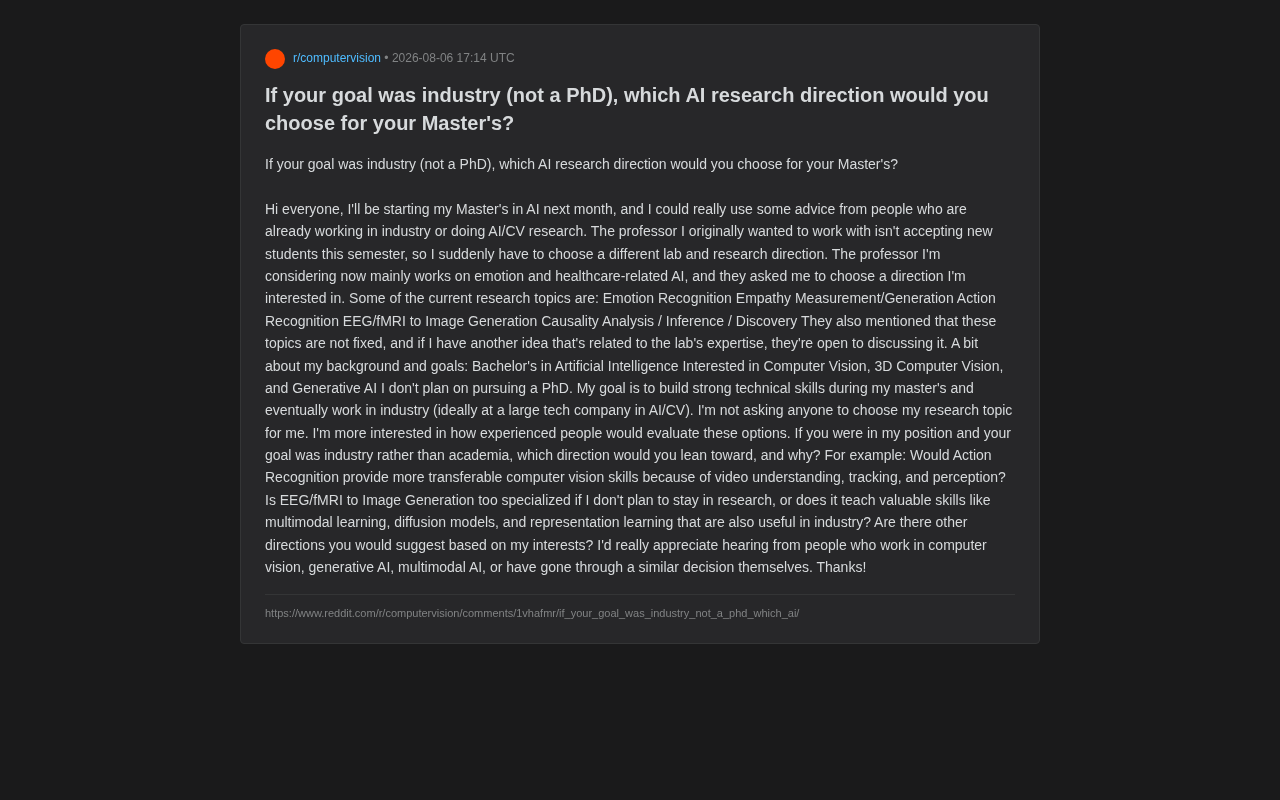
This question is highly representative and deserves in-depth analysis from an industry perspective: When the core goal of a master's degree is employment rather than academic output, the criteria for evaluating research directions should be entirely different.
The Core Criterion for Evaluating Research Directions: Skill Transferability
When choosing a research direction with employment in mind, the key isn't how cutting-edge the topic is, but rather skill transferability. When hiring, industry values whether candidates can solve real problems and what widely-demanded, general-purpose tech stacks they've mastered.
Skill Transferability is a core concept in the AI talent market. Industry tech stacks update extremely fast—a specific technology's lifecycle might only be 2-3 years, but underlying engineering thinking and methodological capabilities can last decades. Take the Transformer architecture as an example: originally designed for NLP (proposed by Vaswani et al. in 2017), it was later transferred to vision (ViT), audio, protein structure prediction, and nearly every other AI subfield. Diffusion models similarly expanded from image generation to video generation, 3D generation, molecular design, and more. Mastering such broadly applicable technical paradigms means that even when specific application scenarios change, engineers can quickly adapt to new job requirements.
An ideal master's research direction should help you accumulate three types of capabilities over two years:
- Hands-on experience with mainstream model architectures: Such as Transformers, Diffusion Models, and multimodal learning frameworks. These are the common language of current industry AI positions.
- End-to-end engineering capabilities: The complete pipeline of data processing, model training, tuning, and deployment—not just paper reproduction.
- Demonstrable project outcomes: Projects you can clearly articulate in interviews, supported by code or demos.
From this perspective, the differences among the options on the list become clear.
Analyzing the Employment Value of Each Research Direction
Action Recognition: A Solid Choice for CV Skills
Action Recognition involves video understanding, object tracking, temporal modeling, and perception—multiple core problems in computer vision. For someone targeting CV positions, this direction has very high skill transferability:
- Video data processing is essential in numerous industrial scenarios including surveillance, autonomous driving, and content moderation;
- Temporal modeling, multi-frame fusion, and similar techniques are applicable across multiple domains;
- Mature open-source datasets and baselines make it easy to produce demonstrable results.
From a technical evolution perspective, action recognition has undergone a paradigm shift from handcrafted features (optical flow, HOG) to deep learning (two-stream networks, I3D, SlowFast) to the current Video Transformer-based approaches. In terms of industrial deployment, surveillance (anomalous behavior detection), autonomous driving (pedestrian intent prediction), smart retail (customer behavior analysis), sports analytics (sports tech), and content platforms (video understanding and recommendation) all have strong demand for video understanding capabilities. Additionally, with the explosion of short-video and live-streaming platforms, the demand for action recognition in video content moderation continues to grow. This means graduates in this direction have multiple viable career paths.
If your primary goal is joining a CV team at a major tech company, action recognition is a low-risk, stable-return choice.
EEG/fMRI to Image Generation: High Ceiling but Highly Specialized
This direction looks very "cool" at first glance, and indeed exposes you to hot technologies like multimodal learning, diffusion models, and representation learning—skills that are highly valued in industry. However, the problem lies in the narrowness of application scenarios:
- Brain signal-to-image generation currently remains mostly in the research stage, with virtually no directly matching industry positions;
- Data acquisition barriers are high, making experiments difficult to scale;
- Without continuing to a PhD or entering niche fields like brain-computer interfaces, the direct value of this experience is limited.
From a technical background perspective, EEG (electroencephalography) and fMRI (functional magnetic resonance imaging) are two complementary brain activity measurement technologies. EEG has millisecond-level temporal resolution but limited spatial resolution, while fMRI is the opposite—millimeter-level spatial resolution but lower temporal resolution. In recent years, research on decoding brain signals into visual images has made significant progress, with works like MinD-Vis and Brain-Diffuser using pretrained diffusion models to reconstruct visual stimuli from fMRI signals. The core technical challenges include: cross-modal alignment (mapping high-dimensional brain signals to visual semantic spaces), few-shot learning (brain imaging data collection costs are extremely high, with individual subjects typically having only thousands of samples), and individual difference modeling. While companies like Neuralink are pushing the commercialization of brain-computer interfaces, the specific task of brain signal-to-image generation is still far from large-scale commercialization.
However, this deserves a nuanced view: the underlying skills you learn (diffusion models, multimodal alignment, representation learning) are transferable. The key is how you repackage "brain signal decoding" as a general "multimodal generation" capability during interviews. If you can do this effectively, this direction could actually help you stand out.
Emotion Recognition and Empathy Generation: Intersection with the LLM Era
Emotion recognition and empathy generation have practical deployment scenarios in conversational AI, emotional companion products, customer service bots, and similar fields. With the proliferation of large language models, "AI with emotional understanding capabilities" is becoming a key differentiator for products. If this direction combines multimodal approaches (text, speech, vision), its industrial relevance increases significantly compared to purely academic versions.
As large language models like GPT-4 and Claude demonstrate increasingly strong conversational abilities, emotional understanding is becoming a critical dimension in AI product differentiation. Character.AI, Replika, and other emotional companion products have already acquired tens of millions of users, proving the reality of market demand. On the technical level, emotional AI is evolving from traditional emotion classification (mapping inputs to discrete emotion labels) to emotion generation (having AI produce responses with specific emotional tones). Multimodal emotion understanding—simultaneously processing users' text, vocal tone, and facial expressions—is the current technological frontier in industry. OpenAI's GPT-4o demonstration of real-time voice emotional interaction is a prime example of this trend.
Causal Analysis: Theory-Heavy, Narrow Employment Scope
Causal inference is a hot topic in academia, but it's not a core skill for most industry AI positions. It's better suited for specific directions like data science, risk control, and recommendation system evaluation. For someone targeting CV/generative AI roles, this direction has relatively low alignment.
Causal Inference originates from statistics and philosophy, with the core goal of identifying causal relationships between variables from observational data rather than mere correlations. Judea Pearl's causal hierarchy theory divides causal reasoning into three levels: association (observation), intervention (experimentation), and counterfactual (imagination). In the AI field, causal inference is mainly applied to effect evaluation in recommendation systems (A/B test alternatives), fairness and interpretability research, and causal world model construction in reinforcement learning. However, in everyday AI engineering roles, most tasks still focus on predictive modeling, and the engineering deployment of causal methods is relatively limited, appearing more in research departments of tech companies or specific business scenarios (such as advertising attribution and medical decision support).
Direction Selection Advice for Those in Similar Situations
Overall, if you're in this student's position, you can make decisions using the following logic:
First priority: Action Recognition. It directly aligns with CV interests, has strong skill transferability, broad employment prospects, and is the "safest" choice.
Second choice: Transform the EEG/fMRI generation direction into multimodal generation research. Since the advisor explicitly stated that topics are adjustable, you can proactively propose a more industry-friendly direction—such as a multimodal generation task centered on diffusion models. This way, you leverage the lab's expertise while mastering the hottest current skill stack.
Key strategy: Proactive communication. The advisor said "topics aren't fixed, feel free to discuss related ideas"—this is a precious opportunity that many students overlook. Rather than passively selecting from the list, combine your interests and employment goals to propose a direction that both parties endorse.
Direction Matters, but Execution Matters More
Finally, it's important to emphasize that for master's students with employment as their goal, while the choice of research direction matters, what truly determines your competitiveness in the job market is the depth of results you achieve in that direction. A solidly completed action recognition project, accompanied by clear engineering implementation and result demonstration, is far more convincing than superficially dabbling in a "hot direction."
Regardless of which direction you ultimately choose, ensure that during your master's you accumulate: demonstrable projects, mastery of mainstream tech stacks, and the ability to clearly articulate "what problem I solved." This is the most solid bridge from campus to industry.
Key Takeaways
Related articles

Why Does the Tesla Roadster Need to Fly? A Deep Dive into Musk's Wild Demo
Tesla's Roadster launch showed wall-climbing, upside-down driving, and flying stunts—but The Vergecast notes the demo car may lack a battery, the Rocket version is invite-only and not street-legal, and the website terms don't guarantee delivery. After nine years of delays, why does this car still need to exist?

AI Is Not a Replacement: Human-AI Collaboration Through the Lens of Factory Root Cause Analysis
Starting from factory root cause analysis, this article explains how AI accelerates evidence chain construction rather than replacing human experts, exploring the pragmatic implementation logic and business value of 'AI supporting people rather than replacing them.'

AI Agent Decision Auditing: Building an Evidence Chain in Regulated Workflows
Starting from a Reddit discussion, this article analyzes three core issues in AI agent decision auditing within regulated workflows: what fields audit records should contain, how to handle feedback latency for erroneous decisions, and how to continuously calibrate LLM judge consistency with human judgment.