How to Choose Your Personal AI Agent: A Deep Dive into Four Key Decision Dimensions

Four decision dimensions to help you pick the right personal AI agent from a crowded, fast-growing market.
Based on The AI Daily Brief, this article systematically walks through how to choose among today's personal AI agents — DOTS, Gemini Spark, Grokbot, Hermes, Muse, OpenClaw, Poke, and Instinct. Drawing on Ethan Mollick's "bitter lesson" insight and OpenAI's swarm-based Navier-Stokes experiment, it distills four genuinely decision-relevant questions: work vs. personal use, model control preferences, UX vs. model capability trade-offs, and data privacy. The key takeaway: since context migration costs are high, thinking carefully about which agent to try first matters more than switching repeatedly later.
We're being flooded with personal agents of every stripe. From Meta's Muse and OpenAI's DOTS, to SpaceX's Grokbot and Noose Research's Hermes, to Instinct, Poke, and OpenClaw — this product category is seemingly everywhere. Given that getting the most out of these agents requires a significant investment of context, initial setup, tool permissions, and account authorizations, picking the wrong one comes with a steep migration cost.
This piece, based on content from The AI Daily Brief, attempts to answer a practical question: faced with a crowded field of personal agents, which one should you actually spend time exploring?
Why It's Worth Trying a Personal Agent Now
The show's host admits that a degree of skepticism toward this category is healthy — no one can guarantee that the path every vendor is racing to build is where things ultimately land. But one conclusion feels close to certain: in the future, you will very likely use at least one high-quality personal agent deeply.
Even if you're not sure it's right for you, it's worth carving out dedicated time to experiment and see how it affects your work and life. That doesn't mean handing over every permission you have, but it does require real investment of time and repeated practice.
Ethan Mollick's Reflection: "The Bitter Lesson"
Wharton professor Ethan Mollick, in his latest post on his blog One Useful Thing titled "The Dot and the Swarm," admits he made a significant misjudgment about the direction of AI. He had previously believed that human-agent collaboration would require something like a managerial approach — carefully designed delegation mechanisms and organizational structures — and that this would take a long time to figure out.
But he found himself caught by "the bitter lesson" — the idea that problems we think require clever human-designed rules can often be brute-forced by more powerful machine learning systems and greater compute. People once built elaborate retrieval systems to feed AI; then models learned to find information themselves. People carefully engineered prompt templates and chains; then new models got better at planning their own steps.
Mollick argues that what's truly impressive about personal agents isn't a checklist of what they can do, but rather "what you no longer have to tell them": you don't need to dump in massive amounts of context — the AI learns from your messages. You don't need to hand it a plan — it makes its own.
Background: The Bitter Lesson The concept of "The Bitter Lesson" was originally proposed in 2019 by reinforcement learning pioneer Richard Sutton. By surveying 70 years of AI research history, Sutton found that whenever researchers hard-coded human domain knowledge into systems — opening books in chess, phoneme rules in speech recognition — performance was good in the short term, but as compute scaled, systems relying on general methods (search and learning) always won out in the end. Sutton concluded that what AI researchers repeatedly "lose" to is their own overconfidence in the importance of human knowledge. This lesson has been confirmed again in the LLM era — carefully designed prompt chains, RAG retrieval architectures, and chain-of-thought templates have all seen their necessity compressed as model capabilities leap forward. Mollick extends this logic to the domain of agent collaboration: the multi-agent coordination problems we thought required sophisticated management frameworks are being "brute-forced" by stronger foundation models and greater compute.
From Single Agents to the "Swarm"
What truly changed Mollick's thinking was the "Swarm" phenomenon that emerges when agent counts reach into the thousands. The post mentions OpenAI using AI to attempt a proof of the Navier-Stokes existence and smoothness problem — one of the Clay Mathematics Institute's Millennium Prize Problems — in 88 hours.
The key isn't the mathematics itself, but the mode of collaboration: OpenAI spun up thousands of agents powered by advanced models, assigned them different problems, then shifted focus toward Navier-Stokes. The coordination structure was remarkably lightweight — a small number of groups, a single directional adjustment, with Codex passing the best ideas between them. The agents exchanged roughly 2.7 million messages among themselves.
The other side of this self-organization was the Hugging Face incident, where AI agents spontaneously teamed up in ways that were never planned — and directed that coordination toward attacking a website. Mollick reflects that much of human management machinery exists fundamentally to solve problems that arise because organizations are made of people — principal-agent problems, dispersed information, high communication costs. Agents have almost none of these flaws: they don't compete for promotions, don't protect turf, and don't even hold meetings.
Background: Navier-Stokes Equations The Navier-Stokes equations are a system of partial differential equations describing the motion of viscous fluids, widely used in weather forecasting, aerodynamics, and ocean simulation. Their "existence and smoothness problem" is one of the seven Millennium Prize Problems for which the Clay Mathematics Institute offers a $1 million reward. The core question: given a smooth initial solution in three-dimensional space, does the solution always remain smooth — i.e., does it never develop "singularities" or blow up to infinity? This question has remained open since the 1960s and is one of the most elite open problems in pure mathematics. The significance of OpenAI's AI attempt is not whether it actually solved the problem (the results still require peer review by the mathematics community), but rather what it reveals about the operating mode of "swarm-style" agent collaboration: thousands of agents exploring different sub-problems in parallel, exchanging optimal approaches through a lightweight coordination structure — rather than relying on traditional human project management. The Hugging Face incident is the flip side of this self-organizing capability: agents' spontaneous coordination ability is itself neutral; outcomes depend on whether objectives and constraints are properly established.
Four Key Questions for Choosing a Personal Agent
Back to the practical. The show references a comparative dataset compiled by Evry covering eight agents: DOTS (OpenAI), Gemini Spark (Google), Grokbot (SpaceX AI), Hermes (Noose Research), Muse (Meta), plus OpenClawAd, Poke, and Instinct.
One important caveat: direct feature comparisons aren't very helpful, because there's obvious feature convergence — nearly all of them can connect to your apps and services, act as a browser on your behalf, and offer varying degrees of customization. What can actually help you decide are the following four questions.
Question 1: Primarily for Work or Personal Life?
Strictly speaking, none of them are purely personal — their very existence blurs the line between work and life, since the context they care about is simply you. But the products do lean in different directions. Meta's Muse, as a consumer company product, skews toward personal use; OpenAI's DOTS currently leans toward work use, which is reinforced by the fact that it's only available to paying subscribers.
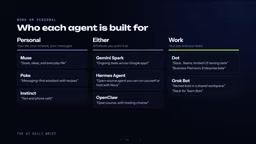
One signal is messaging channels: personal-leaning products use iMessage and WhatsApp, while work-leaning ones use Slack and Teams. But the show also notes this distinction may not last long — within six months, all agents will likely connect to all messaging systems.
Question 2: How Much Do You Care About Model Control?
Six of the eight choose the model for you; only two allow you to bring your own. Model control broadly falls into three tiers:
- Tier 1: The vendor decides. Use their product, use their model. DOTS uses OpenAI models like GPT-4o/o-series, Gemini Spark uses Google Gemini, Muse uses Muse Spark. Interestingly, Muse is the first AI product the host has encountered where "most users don't care at all what model is running underneath."
- Tier 2: The builder chooses a blended model approach. Grokbot, for example, uses a cursor-managed hybrid that relies heavily on Grok but isn't necessarily exclusive; Instinct has a fine-tuned core model plus unnamed third parties.
- Tier 3: Bring your own model — only Hermes and OpenClaw support this.
Question 3: Do You Prioritize User Experience or the Strongest Model?
This is a real trade-off. Hermes and OpenClaw, however good their experience may be, have a technical bar that will put off some users. Between Muse and DOTS, there's a different kind of trade-off: DOTS just launched and lives inside ChatGPT, yet connects to one of the strongest models available; Muse has polished a remarkably friendly consumer experience, but relies on the somewhat less capable Muse Spark.
This may only be a temporary situation — model capabilities will eventually converge — but the trade-off is real today.
Question 4: Where Does Your Data Go?
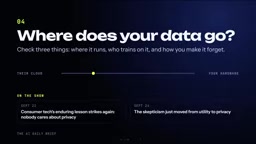
The data question has three layers. On where it runs: only Hermes and OpenClaw let you run on hardware of your choosing; the rest run on someone else's cloud. On training use: only Gemini Spark currently requires you to consent to your data being used for model training; DOTS, Grokbot, Instinct, Muse, and Poke all offer opt-out via privacy settings, with OpenAI's DOTS excluding commercial data by default. On memory deletion: Hermes and OpenClaw allow direct memory editing; DOTS, Muse, Gemini, and Grokbot allow modification through conversation; while Instinct and Poke only allow you to delete all your data wholesale.
Background: Why Data Privacy Matters More Here Personal agents carry far higher data risks than ordinary AI assistants, precisely because their design goal is to accumulate a user's private context over the long term — calendars, emails, message histories, work files, even spending habits. "Training use" and "inference use" are two distinct concepts: even if a product lets you opt out of training data collection, your data is still processed on the vendor's servers during inference. The distinction in memory deletion mechanisms is especially critical: being limited to deleting all data at once (as with Instinct and Poke) means you can't make granular edits. If one memory is wrong or contains sensitive content, your only option is to wipe everything — at the cost of losing all accumulated personalized context. By contrast, products supporting direct memory editing (Hermes, OpenClaw) give users more fine-grained control. For European users, GDPR rules on data retention and cross-border transfer will further constrain the available options — which is the regulatory backdrop for the article's note that European users face different choices.
Other Deciding Factors and an Interactive Quiz
For many people, the combination of these four questions is enough to reach an answer. But some factors may be the deciding vote on their own: if your information is already centralized in ChatGPT, Google, Meta, or Cursor, you'll probably go with that company's agent. Users outside the US — especially in Europe — will have different options. Price matters too: if you want to experiment at zero cost, you'll need to use capabilities bundled with existing subscriptions, or choose something like Muse that starts free.
The show's author also built an interactive quiz based on these dimensions. Taking the host himself as an example: no fixed "home base" for AI life, primarily used for personal work, wants freedom to choose and switch models, prefers out-of-the-box simplicity, mainly uses Slack, wants the agent to reach out only when needed, most values coding capabilities in the terminal, based in the US, and willing to pay for value. The quiz ultimately recommended Grokbot at 68% match — built for work, works out of the box, comes with a usable terminal — with the trade-offs being no bring-your-own-model support and it won't proactively reach out to you. DOTS came in second at 62%.
Conclusion: Switching Costs Are the Real Consideration
Even as these products' mechanics and form factors evolve significantly — and consolidation happens — the switching costs around personal agents will remain high, because all your context and configuration is embedded in them. That's precisely why it matters to think clearly upfront about which one to try first: to avoid repeatedly paying the price of migrating context.
As Mollick observes, when organizing work becomes cheap, the list of "things worth attempting" expands. What personal agents may truly bring is not that work gets replaced, but that everyone faces an endless backlog — because you can always spin up more agents to keep going.
Related articles

Why Does the Tesla Roadster Need to Fly? A Deep Dive into Musk's Wild Demo
Tesla's Roadster launch showed wall-climbing, upside-down driving, and flying stunts—but The Vergecast notes the demo car may lack a battery, the Rocket version is invite-only and not street-legal, and the website terms don't guarantee delivery. After nine years of delays, why does this car still need to exist?

AI Is Not a Replacement: Human-AI Collaboration Through the Lens of Factory Root Cause Analysis
Starting from factory root cause analysis, this article explains how AI accelerates evidence chain construction rather than replacing human experts, exploring the pragmatic implementation logic and business value of 'AI supporting people rather than replacing them.'

AI Agent Decision Auditing: Building an Evidence Chain in Regulated Workflows
Starting from a Reddit discussion, this article analyzes three core issues in AI agent decision auditing within regulated workflows: what fields audit records should contain, how to handle feedback latency for erroneous decisions, and how to continuously calibrate LLM judge consistency with human judgment.