How to Encode Time Series with Mixed Physical Quantities? Reddit Heats Up Over DL Model Input Strategies

Reddit discussion summarizes encoding strategies for mixed physical quantity time series, emphasizing joint design of normalization and encoding.
Based on a Reddit community discussion, this article explores the encoding challenges of deep learning models for time series with mixed physical quantities. For continuous variables (time, velocity, position), the community consensus is standardized input, though time information needs extra encoding (time differences or periodic encoding). Absolute position sparks debate between absolute and relative encodings, with the latter favored in robotics. Practical strategies include separate normalization per quantity, type embeddings to distinguish feature sources, and early or late fusion based on the task. The article stresses that normalization and encoding must be co-designed to prevent inconsistent feature scales affecting attention weights, and notes no one-size-fits-all solution exists yet, with future refinement needed for specific domains.
When deep learning models (especially attention-based ones) process time series, a common but tricky problem arises: when the input data contains multiple different physical quantities (such as time, velocity, absolute position, etc.), how can these mixed measurements be effectively encoded so that the model can reason easily and remain compatible with normalization strategies? A recent discussion thread on Reddit sparked in-depth community debate on encoding strategies.
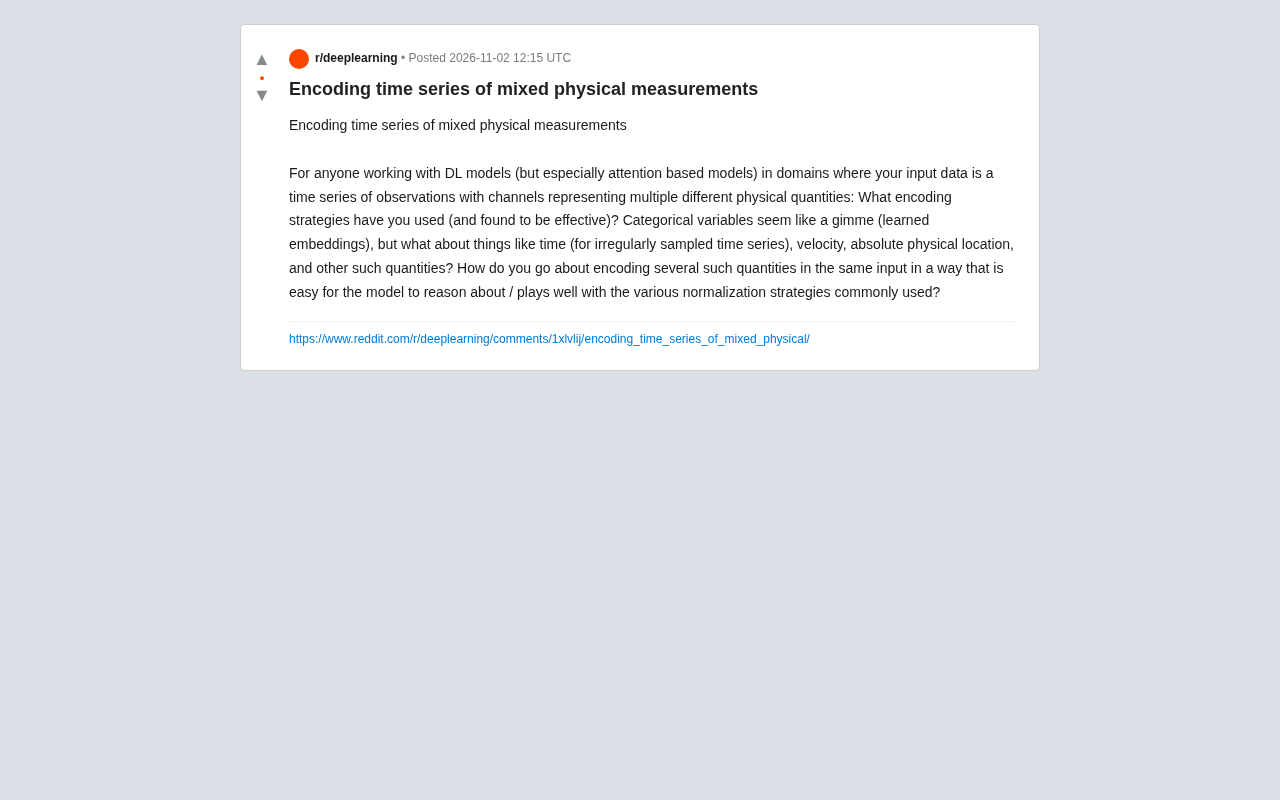
Problem Background: The Encoding Challenge of Multi-Physical-Quantity Time Series
The original poster pointed out that for irregularly sampled time series, where each channel represents a different physical quantity (such as time, velocity, position, etc.), the encoding strategy needs to handle both categorical and continuous variables. Categorical variables can usually be handled with learned embeddings, but encoding continuous physical quantities (such as timestamps, velocity, and absolute position) is more challenging. The author specifically asked how to encode multiple such quantities in the same input and make them work well with common normalization strategies (such as standardization and min-max scaling).
The core of this problem is that different physical quantities have different units and distributions, and direct concatenation or simple normalization may make it difficult for the model to capture their interactions. In addition, the temporal information in irregularly sampled time series itself also requires special handling to reflect the time intervals between observations.
Irregularly sampled time series refer to sequences in which observation time points are not equally spaced, such as event-triggered sensor data or medical records. When processing such data, the model must not only learn the observations themselves but also understand the information contained in the time intervals between observations. A common approach is to input the time difference (delta t) as an additional feature, or to map continuous time into a high-dimensional space through time embeddings. Time embeddings can draw on the idea of positional encoding in Transformers, but need to adapt to the continuous time domain, for example by using learnable Gaussian processes or periodic functions. Unlike regular sampling, irregular sampling requires the encoding strategy to dynamically reflect changes in time intervals; otherwise, the model may incorrectly assume that observations are equally spaced, thereby affecting prediction accuracy.
Community Views: Consensus and Divergence
According to several practitioners sharing their views in the Reddit discussion, the current relatively consistent view is that for continuous physical quantities, simple normalization (such as z-score standardization) followed by direct input into the model is still a common practice, but temporal information requires additional encoding. Some argue that for irregular time series, the time difference (delta time) should be input as a feature, or time embeddings should be used to capture periodicity.
However, there is disagreement regarding quantities such as absolute physical position. Some advocate direct normalized input, while others believe that relative positional encoding or learnable positional embeddings should be used, because absolute position may introduce unnecessary bias. Some comments mention that in robotics or physical simulation, relative positional encoding is often more effective.
In addition, some practitioners emphasize that normalization strategies need to be designed jointly with encoding methods. For example, if velocity is normalized, the time encoding should also be kept within a similar scale range to avoid the model focusing excessively on one dimension.
Positional encoding is used in sequence modeling to provide the model with information about the order or position of elements. Absolute positional encoding assigns a unique embedding vector to each position, commonly seen in Transformer sine/cosine encodings or learnable embeddings; relative positional encoding focuses on the relative distances between elements, as used in Transformer-XL and Rotary Position Embedding (RoPE). In scenarios with mixed physical quantities, absolute positional encoding may introduce task-irrelevant bias, especially when the physical position itself has absolute meaning (such as global robot coordinates), where the model may rely excessively on positional values and ignore other features. Relative positional encoding focuses more on the spatial relationships between elements and is often more effective in fields such as robotics and physical simulation because it can better generalize to unseen absolute positions. The choice of encoding depends on whether the task is sensitive to absolute position and whether the data distribution may shift.
Practical Strategies: Lessons from the Front Line
Based on the suggestions in the discussion, the following strategies were mentioned repeatedly:
- Time encoding: For irregular sampling, use embeddings of the time difference (delta t) or input it as a continuous feature. Periodic encoding (such as sine/cosine positional encoding) can also be used to handle absolute time.
- Categorical variables: Use learned embedding layers, and pay attention to balancing embedding dimensions with continuous feature dimensions.
- Continuous physical quantities: Standardization (z-score) is the baseline, but consider normalizing each physical quantity separately and then mapping them to a unified dimension through linear projection.
- Multi-quantity fusion: Early fusion (concatenation) and late fusion (separate encoding followed by interaction) each have advantages and disadvantages, and the choice should depend on task complexity. Experience shows that for attention models, embedding each physical quantity separately and adding a token type helps the model distinguish different sources.
Early fusion and late fusion are two basic strategies for multimodal or mixed-feature modeling. Early fusion refers to directly concatenating different features at the input layer before feeding them into the model; it is simple and efficient but may make it difficult for the model to learn interactions due to differences in feature scales. Late fusion refers to encoding each type of feature independently and then interacting at a higher level (such as through attention mechanisms or gated fusion), which better preserves the characteristics of each modality but incurs higher computational cost. For attention models, another effective approach is to assign an independent embedding layer to each physical quantity and add a token type embedding, enabling the model to distinguish features from different sources. Token type embeddings are similar to segment embeddings in BERT and can help the attention mechanism learn relationships across physical quantities without confusing semantics. The choice of fusion strategy requires weighing task complexity, data volume, and computational resources.
Joint Design of Normalization and Encoding
A key point repeatedly mentioned in the discussion is that normalization strategies must be designed jointly with encoding methods. For example, if velocity is min-max scaled while time differences are not normalized, the model may find it difficult to balance the contributions of different features. Some suggestions indicate that each physical quantity can be normalized separately, and then its importance can be adjusted through learnable scaling parameters. In addition, for attention models, the scale of input features affects the distribution of attention weights, so keeping feature scales consistent is particularly important.
Scale sensitivity of attention weights means that in attention mechanisms, the dot-product result of queries and keys is very sensitive to the scale of input features. If the feature scales of different physical quantities differ greatly (for example, velocity is normalized to [0,1] while time differences are unnormalized and range from [0,100]), the dot product may be dominated by large-scale features, causing an imbalanced distribution of attention weights and leading the model to focus excessively on certain dimensions. To alleviate this problem, common practices include normalizing each feature separately to a similar scale, using learnable scaling parameters to adjust the importance of each feature, or applying LayerNorm to features before computing attention. In addition, the scaling factor (1/√d) in scaled dot-product attention only addresses the dimensionality issue, not the feature scale issue, so jointly designing normalization and encoding is crucial.
Conclusion and Outlook
There is still no one-size-fits-all solution for encoding time series with mixed physical quantities, but the community consensus tends toward normalizing continuous quantities and supplementing them with type embeddings, using differencing or periodic encoding for temporal information, and ensuring that normalization and encoding are coordinated. In the future, with applications in more domains (such as robotics, meteorology, and healthcare), encoding strategies for specific physical quantities may be further refined. This article is based on a Reddit discussion and is intended as a reference for practitioners.
One-line Summary
A Reddit discussion summarizes encoding strategies for time series with mixed physical quantities, emphasizing the joint design of normalization and encoding.
Paragraph Summary
Based on a Reddit community discussion, this article explores the encoding challenges that deep learning models face when processing time series with mixed physical quantities. For continuous physical quantities (such as time, velocity, and position), the community consensus is to use standardized inputs, but temporal information requires additional encoding (such as time differences or periodic encoding). Regarding absolute position, there is disagreement between absolute and relative encoding, with the latter being favored in robotics. Practical strategies include normalizing each physical quantity separately, using type embeddings to help the model distinguish feature sources, and choosing early or late fusion depending on the task. The article emphasizes that normalization and encoding must be designed jointly to avoid inconsistent feature scales affecting attention weights. Finally, it notes that there is no one-size-fits-all solution and that future work should refine strategies for specific domains.
Related articles

VERS: Editing Activation Explanations to Halve Reasoning Model Tokens
VERS guides reasoning models by editing activation explanations, cutting 45.8% of tokens on GSM8K with only a 0.82 pp accuracy drop and transferring to larger models, but losing accuracy on competition problems.

Finding Errors Is Not Enough: Selective Model Escalation for Entity-Targeted Sentiment Analysis
This study explores selective model escalation for entity-targeted sentiment analysis, comparing data collection ordering, uncertainty-driven re-examination, and model routing—finding that minority-class priority only helps at very small data volumes, the oracle upper bound far exceeds actual gains, and escalation must be tailored to each dataset.

WAS-PO: Using Whitened Advantages to Solve the Correlation Trap in Multi-Reward Reinforcement Learning
WAS-PO paper proposes whitening advantages to correct correlation bias in multi-reward RL: when rewards are correlated, naive weighted summation effectively applies Σ^{1/2}w instead of w. Experiments show training reward improves steadily, but held-out accuracy does not improve in sync, and under two rewards it actually falls behind.