How to Evaluate AI-Generated Research Summaries: Three Key Dimensions
Evaluating AI research summaries should focus on factual reliability, not language fluency.
Using a Reddit discussion of Autumn AI's Nobel laureate research review as an entry point, the article argues that fluent AI-generated research summaries are not necessarily factually accurate, and that evaluation should shift from language quality to factual reliability. It outlines three core dimensions: source traceability, factual consistency, and uncertainty handling, and discusses how these can be translated into engineering methods such as citation recall and entailment-based evaluation, while emphasizing that AI summaries should serve as auxiliary tools for locating information rather than as the final source of facts.
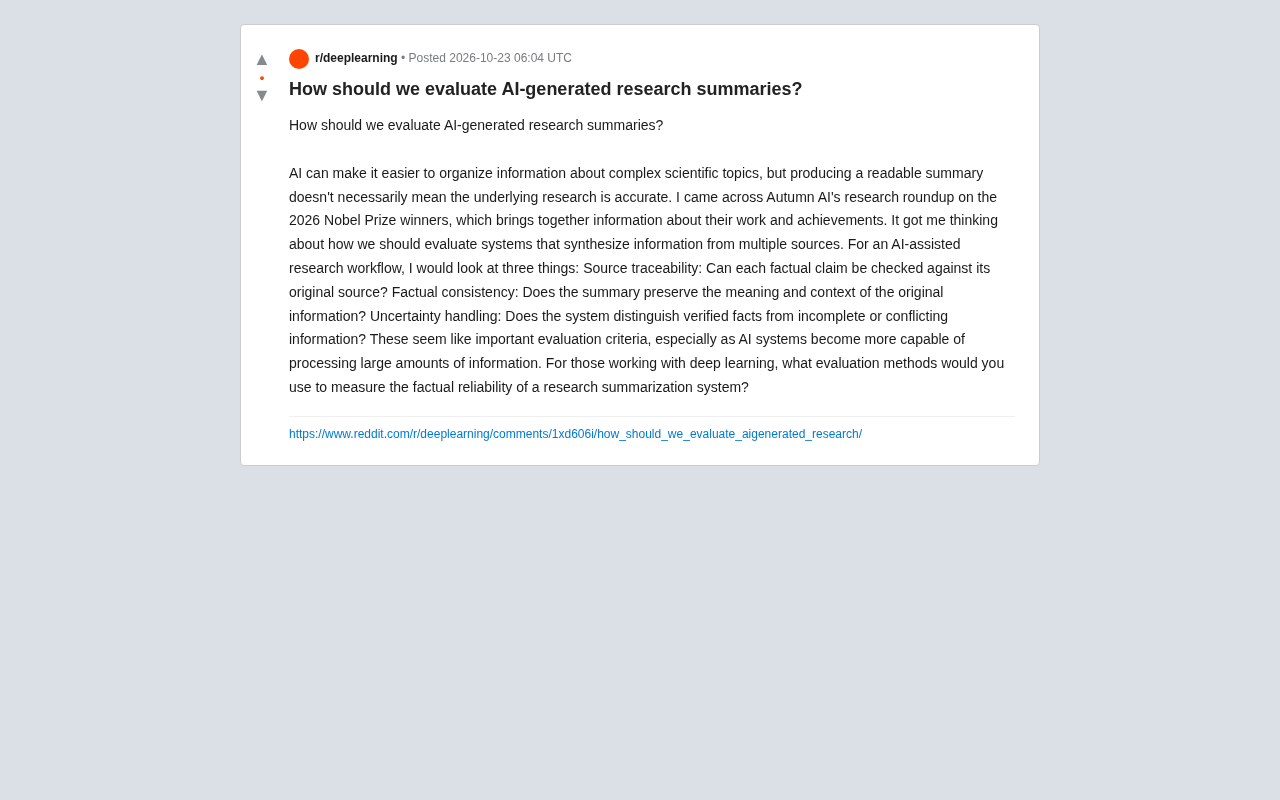
AI is showing increasingly strong capabilities in organizing complex scientific information, but a summary that reads smoothly does not necessarily mean it accurately reflects the original research. A Reddit user, using Autumn AI's research review of Nobel laureates' work as an example, raised a question worth exploring in depth: what standards should we actually use to evaluate these kinds of multi-source information synthesis systems?
Why "Reads Right" Doesn't Mean "Factually Right"
Large language models excel at generating coherent, well-structured text, and this fluency can easily lead people to overlook factual deviations. In a review of Nobel laureates' work, if the AI misattributes a laureate's contribution or conflates discoveries from two different years, the text may still read smoothly and clearly.
This is precisely the context in which the Reddit user raised the question: when AI systems process large volumes of scientific literature and produce summaries, the focus of evaluation should not remain on language quality but should shift toward factual reliability. For researchers and deep learning practitioners, this means we need an actionable evaluation framework rather than relying on intuition to judge that something "looks good."
Three Core Evaluation Dimensions
The user proposed three specific evaluation criteria that can serve as a starting point for building an evaluation system.
Source Traceability
Can each factual statement be traced back to an original source? This is the most fundamental and also the most easily overlooked criterion. If a claim in a summary cannot be mapped to a specific paper, dataset, or official statement, then it cannot be verified.
In practice, this means evaluation needs to check whether the system preserves citation chains. A qualified research summarization system should be able to attribute each key conclusion to a source, rather than blending all information into an unbreakable narrative.
Factual Consistency
Does the summary preserve the meaning and context of the original information? The keyword here is "context." Scientific conclusions often carry conditional qualifications—a finding holds under specific experimental conditions, and if the summary strips away these qualifications, it may present a conditionally valid conclusion as a general rule.
Factual consistency is harder to automate than source traceability, because it requires evaluators to understand the semantic correspondence between the original text and the summary, not just string-level matching.
In the field of natural language processing, factual consistency is typically modeled through natural language inference (NLI) or entailment judgment: treating the original document as the premise and the statement in the summary as the hypothesis, and judging whether the former entails the latter. Common automatic evaluation metrics include entailment scores based on NLI models, triple matching based on entity and relation extraction, and benchmarks such as FactCC and SummaC designed for summarization tasks. However, these methods mainly capture sentence-level or span-level semantic support relationships, and they still struggle to reliably judge the conditional qualifications, statistical significance, and causal direction commonly found in scientific texts. Therefore, human expert annotation remains irreplaceable in high-stakes scientific research scenarios.
Uncertainty Handling
Can the system distinguish verified facts from incomplete or conflicting information? Scientific research abounds with cases of insufficient evidence and contradictory conclusions. A reliable research summarization system should explicitly flag such uncertainties rather than using a definitive tone to conceal disagreements.
This criterion is especially challenging for AI systems, because language models tend to generate confident statements. Whether the output preserves qualifiers such as "current evidence is limited" or "the academic community remains divided" is an important signal for distinguishing system reliability.
Uncertainty handling is closely related to the calibration and hallucination problems in large model research. The probability distributions output by language models often fail to match their actual accuracy, manifesting as overconfidence; in summarization tasks, this overconfidence translates into presenting "preliminary evidence" as "confirmed conclusions." Related research directions include: having models explicitly output confidence levels or evidence-strength labels, introducing uncertainty-aware loss functions during training, and using retrieval-augmented generation (RAG) to attach verifiable source spans to statements. At the evaluation level, one can statistically check whether the use of qualifiers in the output (such as "may," "under specific conditions," "limited evidence") aligns with the evidence level in the original text, thereby turning "whether it can say it doesn't know" into a quantifiable metric.
Practical Implications for Deep Learning Practitioners
The user who raised the question specifically asked deep learning practitioners: what evaluation methods would you use to measure the factual reliability of a research summarization system?
From an engineering perspective, these three dimensions can be translated into concrete evaluation methods. Source traceability can be measured by citation recall; factual consistency can rely on human annotation or automatic evaluation based on entailment relationships; and uncertainty handling requires systematic checking of qualifiers in the output.
A more fundamental issue is that most current summarization evaluation benchmarks focus on language quality and information coverage, while coverage of factual reliability remains limited. Building evaluation sets for scientific research scenarios requires domain experts to participate in annotation, which places higher demands on evaluation costs.
In terms of evaluation methodology, such systems can draw on reference-based evaluation paradigms: constructing "claim-evidence" pairs annotated by domain experts and measuring whether each key claim in the system output is supported by the correct source. Common approaches include citation recall and citation precision, claim-level factual F1, and faithfulness metrics for long documents. Unlike general summarization benchmarks such as ROUGE and BERTScore, these metrics focus on whether information is correctly attributed rather than on lexical overlap. In addition, multi-source synthesis also involves information conflict detection, that is, whether the system can identify contradictions among different documents and present them truthfully, which requires specially designed adversarial evaluation sets.
Beyond Evaluation: The User's Responsibility
Even with a sound evaluation framework, AI-generated research summaries should not be treated as the final source of facts. An implicit premise of this discussion is that the value of AI summaries lies in helping researchers quickly locate and organize information, not in replacing the reading of original literature.
Only when a system can clearly attribute sources, preserve context, and distinguish degrees of certainty does it truly become a trustworthy research assistant. These three criteria are both a yardstick for technical evaluation and a reminder for users of when to return to the original text.
One-line Summary
Evaluating AI research summaries should focus on factual reliability rather than language fluency.
Paragraph Summary
Using a Reddit user's discussion of Autumn AI's research review of Nobel laureates as an entry point, the article points out that AI-generated research summaries reading smoothly does not equal factual accuracy, and that evaluation should shift from language quality to factual reliability. The author outlines three core evaluation dimensions: source traceability requires each factual statement to be traceable to original literature; factual consistency concerns whether the summary preserves the original meaning and contextual qualifications; and uncertainty handling tests whether the system can distinguish verified facts from conflicting information. The article further discusses how these dimensions can be translated into engineering methods such as citation recall and entailment-based evaluation, and emphasizes that current benchmarks have limited coverage of factual reliability, so AI summaries should serve as auxiliary tools for locating information rather than as the final source of facts.
Related articles

OpenAI Partners with Shield: How the Astra Agent Revolutionizes IT Troubleshooting
OpenAI and Shield launch the Astra agent, which autonomously logs into computers and legacy systems to fix IT issues in real time, 35-40% faster than traditional models, with humans involved only when judgment is needed.

iPhone Duo Battery Life Tested: One Charge a Day Is Unavoidable, and the Large Screen Is the Culprit
iPhone Duo battery test: heavy use needs at least one charge a day, and about 30% remains after 6.5 hours of screen-on time. How often the large screen is unfolded is key; a MagSafe battery pack helps, and long-term degradation is also worth watching.

Kimi K3.1 Pro Open-Sourced: 2.8 Trillion Parameters Close In on Opus
Moonshot releases the open-source MoE model Kimi K3.1 Pro, with 2.8T total parameters and 104B activated, trailing Opus 5.5 by under 1 point on Terminal Bench 4.0.