How to Find High-Paying Remote AI/ML Jobs? A Complete Practical Job Search Strategy Guide

Practical strategies to land high-paying remote AI/ML jobs beyond traditional job boards.
This article analyzes the challenges of finding high-paying remote AI/ML jobs and provides actionable strategies to overcome them. It explains why traditional platforms create fierce competition, and outlines more effective approaches including leveraging internal referrals, tapping vertical communities, building personal brand through open-source contributions, and developing scarce expertise in niches like LLM fine-tuning, RAG, and MLOps.
A Common AI/ML Job Search Dilemma
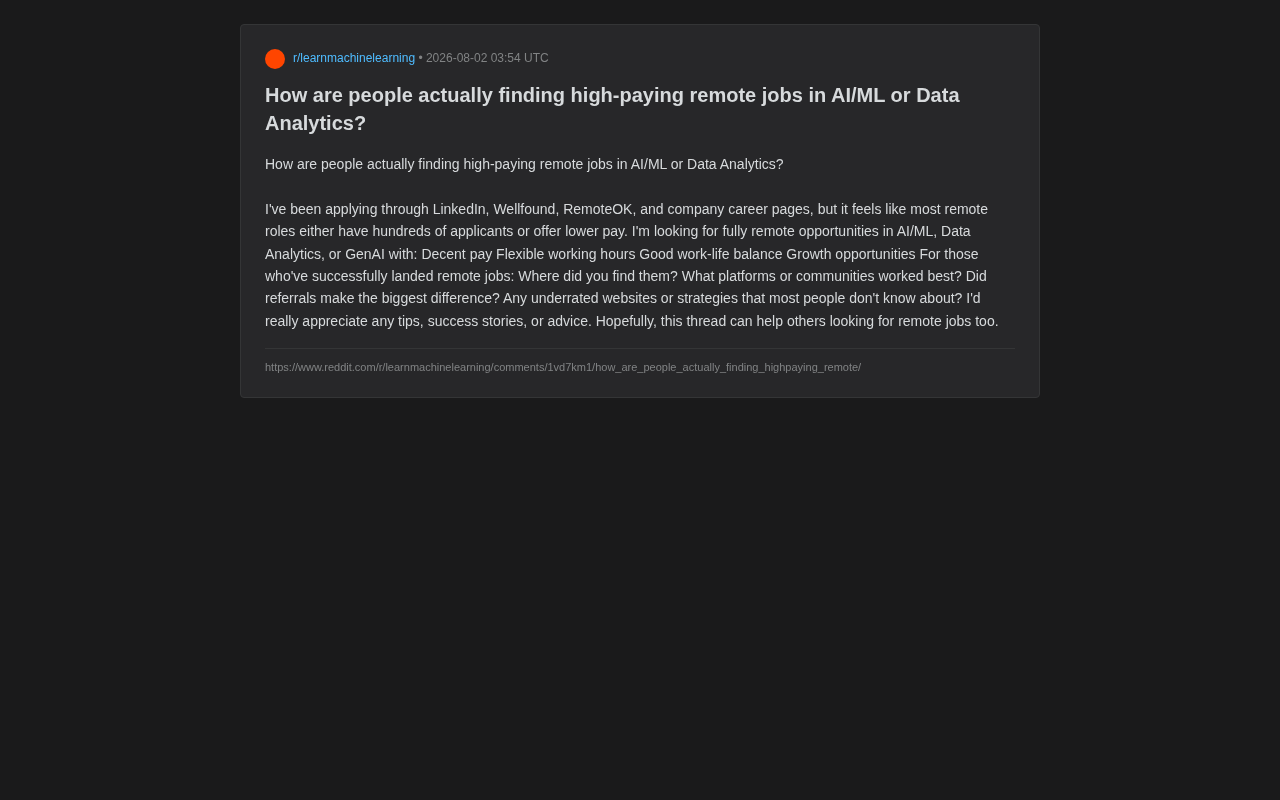
Recently, a job seeker sparked a widely resonant discussion on Reddit: How do you actually find high-paying remote jobs in AI/ML or data analytics?
The poster shared that they had submitted numerous resumes on LinkedIn, Wellfound, RemoteOK, and various company career pages, but the results were frustrating—most remote positions either had hundreds of competitors or offered low salaries. Their ideal role needed to meet several criteria: decent pay, flexible hours, good work-life balance, and room for growth.
This question seems simple but touches on a core contradiction in today's AI/ML job market: the severe supply-demand imbalance for remote positions. When a role carries both "remote" and "high-paying" labels, it instantly becomes a target for job seekers worldwide. Understanding this is a prerequisite for developing an effective job search strategy.
Why Traditional Application Methods Have Limited Effectiveness in AI/ML Job Hunting
The "Red Ocean" Effect of Public Job Platforms
The platforms mentioned by the poster—LinkedIn, RemoteOK, etc.—are fundamentally open, globally accessible recruitment channels. This means when you spot an attractive AI/ML position, hundreds or even thousands of people may have already submitted applications. Employers typically use ATS (Applicant Tracking Systems) for initial screening, and the vast majority of resumes are filtered out by algorithms before ever reaching a hiring manager.
ATS (Applicant Tracking System) is automated software used by companies to manage recruitment workflows. Leading products include Greenhouse, Lever, Workday, and others. These systems use keyword matching, years-of-experience filters, and education requirements to eliminate 60%-80% of applicants before human review. For AI/ML roles, ATS typically scans for specific tech stack keywords (such as PyTorch, TensorFlow, Transformer, distributed training, etc.). Even if a candidate actually possesses relevant skills, their resume may be filtered out if it lacks terminology matching the job description. This makes resume optimization a specialized skill—candidates need to align keywords with each position's JD (Job Description) to improve their chances of passing automated screening.
For remote positions, this competition is further amplified. Once geographic restrictions are removed, a single remote role at a U.S. company might simultaneously attract candidates from India, Eastern Europe, Latin America, and Southeast Asia—regions where salary expectations are often lower, causing "high-paying" roles to face downward price pressure amid intense competition.
Behind this phenomenon is the "Geo-Arbitrage" effect spawned by the rise of remote work. The median salary for an ML engineer in the U.S. Bay Area is approximately $180,000-$250,000 per year, while engineers with equivalent technical capabilities in India or Eastern Europe are more willing to accept $80,000-$120,000. The rise of global employment platforms (EOR, Employer of Record) like Deel and Remote.com enables companies to compliantly hire talent worldwide, further intensifying this competition. Some companies adopt "location-based pay" salary strategies, while others use "role-based pay"—the latter being more favorable for non-U.S. job seekers but also meaning global candidates are compared in the same pool.
The Salary-Competition Paradox
There's a cruel paradox at play: the more a role matches the ideal trifecta of "high pay + remote + flexible," the more intense the competition becomes. Companies know these positions are extremely attractive, so they often don't need to recruit through public channels—internal referrals and talent pools alone can fill the vacancies. This explains why the positions remaining on public platforms tend to be either brutally competitive or mediocre in compensation.
More Effective Job Search Paths for Remote AI/ML Roles
The Power of Internal Referrals Is Severely Underestimated
The poster specifically asked whether referrals are the most critical factor, and this intuition is quite accurate. In technical recruiting, the success rate of internal referrals far exceeds cold applications. According to research from recruitment data platforms like Jobvite, the probability of reaching the interview stage through internal referral is approximately 40%-50%, while the interview conversion rate from cold applications via job boards is only 2%-5%. The average time-to-hire for referred candidates is also about two weeks shorter than other channels. The logic behind this is that referrers essentially absorb part of the screening cost—they vouch for candidates with their professional reputation. In AI/ML, where technical evaluation thresholds are high and resume signal-to-noise ratios are low, hiring managers prefer to trust the judgment of internal team members. Many big tech companies (such as Google, Meta, Amazon) also have referral bonus programs (typically several thousand dollars), incentivizing employees to proactively recommend quality candidates.
Practical approaches to building a referral network include:
- Proactively establishing genuine connections with engineers and recruiters at target companies on LinkedIn
- Contributing to open-source projects and creating real collaboration with team members of potential employers
- Joining technical communities and contributing consistently so people remember your capabilities
Vertical Communities Often Harbor Higher-Quality AI/ML Opportunities
Beyond mainstream job platforms, some vertical, community-driven channels often provide higher-quality opportunities with less competition:
- AI/ML-focused job platforms: Such as AI-Jobs.net, machine learning-focused Slack and Discord communities
- Job sections in tech newsletters: Many well-known AI newsletters feature curated job listings
- GitHub and Hugging Face: Active technical contributors are frequently sourced by recruiters
- Y Combinator's Work at a Startup: A hub for remote positions at startups
The common characteristic of these channels is information asymmetry—fewer people know about them, fewer people apply, and your resume is more likely to be seen by actual technical decision-makers.
Building the Ability to "Be Found": From Applying to Attracting
The Strategic Shift from Active Applications to Passive Attraction
For fields like AI/ML that heavily depend on demonstrated competence, the most efficient job search strategy is often not "applying" but "being discovered." When you can consistently produce valuable technical content—whether open-source projects, technical blogs, or high-quality code on GitHub—recruiters will come to you. In this scenario, negotiating leverage shifts back into your hands.
In the AI/ML field, open-source contributions on GitHub and Hugging Face have become more convincing proof of capability than degrees or years of experience. Hugging Face Hub hosts over 500,000 models and 100,000 datasets, and active contributors' code, model cards, and technical documentation are all publicly verifiable. Recruiters increasingly use technical sourcing tools (such as Sourcegraph, GitHub advanced search syntax) to proactively find developers with high-quality contributions in specific tech stacks. A merged PR in a mainstream open-source project (such as LangChain, LlamaIndex, vLLM) carries far more signal value than project descriptions on a resume, because it has undergone community code review, proving the candidate can produce high-quality code in a real collaborative environment.
Specific areas to focus your efforts:
- Build a demonstrable project portfolio: A deployed GenAI application is worth more than ten polished resumes
- Share technical insights publicly: Consistently produce content on blogs, Twitter/X, or other platforms to build a personal brand
- Optimize LinkedIn keywords: Ensure your skill tags can be found by recruiters' searches
The Reality of Salary Negotiation for Remote Positions
To achieve "high pay + remote + flexible" simultaneously, a key insight is: you need to provide unique value sufficient to match these conditions. In global competition, if your skills are homogeneous with a large pool of candidates, it's hard to escape price wars. Those who actually land ideal offers typically possess scarcity in a specific niche.
Several sub-domains with particularly notable supply-demand gaps in the current AI/ML field are worth attention: LLM Fine-tuning refers to further training a pre-trained large language model on domain-specific data to adapt it to vertical scenarios; common methods include full-parameter fine-tuning, LoRA (Low-Rank Adaptation), and QLoRA parameter-efficient fine-tuning techniques. RAG (Retrieval-Augmented Generation) is an architecture combining external knowledge bases with LLMs, solving issues of outdated knowledge and hallucination by first retrieving relevant documents before generating answers. Vector databases (such as Pinecone, Weaviate, Milvus, Qdrant) are core infrastructure for RAG systems, storing high-dimensional vectors converted from text via embedding models and supporting efficient similarity search. MLOps applies DevOps principles to machine learning, covering model version management, automated training pipelines, model monitoring, and drift detection. These sub-domains currently have significant talent gaps, and deep practical experience in any of them can form a competitive moat, giving you leverage in salary negotiations.
Action Checklist for AI/ML Job Seekers
Synthesizing the market realities reflected in this discussion, here are several actionable strategies:
- Reduce blind applications on red ocean platforms and redirect energy toward referrals and vertical communities
- Actively cultivate your professional network—referrals deliver conversion rates far exceeding cold applications
- Build visibility through publicly available technical work so opportunities find you
- Develop scarce competitiveness in a niche area—this is the fundamental source of negotiating power
- Adjust expectations for the "perfect role"—understand that combining high pay, remote work, and flexibility requires scarce skills as a prerequisite
The value of this Reddit discussion lies not only in exchanging specific recruitment channels but in revealing a deeper truth: In the rapidly evolving AI/ML field, job search strategy is fundamentally a competition for skill visibility. Rather than battling hundreds or thousands of competitors on crowded public platforms, invest your time in honing skills and building influence—because the best remote opportunities often never appear in job postings.
Related articles

Gemini 3.7 Flash Spotted in Google Cloud Console — Launch Countdown Begins
Developers spot Gemini 3.7 Flash in Google Cloud Console, sparking discussion about its relationship to Pro and Google's model distillation strategy.

AI-Memory: Building a Cross-Tool Long-Term Memory System for Coding AIs
AI-Memory is a Rust-based open-source project providing long-term memory for Claude Code, Cursor, Aider and other Agent coding CLIs, enabling seamless handoff between vendors.

Bullet Enters the Stage: YC Newcomer Bets on a Faster Coding Agent
YC S26 startup Bullet launches a speed-focused coding Agent targeting developer latency pain points. Analysis of its differentiation, acceleration techniques, and market opportunity against Cursor and Claude Code.